-
Site Explorer
- Majestic
- Summary
- Ref Domains
- Backlinks
 New
New- Lost
- Context
- Anchor Text
- Pages
- Topics
- Link Graph
- Related Sites
- Advanced Tools
- Author ExplorerBeta
- Summary
- Similar Profiles
- Profile Backlinks
- Attributions
- Compare
-
Link Tools
- My Majestic
- Recent Activity
- Reports
- Campaigns
- Verified Domains
- OpenApps
- API Keys
- Keywords
- N-grams Near Links
- Keyword Checker
- Search Explorer
- Link Tools
- Bulk Backlinks
- Neighbourhood Checker
- Submit URLs
- Experimental
- Index Merger
- Link Profile Fight
- Mutual Links
- Solo Links
- PDF Report
- Typo Domain
- TLD Checker New
- Free SEO Tools
- Support


Discover where AI is going to fit into your customer journey
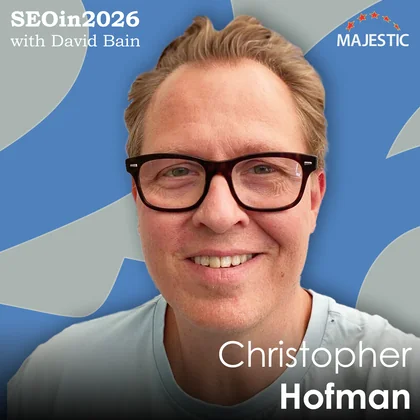
Christopher Hofman
Christopher Hofman Laursen shares that once you’ve mapped out your customer journey, it’s time to determine where AI is going to help you.
More SEO in 2026




Discover where AI is going to fit into your customer journey
Christopher says: “Take a step back and really try to understand where generated AI platforms will fit into the customer journey.”
Do you do that by instinct, or is there research and data you can use to determine where that's likely to be?
“First off, it's super important to realise that there's so much noise in the market at the moment.
Right now, we're talking about ‘GEO’ as a new SEO discipline, trying to optimize for generative AI engines. There are former SEO consultants now going all-in on GEO. You see future crypto bros trying to get their foot in the door and creating blank canvas agencies competing against the established agencies. There's a lot of noise to declutter at first.
Once we have decluttered that noise, it's important to look at what the data tells us, and how we can abstract from our own user behaviour (which is called solipsism, and we will talk about that more later).
The first thing to understand is what the generative AI platforms are. Where has that Google traffic disappeared to? 2025 may be seen as the year when organic traffic to websites from Google peaked. What are the new usage patterns? Fortunately, there's so much data on this.
There's first-party data. What are we losing? Right away, you can look at that in Google Search Console. Of course, a lot of that is going to Google's own AI overviews. Secondly, there are many studies regarding traffic and usage behaviour on generative AI platforms (ChatGPT, Perplexity, Claude, etc.).
Then (this is a whole black box), what are the users’ patterns on ChatGPT? What are people using it for? OpenAI already came out with some studies that show people are using ChatGPT for creative writing, creativity, efficiency, and for information search as well.”
How do you determine what is noise, and what do you do about it?
“I make my own case studies. I've always tried to listen to people, but at some point, you just need to go back to the workroom and try to find out for yourself what is working, what is not working, what is up, and what is down.
I'm running my own projects on the side. For instance, I have a Danish wine site, DanishWine.com, that I use to get a lot of experience on what is actually working.
There are some SEO gurus and consultants who suddenly change their minds about everything. This is where that word ‘solipsism’ becomes important. What it means is that you're basing all the facts on your own truth and your own behaviour. As digital marketers, we really have to take a step back and understand that our behaviour does not reflect how other people use generative AI, or use Google and generative AI together.
Then, there are the hype marketers, who come in quickly and then leave again. You only have to look at other revolutions to recognise the same signs every time. Somebody who hasn't worked in SEO will come in and decide that they’re going to create an AI agency. Those are some of the tells in the market.”
Does the idea of solipsism reflect the fact that it’s very difficult to determine what the true reality is?
“Yes. Imagine that you are an SEO consultant and you've worked in the field for 10-20 years, and you've always been right. Now, generative AI comes along, people are starting to search on ChatGPT, you’re starting to search on ChatGPT, and with the limited information that you have, you start to believe your own truth.
You were right about SEO; now you must be right about AI because your judgment of human behaviour must be accurate – and your grandmother has started using ChatGPT.
Semrush recently came out with a study where they looked at a lot of new ChatGPT users in the US, and their search behaviour before and after using ChatGPT. It turned out that, after they started using ChatGPT, they used Google even more than before, which is very counterintuitive if you are a GEO consultant.
With a lot of the things that we used Google for before, we just wanted quick answers to go on with our day and our buyer journey. Now, we can get through our buyer journey faster, and that journey ends up on Google. For the travel package you're going to buy or the local service that you're going to order, you end up on Google anyway.
You're not dropping the task just because clicking through websites on Google wasn’t the most user-friendly experience. When you're now using ChatGPT for some of the research, you can complete your journeys faster, but you will still end up on Google. This is the use pattern that we've implemented over the last 25 years.
That's my belief, but I could be a victim of solipsism. I'm aware of that. I want to leave everything open. I'm just looking at the data, and it goes against the idea that GEO consultants have, which is that ChatGPT is replacing Google. That's not the case.”
If Google retains some of the buyer journey, is it up to the SEO to determine where the other touchpoints are and what that new journey is?
“It's different for everyone. There are 6 billion monthly visits to ChatGPT, and 100 billion to Google. Of course, some of those visits to ChatGPT will stay there. They will be able to use ChatGPT's AI agent to make the purchase, and some people will only use ChatGPT from now on.
In general, though, a lot of people will continue to use Google. The market share of ChatGPT will rise to some extent, but right now we are seeing that one and a half days of Google users is the equivalent to one month of ChatGPT users. The numbers are very small. When people say that ChatGPT and other generative AI tools will replace Google because they can do the same thing, I just don’t see that happening.
Right now, it's a hockey stick curve, but we don't know if that's going to flatten out. I'm also aware that you will hear from people with very different opinions. Every SEO consultant has different levels of skill and works in different industries. Every SEO case is contextual. We will come at these ideas from very different angles, very different perspectives, and very different ways of attacking a business case.
If you've been doing SEO in the way that we did in 2015, creating big skyscraper guides, and you jump into ChatGPT, then you're on a different journey than the one I've been on in the last few years. I'm working on enriching data with semantic structures, with entities, and really trying to build the equivalent of Wikipedia to create topical authority. Everything is contextual.
Even if we have the same title, we are talking from totally different angles.”
Why do you believe that semantic SEO is still the way to become a topical authority, and what do SEOs have to do to achieve that?
“You have to work on two things. You should be going back to best practice SEO, which I believe is also best practice for AI. There may be a little bit on top, and there are some manipulative hacks like prompt injection and white text on a white background. Maybe they will disappear at some point, as they did with SEO.
However, it's really about best practice SEO, where you’re focussed on. You want to cover everything that they need to know in the customer journey, from the awareness stage to the purchase stage, to the loyalty stage, etc.
You also want to engineer your website. Google wants a low cost of retrieval. It's easy to understand that this is where you can go and get all of your information in a very economical way. There is an engineering part as well, which is super important now. It’s becoming harder and harder to get pages indexed. However, you also see that you can have one website dominating the AI overview. Google is not looking for 5, 6, or 7 sources for their AI overviews if they can find it in one place. This dual work is very important.
When we're talking generative AI, you also have to work more on the digital PR side of SEO. That means working on your digital footprints across the web. It's important to look at your Webmaster Tools, to have a company profile on Wikipedia, to write LinkedIn Pulse articles, and to be part of Reddit. It's also important to base that on what you want to be known for.
I want to be known as an international SEO strategist. Those are the footprints I'm going to place everywhere. I'm not going to be the guy who can do 10,000 things. I'm just going to focus on my must-win battle and how I am going to go out and create digital footprints across the web in order to achieve that.
That's where generative AI starts to get interesting because it mixes up all kinds of different sources where you are cited, not only your own website. It's also why I think we should just call it Search Everywhere Optimization, because that's really what it is now.”
Christopher, what's the key takeaway from the tip you shared today?
“Cool down, avoid the noise, and do best practice SEO.
Understand the semantic structure of SEO that allows Google to understand your website, and become a brand. Know what it is you want to be known for and make sure that message is on your website and across all of your other digital footprints on the web.”
Christopher Hofman Laursen is an SEO Strategist. Find out more over at HofmanSEO.com.
Also with Christopher Hofman
SEO in 2025
|
As Jake Gauntley touched on in "Remind yourself of the people you are trying to reach", getting to know your users is also about knowing what journeys they are on. Christopher Hofman from HofmanSEO encourages you to map out those journeys and meet them on the road. |
Choose Your Own Learning Style
 Video
Video
If you like to get up-close with your favourite SEO experts, these one-to-one interviews might just be for you.
Watch all of our episodes, FREE, on our dedicated SEO in 2026 playlist.
 Podcast
Maybe you are more of a listener than a watcher, or prefer to learn while you commute.
SEO in 2026 is available now via all the usual podcast platforms
 Book
BookDon't miss out
Opt-in to receive email updates.
It's the fastest way to find out more about SEO in 2026.
Fresh Index

Unique URLs crawled
193,178,528,729
Unique URLs found
614,496,253,840
Date range
08 Apr 2026 to 06 Aug 2026
Last updated
20 minutes ago
Historic Index
Unique URLs crawled
4,502,566,935,407
Unique URLs found
21,743,308,221,308
Date range
06 Jun 2006 to 26 Mar 2024
Last updated
03 May 2024
