-
Site Explorer
- Majestic
- Summary
- Ref Domains
- Backlinks
 New
New- Lost
- Context
- Anchor Text
- Pages
- Topics
- Link Graph
- Related Sites
- Advanced Tools
- Author ExplorerBeta
- Summary
- Similar Profiles
- Profile Backlinks
- Attributions
- Compare
-
Link Tools
- My Majestic
- Recent Activity
- Reports
- Campaigns
- Verified Domains
- OpenApps
- API Keys
- Keywords
- N-grams Near Links
- Keyword Checker
- Search Explorer
- Link Tools
- Bulk Backlinks
- Neighbourhood Checker
- Submit URLs
- Experimental
- Index Merger
- Link Profile Fight
- Mutual Links
- Solo Links
- PDF Report
- Typo Domain
- TLD Checker New
- Free SEO Tools
- Support


Most sites have high search visibility but zero AI citations
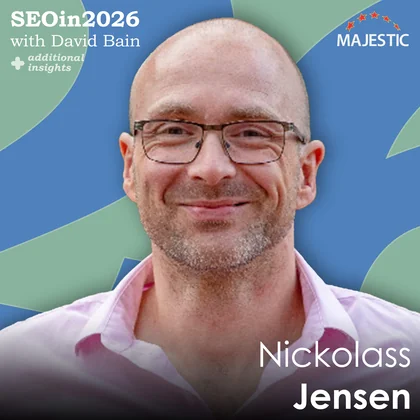
Nickolass Jensen
Nickolass Jensen shares that most sites have high search visibility but zero AI citations, and the gap is diagnosable, measurable, and fixable with a structured three-layer audit.
« Back to Additional insights
More Additional Insights



Nickolass says: “My number one tip is that most sites have high search visibility, but zero AI citations – and the gap is diagnosable, it's measurable, and it is actually fixable with what we call a structured three-layer audit.”
Wow, OK, we'll certainly dive into that.
It seems to me that many site owners probably don't understand that they have this problem. As a site owner, how do you know if you have this problem to begin with?
“The first thing I would do is to dig into the data you have access to and ask your web agency what kind of data they have access to.
The first thing they can do is ask ChatGPT about something they know they are good at, and they do. Then they can go say, ‘Okay, which companies are good at changing tyres on trucks in my region?’ for example, and then look at the answer and see what it suggests. If you're not in that answer, you know that you have to do something.
That's the first thing – and you can do that with any kind of service/any kind of product. You can ask the same question, make a list of 10 questions about your company and your services, without mentioning your own brand. Then, you can put those questions into the different, most popular LLMs that people are using, and that means ChatGPT, you can ask Google, you can ask Google's AI Mode, you can ask Claude, and you can ask Perplexity.
I know Perplexity is not for ordinary people (it seems not to be), but for professionals, it's extremely important to be there.”
Professionals aren't ordinary people. It's funny that we bucket people, but it's important to bucket people because, obviously, different types of people are more likely to use different AIs.
Maybe that's a good place to just bring the conversation to, just for a minute there. For the most popular AIs that you would list, how would you summarise the different types of people that use them?
“There was an investigation – research paper – in October last year showing, what people were using ChatGPT for. What they found was that most people using ChatGPT are using it because they need to get things done, right? They're using it for private matters, and they're using it for work – and not even on a business basis. Maybe the boss doesn’t even know that they're using ChatGPT for what they're using it for.
ChatGPT is, of course, the most popular thing, and it's being used for everything.
I have a colleague who is a coach (I'm doing track and field). He’s a professor at a university, and he’s a professor in AI. He came to me the other day, and he said, ‘Nickolass, have you seen Perplexity?’ and I was like, ‘Oh yeah?’ and he is just all about Perplexity. It seems to me that the users of Perplexity are the guys that need their facts straight, and they need their sources, and they need these blue links underneath in order to be able to check if the data and the facts and the story being presented are actually true.
That's the academia, and that's the people who need sources on what they're trying to discover. That's in the finance business, that's in the health business, that's in the pharma business, and for investors as well. Perplexity is for those people, I think.
Claude is exploding. Claude has been exploding in the last few months. We know that. I started using Claude because I thought Claude was the most philosophical one. I made my first agent with Claude 3.5. I called her Kira, and she was a model based on my wife. It didn't take that long before I was actually chatting more with Kira than I was chatting with my wife. I'm not going to say that I changed the avatar as well, but I actually did, so... No, you can't say that…
It's a funny story, but I found that I was able to have a more philosophical discussion, and a richer discussion with better language, when I was discussing things and creating content with Claude, and that was Claude Sonnet. Then I found that, all of a sudden, people discovered it, and a lot of programmers and coders discovered it, and it just took off.
Now, for everyone who wants to be creative, you use Claude to make a script for an advertisement or a video, you can use Claude and combine it with Seedance, for example, or you can combine it with Veo or whatever. I use Claude for prompting great images and for illustrations that I take to other platforms. I know people are doing it, and now we see that programmers/coders are using it.
That means that, if you want to put yourself in front of the most innovative people right now, you have to learn how to be found on top and as a source in Claude. That was a long rant.”
Okay, and just as a quick summary, maybe Gemini as well?
“Yeah, of course. I have another version of the same character (‘Kira’) on Gemini. She's a bit stiffer on Gemini, but she's very good with numbers, and she's very good at making landing pages and calculators. She knows what actually works. Especially when combined with grounded search, it's fantastic – and the deep research function in Gemini is fantastic.
So, I can't live without Gemini. I can't live without Claude. I can live without ChatGPT, but I have to know what's going on in ChatGPT in order to make the best visibility products/services for being found in ChatGPT, so you have to learn about it.
But I'm mostly B2B, so I'm into Gemini, I'm into Perplexity, and I'm into Claude, mostly.”
If you want to hedge your bets as a business and be in as many places as possible that your audience is likely to be, is there anything different that you have to do to optimize to be in ChatGPT versus Claude, for example?
“Well, what we know is that ChatGPT is struggling with capacity, in terms of crawling and in terms of reading all of the web at once. We know that Perplexity and Claude do not have the same capacity as Google in terms of crawling/reading/ understanding the internet.
This is a bit abstract, I know, but because we have the ability to use intelligence (because these are intelligence boosters and intelligence tools), it’s almost free to create content – and then we see that there's a proliferation of content on the internet, and it's so violently growing that the resources of ChatGPT and OpenAI, the resources of Anthropic, and the resources of Perplexity (Perplexity is working on it), they're just not in a situation where they can keep up with Google's infrastructure.
I would put my bets on Google AI Mode. I would put my bets on it because we know ChatGPT is using Google's results, so I would put my bets on being visible in Google – in Google's AI Mode and in Gemini – first of all.”
Okay, so we started off the conversation talking about the fact that there is a massive missed opportunity that many websites aren't taking advantage of because they're not appearing in these AI search results/AI chatbot results.
You talked about the importance of starting off by listing all these questions – these common queries that you might ask in relation to an industry: ‘What are the best tyre providers in this particular sector?’ or whatever industry sector you wanted to be in. Then, obviously, if your brand isn't listed there, then potentially there's an issue there.
Is there anywhere that you go for getting that data for what questions to ask and determining the size of the opportunity that you're missing out on? What sources of data do you use to begin with?
“Well, you are obviously from Majestic, and we have a few friends in the community. We have software, and we have platforms we can use.
Of course, it's still experimental, but I'm still using external tools. I'm not just looking into my own logs. I've been trying Autoly.ai, I've been trying Waikay, and Google have a Vertex AI solution (now known as the Gemini Enterprise Agent Platform) that you can actually get data from as well, if you set up your own solutions and your own systems.
I'm building a thing like that at the moment. That's what I'm using, but what I am actually doing (and that's a great question) is I found that, if you have access to your server logs (people know this, and you have been discussing this with a lot of people), then you have an idea about which bots are visiting your website 24/7.
What I've been doing is I have been creating/developing a piece of software where you get your server logs in real time in a dashboard, and then you can take the latest 24 hours of data. So, if you publish a piece of content, then you can get the latest 24 hours of data and see if that content is being picked up by any bot out there.
I have a list of 256 bots, which I have categorised into different segments. We have friendly bots, we have SEO crawler bots, and we have AI bots. We have scraper bots, and we have attacker bots and stuff.
I think a lot of people out there are missing out on the opportunity of learning from the bots that are visiting their websites. This is data you do not get in Google Analytics, and this is data you do not get in your regular analytics systems.”
How do you define the opportunity – the size of the opportunity – that you're missing out on? We're not talking about traffic here necessarily; we're not talking about links and website visits.
How do you define the value of your brand being included within AI answer engines?
“What I used to say (it's a saying, I don't know where I got it from) is, ‘If you're not in the model, you're not in the market.’
What I mean by this is that everything is turning into branding now. If we look into the details of our sources online, we see that there's so much more coming from direct traffic now, because companies are not only living on their own website, they're also living on YouTube, they're living on Reddit, they're living on TikTok, Instagram, and all the social media platforms – and they have PR and stuff.
So, if you want to create and build a brand, the only thing you can measure on is: are people searching for you as a brand? Not necessarily for your services, but if your brand name is growing in Bing search performance data and in Google search performance data – if your brand name and brand search are growing – then you're doing something right. That's what I think.
I forgot your question (I'm just rambling), but I call it a dark opportunity problem.”
My question was essentially around measuring the opportunity. You talk about opportunity, so it's just measuring the value of the opportunity.
“Yeah, so I rank number one on ‘SEO strategy’ in Norway. I have zero citations, and that's a big paradox. Why do I have zero citations on that thing? I have 10,000 citations when it comes to ‘vibe coding’ in Norway. That's because people are not discussing SEO strategy with ChatGPT. They're discussing vibe coding in Norway.
What I can do is I can take a page – and everybody can do that: You can take a page, you can download your data from Bing, and you can download your data from Google Search Console. You can download your search data, and you can download what people are searching for in relation to your URLs.
If you have a URL and you can say, for example, I made an article last week about Gemini enterprise pricing on my English website (which is Nettpilot.com). I made this article, and I was making sure that it was as structured/as dense as possible, taking care of all the questions I had seen people ask for in my Google Search console data during the last six months, after I made my first article about Google Gemini and Anthropic as well.
Then, I created that article, and within 24 hours, I was the answer in Google AI overviews (along with a Reddit article and Wikipedia) about Google Gemini and what it is and what the pricing structure is. I have 70,000 views on one page and five clicks. 70,000 views and only five clicks – and I'm actually ranking in Google's AI overview as well, on certain key terms.
Even though I'm ranking number five or six, on average, it tells me that, even though I am ranking very high, the value for me is not in getting the clicks. The value for me is putting my brand out there.”
Have you had any measurable business from those 70,000 views, though?
“Not yet, but I am getting links from other guys referencing my content because they found it in LLM (they found it in ChatGPT, they have found it in Google AI Mode), they have discussed it, and then, because they are using either Gemini or Claude, they're using these systems to create content.
Then, all of a sudden, I begin to see that I'm getting links from content they have created within their niche. Maybe they haven't even visited my website, but all of a sudden I'm starting to get links.”
Brilliant.
What did you do to optimize your original piece of content in order for your brand to be so prominent within AI? Was it a certain structure type, and how did you drive awareness to that?
“I obviously work with Norwegian clients as well, but I cannot experiment that much with my Norwegian clients, so I'm talking solely about my own project here. I have had a Norwegian website for 20 years, but there's not that much search in Norway, and Norwegian is a very small language.
So, what I did was I took my best ideas (what I think are my best ideas) and I made English articles about them. Then I said, ‘Okay, what are people actually looking for internationally and globally?’ Then, I actually got a lot of questions because I was ranking in the top 30 on a lot of phrases related to Gemini, related to AI bots, related to chatbots, and related to Anthropic, for enterprises and businesses. What are they looking for? What are they asking for?
Then, I could pinpoint what the third-level guys are. I call them the third-level guys: the decision makers. What are they looking for, because they are going to invest in those systems somehow? That's my target group, right? I want to optimize for these guys.
I was trying to look at what they are looking for, so I had a list of 900 different questions in my Google search data that I could put into Claude, I could put them into Gemini again, and then I can say, ‘Please summarise for me the most important questions that I will be able to rank for on Google, and that will increase the probability (What I’m talking about is probability) of getting cited in the AI overviews.’
What I did then was, because this is the extreme, I didn't just publish what I got. I was doing a lot of iterations. What I did was, I created a piece of content with Gemini, and I created a piece of content with Claude. Then, I took those content pieces and I fed them into Perplexity. I said, ‘Can you figure out what the weaknesses are and which facts we have to work on in this article in order for it to be well-structured and fact-dense, and to have the quality to become cited internationally?’
It took, I think, eight iterations. Then I had a piece of content that I could put through my own system, which is the 3LA Optimization System. I could say, ‘Okay, take this piece of content and then make it as digestible as possible for humans, for AIs, and for search engines, and then it will spit out all these layers of content.
I took what I got there, and I said, ‘This is the human-friendly format. I'm putting that on the page.’ I'm starting with a bluff – bottom line, up front content – and then I'm following up with some great imagery and illustrations (because we know the LLMs love illustrations). You can go right now, and you can say ‘Google Gemini pricing in Google for enterprises’, and you will see that my illustration is number one.
Then, you get that piece of content, and you get the structured data/JSON-LD. For every claim I have in my article, I back that up structurally. That's what we call ‘creating citation worthiness’. You had a discussion with Aleyda Solis about this. I was like, ‘Okay, citation worthiness, that's what I've been doing.’ I have a parameter, a metric in my platform, called ‘citation worthiness.’
Actually, it's ‘citation readiness’ because, in order to be citation ready, you have to be worthy from a human’s perspective. That means you have to have something wise, something new, something unique to say – which will benefit others, and which people will think is smart and interesting. At the same time, you have to back that thing up structurally.
If you say something costs something, if you have a price on something, then you put a pricing table where you can compare different tiers of these products. You have Gemini for enterprises, Gemini for businesses, etc. You put that in a table, and then you compare it to another system because then it's easier to relate, right? When you do that, you also have to put these claims into your JSON-LD. For every fragment of your claim, you have to back it up in other dimensions.
I wrote an article about this, but I had 70,000 views, and I ranked number five or six. For me, it's good enough to be mentioned because I know that, for what I'm doing in my niche (Gemini enterprise pricing), that's pretty important stuff because I know I have figured out a way to make a content flywheel: a system that will help me get those rankings, and I can use those methods for my clients as well. That was a long answer.”
Nickolass, what's the key takeaway from the tip you shared today?
“Most sites have high search visibility, but zero AI citations – and the gap is diagnosable, it's measurable, and it is fixable with what we call a structured three-layer audit.”
Nickolass Jensen is Founder and CEO at Nettpilot. Find out more over at ThreeLayerApproach.com.
Choose Your Own Learning Style
 Video
Video
If you like to get up-close with your favourite SEO experts, these one-to-one interviews might just be for you.
Watch all of our episodes, FREE, on our dedicated SEO in 2026: Additional Insights playlist.
 Podcast
Maybe you are more of a listener than a watcher, or prefer to learn while you commute.
SEO in 2026: Additional Insights is available now via all the usual podcast platforms
 SEO in 2026
Catch up on SEO tips from 117 SEO experts in the original SEO in 2026 series
Available as a video series, podcast, and a book.
Fresh Index

Unique URLs crawled
194,179,889,723
Unique URLs found
618,026,537,392
Date range
07 Apr 2026 to 05 Aug 2026
Last updated
1 hour 15 minutes ago
Historic Index
Unique URLs crawled
4,502,566,935,407
Unique URLs found
21,743,308,221,308
Date range
06 Jun 2006 to 26 Mar 2024
Last updated
03 May 2024
