-
Site Explorer
- Majestic
- Summary
- Ref Domains
- Backlinks
 New
New- Lost
- Context
- Anchor Text
- Pages
- Topics
- Link Graph
- Related Sites
- Advanced Tools
- Author ExplorerBeta
- Summary
- Similar Profiles
- Profile Backlinks
- Attributions
- Compare
-
Link Tools
- My Majestic
- Recent Activity
- Reports
- Campaigns
- Verified Domains
- OpenApps
- API Keys
- Keywords
- N-grams Near Links
- Keyword Checker
- Search Explorer
- Link Tools
- Bulk Backlinks
- Neighbourhood Checker
- Submit URLs
- Experimental
- Index Merger
- Link Profile Fight
- Mutual Links
- Solo Links
- PDF Report
- Typo Domain
- TLD Checker New
- Free SEO Tools
- Support


Technical, on-page, and off-page remain the fundamental SEO building blocks
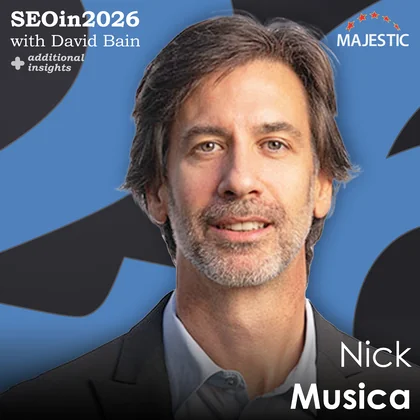
Nick Musica
Nick Musica talks about the importance of focusing on the fundamentals of technical, on-page, and off-page SEO.
« Back to Additional insights
More Additional Insights



Nick says: “The number one SEO tip for 2026 is to keep your eye on the ball in terms of what actually moves SEO – and by SEO, we're talking about Google, Bing, answer engines, ChatGPT, etc.
The three fundamentals, they've been around since day one. They are technical, they're on-page, and they're off-page.
The expression of those items has changed over time. For example, white text on white background doesn't quite cut it anymore, but text still does cut it. That's super simple, overly simplified, but for folks who've been in the game for a while, they understand what I'm talking about.
For folks new to the game (and there seems to be a lot of them, given the chatter on LinkedIn about what actually is SEO and what drives visibility), these three items seem to be very important for everyone to remember or to learn, in some cases.”
I’ll tell you what I did: instead of white text and white background, I progressed beyond that. I used to have a tiled image on the background, the same colour as the text, but the actual background colour was different to the text.
“Oh, interesting.
Yeah, yeah. I remember talking to someone a long time ago, and there was a penalty around something like that. The entire page looked fine, but the contrast between the text and the image in the back… they were like, ‘Maybe the contrast isn't enough?’, and this was as Google was getting smarter around what is actually on the page, for the user.”
Reminiscing about SEO from 20 years ago… So, in 2026, one expression that you said was ‘the expressions of those SEO building blocks have evolved over the years’.
I'm keen to know what you mean by those expressions changing, but the fundamentals remaining the same.
“Those three items again are: technical, on-page, and off-page. There's been a lot of migration away from technical in terms of a conversation, at least from what I've seen, and a lot of it went to content.
A lot of folks, it seems, just don't really think about how their web pages get crawled and indexed. It just doesn't seem that big of a conversation anymore. It used to be a big conversation (at least in the conversations I was in).
When we talk about the expression of them – for technical, for example, we didn't used to have the canonical tag. As another simple example, sitemaps weren't a thing. Now, a lot of the conversations are about ChatGPT or whatever the answer engine of the day is.
There's not a whole lot of talk (I haven't seen anything, David) around how those engines are grabbing that content, in terms of being crawlable and indexable. I mean, ‘ChatGPT uses Bing,’ that's the biggest soundbite that I've seen.”
What elements, then, remain exactly the same?
Obviously, you highlight technical, on-page, and off-page aspects of SEO. Shall we perhaps dive into those three areas and maybe talk about the areas that were exactly the same as they were perhaps 10 years ago?
So, starting with technical, what aspects of technical are the same?
“Yeah, I think of all of them (and maybe this isn't true), that one is probably the most similar, right? Because the website needs to be crawled, it needs to be indexed, and therefore, it can be ranked.
If your website isn't accessible – and that's a yes or no. Can the site be crawled, yes or no? If it can be, great. If it can't be, then release the blocks. If it can be, then the question now is, how accessible is the website?
Now we're talking about efficiencies, and we're talking about canonicalisation. Is the URL in the address bar the URL that's actually the canonical URL? Are we throwing a bunch of 301s or 302s, or something other than a 200 status code at search engines?
At some point, if the search engine is not getting what it wants, it doesn't spend as much time on all the URLs that actually have content. If that's true, then we get into a case of, ‘Well, it crawled 100 URLs, but we actually have 200 URLs on the site, and we just didn't get all the access to all the content.’
So, there are fundamentals around: is the site crawlable indexable? Yes or no?”
You're talking a lot about crawling and indexing there, and obviously, we've got different crawlers/different bots that visit our site nowadays. In the last couple of years, we've got lots of AI bots.
Are they looking for something different? Do they respond in any different way to the different technical setups that you mentioned there?
“The one thing that I've seen is the llms.txt file – which, according to Google (and I'm not sure exactly what the weight would be there in terms of the soundbite), but: (I forget the gentleman who said it over at Google) ‘That's not a thing. That file doesn't mean anything to us.’ Maybe it doesn't mean anything to them, but maybe it means something to another answer engine. I don't know if that's true or not.
Also, how much context do those files actually give? Not a whole lot. Certainly not a lot compared to understanding the entirety of the page, and being able to parse the page, and being able to deliver some pieces of the page when someone asks a very detailed prompt around, ‘What are the best restaurants in my area [enter town here] that serve Mexican food and are open at certain hours and have four stars at least and have a price range of X, Y, and Z?’
The more you ask those types of questions, the more information that the answer engine needs to have available to deliver on those types of answers. If they don't have any information in their index, or whatever you want to call it – or not enough – then you're not a candidate for retrieval.”
That's a great summary of technical SEO and how the majority, it seems, of aspects have remained the same. We've highlighted a few key areas there that are perhaps evolving a little bit, depending upon what bots are visiting the site.
But what about on-page SEO? What aspects of that have remained largely the same over the last few years?
“HTML is by far the most crawlable, indexable, and therefore retrievable, right?
We have videos, and that's a big thing as well, but PDFs, not so much, right? Certainly, text files – specifically HTML files – but the bigger conversation now is, how do you format it so that it's proper for retrieval?
What I've heard around answer agents sounds very similar to how we used to talk about it with People Also Ask. ‘You want to have very specific information to answer very specific queries’, and it sounds very similar to, ‘You want very specific information to answer very specific prompts.’ Those are the soundbites that I've been hearing, so I'm not seeing a big differentiation there.
The big differentiation that I'm seeing is the possibility of more details being involved in that more fine-tuned type of prompt – the prompts that have more details that are being asked.
For example, I was using Google Gemini to search for, ‘in Carlsbad, California, (where we live, me and my wife), give me a seven-day itinerary for a trip. Here's what it is, here's the length of it, here's what we like to eat, here's where we like to stay, here are the activities we like to do, here's our budget.’
What I got back was, I think, lovely information. I think it was great. I didn't click on everything. I say ‘I think’ because one, I didn't click on everything, and two, there were some things that I wasn't familiar with that came back. So, I don't know if there were hallucinations or not, but minimally, what showed up appeared to be a really helpful itinerary.
Let's assume the information that it pulled back was true. It was able to pull back that information because pages were marked up correctly, because pages had the content correct on-site or in reviews or wherever it may have grabbed the information from – be it Yelp or Reddit or wherever it's pulling the information from, based on how I asked the information/how I asked the prompt or the query.
Did that answer your question? I think so.”
Yeah, yeah, definitely. Obviously, you're talking about changes in user behaviour and the way you retrieve the information.
I guess the key part of on-page SEO to focus on is where AI search engines take that content from, what has changed from an on-page perspective, and how to optimize for AI search engines.
Do you think that is in any way distinct compared with how to actually optimize for Google?
“I think 90% of it is the same. I think there are going to be some aspects that are different, and I don't think we have a very good handle on that. A lot of it is speculation at this point.
From what I've seen, given the details of the queries, the more we can mark up the content on the pages and the more specific details we can have (which is not new), the greater the chance that, when someone asks a detailed prompt, the site will show up in that answer.
But largely, here's what I think about it: a lot of the things we've been doing, they have changed throughout time, but there is no – (what are we calling it today? GEO? We’re calling it GEO?) there's no GEO without SEO. There’s just not.
Going back to the technical conversation, I've seen very little conversation around how these answer engines were actually grabbing the content. Very little. It's usually about the actual content. Now, we get into conversations that sound a whole lot like SEO. I've seen the posts on LinkedIn that say, ‘SEO is dead, GEO is the new big thing. Also, here are 10 things that we've been talking about for SEO for the past 15 years.’
It seems like there's a lot of changing of the names for what SEO means, but a lot of the details largely stay the same. A lot of the work is: is that crawlable and indexable?
Change is what we're talking about here. Not a lot. The headline is: not a lot. The fundamentals will still get you the results that you're looking for. When we get into the very specifics of things, the biggest thing that I've seen is what I've heard being called ‘citations’ – the off-page.
So, less of the links and more of: are you mentioned in Reddit? Are you mentioned in Quora? Are you mentioned in these social websites where there's chatter about your brand? If that's the biggest thing, then you need to have a brand that people actually want to talk about in a positive regard, ideally, so that people are mentioning it in context.
Then there's a chance that, when someone says, ‘Give me the best XYZ in [Place]’ or ‘to solve XYZ problem,’ you have a chance of showing up because someone mentioned you in Quora and Yelp and Reddit, or wherever it may be.”
Off-page is obviously where I was going to go next.
In terms of citations versus links, would you say links aren't as important as they used to be? Would you say they're roughly the same level of importance as citations, or are citations more important?
“I'll tell you what I've heard, and then I'll tell you what I think.
What I heard from someone was, ‘Here's what we need from other websites: citations.’ I said, ‘Well, tell me about citations.’ This was a gentleman I was talking to who was selling a GEO reporting platform, and he said, ‘You know, mentions on another website. We want to get your brand name on other websites,’ and he said, ‘And if there's a link, that's even more valuable.’
Oh, so we're talking about links. Got it. Thanks. So, one, links are still very important. They are still the votes online. The more important links are going to come from the more important websites. Maybe that's been throttled back, maybe it's been throttled forward, we don't know.
The algorithm changes all the time, the weight of the factors change all the time, but it sounds like it'd be a really bad thing to say, ‘What you don't need is people talking about your company.’ It's online, people talk about your company (or they should be). If they're not talking about your company, there's a problem.
So, people should be talking about your company, and that typically looks like citations and, ideally, links. Why would you talk about something on a website and not be helpful to users and have a link? That sounds silly. So, links are important.
Another one of the bigger conversations that I'm hearing that is sort of cycling back is: ‘PR is very important.’ When did PR get to be not important? PR has always been important, but now it's really important for GEO. Well, it's because of the output of PR, which is the citations (AKA your company being talked about someplace), and the links, that make PR important.
It goes back to that off-page element that we've been talking about for years and years and years. It's a little bit of a ‘the more things change, the more they stay the same’ scenario. There are specific things where, if it's not expressed like this today, it's expressed like that. The new ‘that’ today is quote-unquote ‘citations’ for off-page.”
So, we started producing this type of series back in 2022. This is the fifth year of producing this series. What you're saying is there are many aspects of SEO that are exactly the same as they were back then.
Is there anything that you can name off the top of your head, from five years ago, that absolutely doesn't work nowadays and that SEO shouldn't be doing now?
“From five years ago? I can't think of anything from five years ago, but I would say this – and this part of the training that I have for folks.
There's a very popular website out there that lists the top ranking factors for a year – for 2025/2026/whatever. They change the date of the year, then they publish the quote-unquote ‘new’ things.
In the introductory paragraph, they say, ‘These are proven ranking factors. Some are speculation.’ Oh, great. Some are speculation? So, they're proven but also speculation? This is not too long ago, when I saw this: Exact Match Domain (EMD) – which actually is a thing that I've seen popping up for answer engines. But for SEO, not so much. It just doesn't have a weighting factor.
However, considering that some of the elements we're seeing for answer engines are a little bit like 20 years ago SEO, there are some gaming factors that are going on. One of which is I've seen a case, one case, which caught my attention, of a direct match domain showing up in GEO.
It's an interesting time to see the older tactics showing up in some ways that are producing some amount of results, possibly, for these GEO answer engines, but the tracking is so hard. It's just not the same as SEO. There's no keyword research. If you don't have keyword research – which is terribly flawed to begin with, but at least we have something to work with in SEO. But you don't have an equivalent in the answer engines.
How many people are searching, and what are they searching? The best way to start that conversation with answer engines is, well, what are you ranking for in SEO? That's the start of it.
There's clearly been an adoption of GEO, but how much have people been using it, and who's using it versus this echo chamber that we have regarding marketing folks, I don't know. That's very unclear to me at this point. It's very unclear.”
Nick, what’s the key takeaway from the tip you shared today?
“The key takeaway is: keep your eye on the prize around technical, on-page, and off-page.
There's a lot of noise and discussion out there that can throw you off your game. Stay productive around what actually works. The fundamentals done very, very well have always proven to work very well.”
Nick Musica is CEO and Founder at Optics In LLC. Find out more over at OpticsIn.com.
Choose Your Own Learning Style
 Video
Video
If you like to get up-close with your favourite SEO experts, these one-to-one interviews might just be for you.
Watch all of our episodes, FREE, on our dedicated SEO in 2026: Additional Insights playlist.

 Podcast
Maybe you are more of a listener than a watcher, or prefer to learn while you commute.
SEO in 2026: Additional Insights is available now via all the usual podcast platforms
 SEO in 2026
Catch up on SEO tips from 117 SEO experts in the original SEO in 2026 series
Available as a video series, podcast, and a book.
Fresh Index

Unique URLs crawled
194,181,258,261
Unique URLs found
618,029,643,510
Date range
07 Apr 2026 to 05 Aug 2026
Last updated
56 minutes ago
Historic Index
Unique URLs crawled
4,502,566,935,407
Unique URLs found
21,743,308,221,308
Date range
06 Jun 2006 to 26 Mar 2024
Last updated
03 May 2024
