-
Site Explorer
- Majestic
- Summary
- Ref Domains
- Backlinks
 New
New- Lost
- Context
- Anchor Text
- Pages
- Topics
- Link Graph
- Related Sites
- Advanced Tools
- Author ExplorerBeta
- Summary
- Similar Profiles
- Profile Backlinks
- Attributions
- Compare
-
Link Tools
- My Majestic
- Recent Activity
- Reports
- Campaigns
- Verified Domains
- OpenApps
- API Keys
- Keywords
- N-grams Near Links
- Keyword Checker
- Search Explorer
- Link Tools
- Bulk Backlinks
- Neighbourhood Checker
- Submit URLs
- Experimental
- Index Merger
- Link Profile Fight
- Mutual Links
- Solo Links
- PDF Report
- Typo Domain
- TLD Checker New
- Free SEO Tools
- Support


The most effective SEO strategy is to create truly unique, non-replicable content
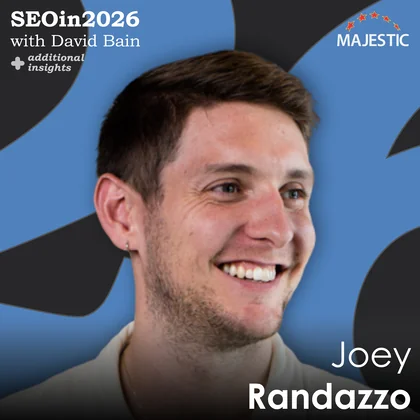
Joey Randazzo
Joey Randazzo argues that successful SEO comes from doing the hard, human work of creating truly unique, experience-driven content while using AI only as a supporting tool, not as the strategy itself.
« Back to Additional insights
More Additional Insights



Joey says: “Create truly unique content that cannot be replicated by any of your competitors.
To add a little bit of flavour to that: without the use of mass-generated AI content, which is very, very prevalent today. It's easy to create that content, but doing hard things sometimes pays off a little bit better.”
It does indeed, and there's so much to unpack there. The first part of the answer you gave was talking about truly unique content, and the second part was without using mass-scale AI. I guess definitions for both of those areas would be useful to begin with.
What is truly unique content, in your eyes?
“I think the easiest way for me to explain this is through an example, if that's okay.
An example I can use is of a chiropractor. Chiropractors treat a bunch of different ailments: people with back pain, people with TMJ jaw pain, people with migraines, etc. Let's say they're creating a landing page targeting someone experiencing migraines. Truly unique content (how we do it, and how anybody can do it) is interviewing the doctor and hearing, from their perspective, how they treat people with migraines.
When someone comes in, what questions do they ask? How do they treat them? What's their process? What are some stretches or exercises that they recommend? Then, you take that interview – and that's truly unique, from the doctor's perspective. Very few doctors are going to do it exactly the way that they're going to do it. Now you can create a landing page that aligns with whatever the doctor just said about their treatment plan for people who experience migraines.
Whereas, other folks creating mass-generated AI content are going to go to ChatGPT and say, ‘Hey, I'm an SEO specialist. I'm working with a chiropractor who helps people with migraines, TMJ jaw pain, or back pain. Create 27 pages for each of these ailments.’ Voila, 10 minutes later, they have 27 pages.
The difference there is that one is unique from the doctor's perspective – their words coming out of their mouth – and the other is 27 pages created by AI in 10 minutes. Hopefully that gives a little bit of flavour to each of those.”
Absolutely. Is there a go-between here? Is there a happy medium where you can perhaps use AI to augment or expand on something that's truly unique?
“Absolutely, and we do that as well.
You can take that 10 or 15-minute interview with the doctor, and you can use tools like Wispr or Rev – a transcription tool. Suddenly you have the transcription, and now you can leverage AI to create that landing page a whole lot faster, and structure it. You can ask AI to use the words that came out of the doctor's mouth, because you have the transcription in front of you. That is the in-between.
Or again, as you said, asking for expansion from AI, and then confirming with your client that that's actually legitimate. AI might say, ‘Oh, we do this type of modality for people who experience migraines,’ and the doctor goes, ‘I don't do that. Other folks might do that, but I don't do that.’
That's the area of being a little bit cautious when AI expands or tries to come up with extra ideas on its own.”
I'm a big fan of what you called the ‘in between’ when conducting interviews. I host lots of different podcast episodes for Majestic and, obviously, transcriptions can be produced from that, and blog posts can be produced from that as well.
The process is very human-centric, but it is based upon completely unique content: authoritative individuals with a unique perspective giving their opinion. Then, the rest of the content is based on that.
Are you entirely comfortable with that type of approach?
“Yeah, and I think there are areas of layering on where it gets even more unique. The answer is ‘yes, and’, and the ‘and’ is that, in many cases, businesses are selling a service/product that has a before-and-after. So, case studies can be truly unique.
A case study from someone named Steve in Seattle, Washington, who got in a car accident, who can share his story – that can't be replicated by anybody else because that's a unique story with this particular chiropractic practice. Again, you can use AI to follow the same formula.
If the client or patient is willing to be featured on your website, you can now interview them, transcribe it, create the case study, ideally get pictures, or you have videos of the before – the person limping down the hallway – and then the after – them sprinting down the hallway – or whatever crazy before-and-after you want to see. That's the additional. You can use it to create that unique content. That's not just the doctor's perspective, but now the before-and-after.
The final thought is that Google owns YouTube, and in AI Overviews (particularly when people ask detailed question-based or long-tail queries), Google sometimes features YouTube videos as a source for the answer. Now you have the doctor sitting in front of a beautiful background like you have, talking about their approach to treating migraines. Publish that two-minute video, and then you embed that YouTube video on the migraine landing page on their website.
That has the unique content. That has the before-and-after case study of Steve, and it has the YouTube video of the doctor. That right there, there's no doubt in a crawler's mind that it is truly unique, and not created with AI as the original source. Nobody can fight that.
Businesses don't want to spend that time to get the before-and-after of Steve, and the case study, and film the YouTube video, and publish the YouTube video, and create these really detailed landing pages, so it's a strategy that's really hard to lose with. It's difficult to do, it takes time, but it's a strategy that is just really powerful.”
There was an old way to describe SEO as being black hat, grey hat, or white hat, and I guess this could apply to the production of content and how much AI you use.
Where does the line lie when it starts to get grey? What kind of tactics/methods do people start using where you start to question it, and you think that's not the right thing to do?
“There are some video tools, for example, where you use your own avatar, then you write a script using AI, and then it has your voice, of sorts. Suddenly, you've got different videos of you talking about migraines or back pain, and no one else is going to create that exact video with that exact avatar.
However, I think about it from the user's perspective. If I'm in pain at three in the morning, and I need help, and I do choose to watch a video, I want it to be the real deal. It's for crawlers, but it's also for users.
The same thing is true with case studies. We've had so many clients say, ‘Hey, can't we just create a generic case study? We know we had somebody that we helped. Can’t we just say that someone came in with a migraine and after X number of treatments, they felt better?’ You can, but having that real person and putting in the work to get that real person, and photos or videos, that is truly white hat.
If a user watches that or a user lands on that page, there's no question, they're going to say, ‘I think this business can help me, and I'm willing to potentially call them and schedule an appointment because I need relief and I need help,’ or ‘I need more revenue for my business,’ or ‘I need a better CPA because I'm not saving as much money on taxes as I think I can.’
There are some grey hat versions where you use some examples of what you have done, but you're not naming the situation at that deep, true level. You're just using the generics of it. Then you're asking AI to fill in the blanks on those generics. That's the grey area that we try to stay away from.”
That's a great way to put it. So, the grey area is about a poor user experience.
With the grey, essentially, search engines will give you an opportunity. They'll trial out your content, they will rank your content initially, but when the traffic is driven to your site – your landing page, wherever it may be – and there aren’t any strong user signals as a result of that, then it's probably not a long-term strategy.
“That's exactly correct.”
Obviously, the black hat, or the no-no from your perspective, is starting off with AI. It's simply asking AI to research what exists out there already in your particular niche and then just create content to satisfy something.
“Make up some person named David…”
There are lots of them
“… and explain how he had migraines and how he's feeling better. Then, go to these image creation sources and create a before-and-after video of a roof, if you're a roofer.
You can do that; you can create a before-and-after gallery of fake images. You can create fake video content that you publish on YouTube. It's legitimately published on YouTube, but it's all AI-generated.
That's the game that people are playing because they think, ‘Wow, I can suddenly now create 50 landing pages with photos and videos and all these things, and it's going to rank because it's got content on it.’
I think that is incorrect.”
Are we not going to be at a stage in three or four years’ time where AI content is going to be largely indistinguishable from real human content?
“I think so. I'm forecasting and making an assumption, and here's my bet: less polished images and videos are going to feel more real, and content that is not perfectly written is going to feel more real.
With AI, I can immediately spot landing pages that are AI-generated right now. The copy has this flow to it, and the landing page has that particular style to it. Perhaps that's going to change, but that's where doing the hard things of…
We have other problems on our hands. If someone can make an AI-generated video of me and you can't tell the difference at all, then we've got other bigger world issues that we need to face, but that's why a person creating video content of themselves, maybe not filmed with the most amazing camera in the world, but it feels more real with an iPhone or something – or pictures from an iPhone of before-and-after. The words can be generated with AI, and the photos and videos currently can, but I think those are going to be easier to differentiate and spot.
The answer is that it might perhaps be indistinguishable. It’s a scary thought, in terms of the users and consumers of the world being told a story that's not real; someone selling something that's not legitimate because they can use AI to create that story.
By proving to users that you actually do what you say you do, where you say you do it – figuring out 2, 3, 4, or 5 years from now how to do that in the most legitimate way that really proves that it's not created with AI, it's not fake, it's actually a business has done something in a particular place and helped particular people.
That's going to be the challenge that Google has while crawling, and ChatGPT has while crawling, and then the business has to prove to Google and ChatGPT and all these crawlers: ‘No, we're the real deal. This isn't just created with AI and not true. This is us. We've actually done this before. We've actually helped people before.’
That doesn't really answer your question, but those are my thoughts around it.”
An audience really wants to know the personal experience of someone. If you're going to record a video giving that perspective, giving your point of view, you also want to make sure that it's likely to resonate with that target audience and talk about the things that are of concern to them.
How do you research and do your best job to ensure that what you're discussing/sharing is likely to appeal to them and assist them down the buyer journey?
“What we do is we just ask our clients, who are the subject matter experts. They hear it from clients or customers every day. AI can help do that research, but that doctor who sees 20 patients a day, frequently and for the same issues, knows what those people are dealing with. They know their deepest problems. They know that they want to sleep at night, and when their back hurts, and they can't sleep, that wrecks their day.
I was just at the chiropractor’s recently, which is why this is all coming up for me. I have a three-year-old, and my wife's pregnant. As of just a couple of days ago, I've been able to hold my kid again, but for a week after I threw out my back, I couldn't help my pregnant wife hold our child.
Those are the pain points that are at the deepest level. Ask the chiropractor, the CPA, the roofer, or whoever your client is: ‘What do you hear over and over and over and over again?’ Then, validate with AI, sure. Say, ‘Do they also talk about this problem? Oh, they do talk about that problem? That's a great extra idea.’
Just make sure that the actual practitioner, it doesn't matter what type of business it is – that person that's client-facing, that hears from the client every day. They're going to know what those deepest problems are. Starting there and then creating the video script that answers each one of those, that's the formula.”
I like the story that you shared there because that was very personal, and it demonstrates that personal bond that you're trying to build with the audience. Hopefully, the kind of content that you encourage people, professionals, and brands to produce incorporates some of those stories as well.
I also like the word that you used in terms of how you go about researching what to write about. Obviously, you talk about conducting real research with a target audience to begin with, but then ‘validating’ it with AI. So, you're not actually using AI to conduct the research to begin with – because obviously AI will see what exists out there already, and they may find gaps in that, but they may not necessarily find that one unknown that doesn't exist.
You're getting that unknown from your target audience, to begin with, and then validating that with AI.
“Exactly. Also, AI doesn't know the nuances of each business and how they think about their target audience.
The whole theme of this conversation is that AI is a very powerful tool. You can weave it into processes, you can weave it into content creation, and you can weave it into strategy, but this is SEO in 2026 and focussing on that is not the answer. That is not the formula. AI is not it. It's the hard work and doing things that align with the customer on the other end of the screen. That's the starting point.
How can you use AI to get there faster, better, or more powerfully? Sure, but the hard work is filming videos, getting case studies from clients, and getting Google reviews. AI can assist with that, but that is the tool that is not the strategy and the formula.
I've heard so many times, ‘AI does SEO.’ No, no, no, no, no. ‘AI runs my SEO strategy; AI is my SEO strategy.’ That's the problem that I've been seeing over and over again.”
Joey, what's the key takeaway from the tip you shared today?
“The key takeaway is to do the hard things, and do the hard things that are going to resonate with your clients and your customers at the deepest level.
That might mean getting in front of a camera. That might mean interviewing yourself, if you're the owner of the business. That might mean interviewing your clients, if you're an SEO agency or freelancer. Your content creation might take a little bit longer, but in the long run, I think you're going to have a winning strategy.
The takeaway is that short-term, massive gains in SEO are usually fleeting. Doing the hard things consistently is what's allowed us to win in our market. We rank at the top for our services in our market, and a lot of our clients rank at the top of Google and ChatGPT for their services in their market.
It didn't happen month two, it didn't happen month four, but consistent, deep, deep effort led to those results.”
Joey Randazzo is Owner at SEO Growth Partners. Find out more over at PortlandSEOGrowth.com.
Choose Your Own Learning Style
 Video
Video
If you like to get up-close with your favourite SEO experts, these one-to-one interviews might just be for you.
Watch all of our episodes, FREE, on our dedicated SEO in 2026: Additional Insights playlist.

 Podcast
Maybe you are more of a listener than a watcher, or prefer to learn while you commute.
SEO in 2026: Additional Insights is available now via all the usual podcast platforms
 SEO in 2026
Catch up on SEO tips from 117 SEO experts in the original SEO in 2026 series
Available as a video series, podcast, and a book.
Fresh Index

Unique URLs crawled
194,181,258,261
Unique URLs found
618,029,643,510
Date range
07 Apr 2026 to 05 Aug 2026
Last updated
56 minutes ago
Historic Index
Unique URLs crawled
4,502,566,935,407
Unique URLs found
21,743,308,221,308
Date range
06 Jun 2006 to 26 Mar 2024
Last updated
03 May 2024
