-
Site Explorer
- Majestic
- Summary
- Ref Domains
- Backlinks
 New
New- Lost
- Context
- Anchor Text
- Pages
- Topics
- Link Graph
- Related Sites
- Advanced Tools
- Author ExplorerBeta
- Summary
- Similar Profiles
- Profile Backlinks
- Attributions
- Compare
-
Link Tools
- My Majestic
- Recent Activity
- Reports
- Campaigns
- Verified Domains
- OpenApps
- API Keys
- Keywords
- N-grams Near Links
- Keyword Checker
- Search Explorer
- Link Tools
- Bulk Backlinks
- Neighbourhood Checker
- Submit URLs
- Experimental
- Index Merger
- Link Profile Fight
- Mutual Links
- Solo Links
- PDF Report
- Typo Domain
- TLD Checker New
- Free SEO Tools
- Support


Be where your users are
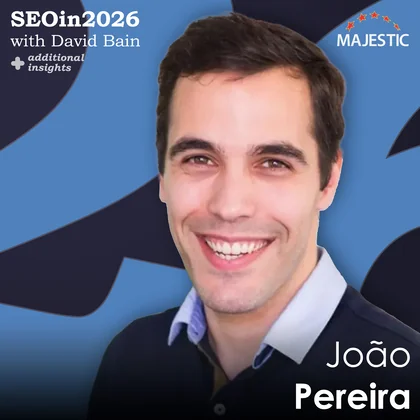
João Pereira
João Pereira discusses the importance of understanding your audience, building trust, and leveraging data from various platforms.
« Back to Additional insights
More Additional Insights



João says: “Be where your users are.”
Be where your users are. How do you know where your users are?
“I think that's the one million dollar question. Today, we have many options to see and tools to use to evaluate where our users are. I would say that we can just go first with our understanding of the target.
Who are our users? Who is our target audience? Who are they? Where are they from? The ages? Are they male, female, or both? When we understand that, if we have that understanding (and I'm assuming that most of us partially have that understanding), we can start understanding where they are.
Are they online? Are they offline? Are they online using social media, or searching on Google? There are tools today that help us to identify where they are and identify audiences. Paid media is also a way for us to quickly try to get more insights.
But the bottom line is: just try to listen to those users who are landing on your website. Try to understand where they are coming from. Use Google Analytics or your analytics to understand where they are coming from/which referral you have. By collecting all of this data from the different tools that you have – but also using your own insights: data insights from your own company, from your sales representative, from your analytics, etc. Collect all of that and try to understand who they are, and if they are searching on social media.
Are they evaluating your service and your product on social media, or are they on Google? Are they just going directly to your website via direct search and searching your brand? I think it's a complex framework of analysis to come to a point where you understand the entire funnel.
Today, it is even more complex to understand that funnel because you don't go straight to a website. You might go to the website and then get back to Google or LLMs to understand if you can trust that website or not.
So: collecting all of this data, understanding where your users are to collect that data, and then being there. Be sure that you are on Reddit if your users are on Reddit. Be on YouTube if your users are using YouTube. Be where they are. You don't need to be everywhere. I think that's also a common mistake.”
In terms of tools, you recommended (or at least mentioned) Google Analytics there. What other tools do you recommend using to determine who your users are?
“I would say that the most common ones, and the ones that I know many companies use (and they are quite powerful), are just AdSense and your social media campaigns. They provide you with a lot of insights about your audience. I think that's really, really powerful. You can, on a budget, grab a lot of insights about your audience.
That's the number one way, if you don't have anything else. If you don't have Google Analytics or referral traffic to understand, or if you are starting a website or an online business, you can definitely use your budget to run a campaign just to understand who the people are that are interested in your website, your product, and your users.
But then you have multiple marketing tools, and I can mention many of them – from Semrush, to Ahrefs, to SimilarWeb and Majestic as well, just to collect and understand who is talking about you, and where your brand or your website is being mentioned.
Those tools can help you to understand who is talking about you and who is interested in your product or brand. Use, for example, Google Trends. It's a free tool, usually overlooked, and you can use Google Trends just to understand where users are searching for your brand, product, or service: which geos, which countries, or how they are searching online.
Collecting all of this data using the different tools that you have available and, depending on your budget, you can be more creative or not, but you can definitely grab many insights on a budget – data insights about your audience. I would say, for the majority of us, when we are starting a website, running some paid campaigns is the fastest way to grab some initial insights about age, interest, gender, etc.
All of that information will start accumulating, and over time, we will have a better understanding of who our audience is and where they are.”
Now, you started off by talking about getting data from social media ad campaigns. I was really intrigued by that.
By social media ad campaigns, are you talking about ad campaigns on Facebook or somewhere else, maybe?
“Meta.”
Meta, yeah. Okay. What specific data are you looking for, and how would you use that data in SEO?
“Yeah, it's really important, and I will give you a very concrete example. It is an old example, but still valid. I used to work for EF Education First, and one of our products, our main product, was English courses abroad.
We had a page to sell a summer camp, and our optimization for SEO was speaking with the younger generation. All the content on the page was focused on 15/16-year-old boys and girls. Then, when we started running some campaigns, and we understood who was actually clicking on those campaigns, who was actually engaging with our campaigns, we understood that our audience was the parents, not the kids.
So, what we did was completely change the copy on the page, not to speak with the young folks, but actually to speak with the parents. They have different concerns. While a teenager wants to know what to do in the summer camp, what type of activities, how much fun it is, etc., parents might be concerned about the safety, about the costs, and about the logistics.
Using this data, it helped us to address the right content to the right audience.”
Brilliant, okay, so that's identifying who your users are.
What do you do when you have that data? How do you identify where those users are likely to interact online?
“So, SEO – the old SEO or the SEO as we still know it – was basically focused on Google: how we rank on Google. But today that's not the case anymore.
Today, when we look at the marketing funnel, we understand that users are still using Google, so it's quite critical that we still look at Google, but users are also getting information and being convinced about the product and service they are about to acquire elsewhere.
They are on LLMs, they are on social media – and by understanding our audience, we can try to understand where they are. If our audience is majority grown-ups/parents are most probably using Meta. If they are younger teenagers, they might be using a different social media platform. By understanding who they are, we can understand where they are and how they are searching.
Something that we did at Eventbrite when I worked there, last year we launched (together with Spotify, most recently, but with TikTok at the time) some integrations that help us to understand where the users searching for events were and to be able to present Eventbrite tickets on those platforms.
You might argue, ‘What is SEO?’ and if SEO is still to be ranking only on Google or if these social media are also search engines per se. My concept of SEO is ‘Search Engine Optimization, and TikTok is a search engine. All those social media, in a way, are search engines – and we do it without paying, so it's organic.
We need to understand how we can use those platforms and integrate our content and distribute our content on those platforms. Eventbrite had this connection, and we connected our website with TikTok and then with Spotify. So, understanding where our users were helped us to evolve our product to be where they are.”
You mentioned the phrase ‘marketing funnel’ there as well. How do you map your users to your marketing funnel, and then what's the next stage of the process after that?
“Today, it is quite challenging, and I think all of us are still trying to figure out the best way to keep track of the funnel.
Five years ago, the funnel was pretty much static, where you had a phase of consideration, and then you just went to purchase. Today is slightly different. The funnel is not straight anymore. It's not a linear funnel. You have users searching elsewhere for confirmation of trustworthiness or understanding if they can trust your company and website. That funnel today is quite complex.
Looking ahead, and being positive, I would say that we will eventually come up with a solution to figure out the entire funnel. Today, with the emergence that exists here in the world with AI and all the LLMs appearing, and all the companies running after AI, we understand that in this moment, it is really complex for everyone to understand where we will be landing, but eventually we will. We will understand if users are still shopping online, if they are using agents to make the purchase, and if they are still visiting the website.
Today, however, we are evolving, and we need to wait and be patient to understand where the technology will land.”
Okay, and another difficult question for you is, you're talking about users jumping all over the place to different platforms and not necessarily having a consistent marketing funnel.
What does this mean from a measurement perspective? How do you measure SEO success nowadays?
“Currently, I'm leading marketing at BusBud, a company that sells bus and train tickets. What we understand is that users who are more price sensitive, they land on our website, and then they just go elsewhere to compare prices.
It's a huge challenge for us to understand what success in SEO is, because we can be ranking number one with our website, getting the traffic, and not getting the conversion. So, we need to understand where those users are going next. We need to understand how we can engage with them, how they are searching for our brand, and how they can trust our website, our brand, and our company.
I would say that, more and more, direct traffic, impressions, and brand impressions specifically will be quite key for the measurement of success. We want more users to search directly for our brand. We want more people to search directly for our product and service.
We need to understand that it's loyalty that is at stake here. If you grab your audience – if you are providing the best user experience, the best product and service, and creating that relationship with your audience – you will see an increase in brand. This is not a magical recipe because, as you know, people are always looking at different ways of purchasing/booking, and you need to ensure that, from an SEO standpoint, success will be to measure visibility on Google, but also measure visibility where users are searching, and it's quite tricky.
Even today, a couple of years after the launch of ChatGPT to the public, we are still not sure how to measure visibility on LLMs. I think this is where the future will go. We need to measure our visibility. We need to understand how we can measure our visibility on LLMs and social media, in the same way that we figure out how to do that in SEO for Google.”
João, what's the key takeaway from the tip you shared today?
“Just do your best. Do your best to share with your audience what you do, who you are, and how critical you are for the product or service that your audience is looking for.
Be yourself and ensure that they trust you. Being trustworthy is really, really critical today. Think about your brand, think about the values of your brand, and mirror that – not only on your website, but everywhere where you have an online presence.”
João Pereira is Marketing Director at BusBud. Find out more over at BusBud.com.
Choose Your Own Learning Style
 Video
Video
If you like to get up-close with your favourite SEO experts, these one-to-one interviews might just be for you.
Watch all of our episodes, FREE, on our dedicated SEO in 2026: Additional Insights playlist.
 Podcast
Maybe you are more of a listener than a watcher, or prefer to learn while you commute.
SEO in 2026: Additional Insights is available now via all the usual podcast platforms
 SEO in 2026
Catch up on SEO tips from 117 SEO experts in the original SEO in 2026 series
Available as a video series, podcast, and a book.
Fresh Index

Unique URLs crawled
194,181,258,261
Unique URLs found
618,029,643,510
Date range
07 Apr 2026 to 05 Aug 2026
Last updated
56 minutes ago
Historic Index
Unique URLs crawled
4,502,566,935,407
Unique URLs found
21,743,308,221,308
Date range
06 Jun 2006 to 26 Mar 2024
Last updated
03 May 2024
