-
Site Explorer
- Majestic
- Summary
- Ref Domains
- Backlinks
 New
New- Lost
- Context
- Anchor Text
- Pages
- Topics
- Link Graph
- Related Sites
- Advanced Tools
- Author ExplorerBeta
- Summary
- Similar Profiles
- Profile Backlinks
- Attributions
- Compare
-
Link Tools
- My Majestic
- Recent Activity
- Reports
- Campaigns
- Verified Domains
- OpenApps
- API Keys
- Keywords
- N-grams Near Links
- Keyword Checker
- Search Explorer
- Link Tools
- Bulk Backlinks
- Neighbourhood Checker
- Submit URLs
- Experimental
- Index Merger
- Link Profile Fight
- Mutual Links
- Solo Links
- PDF Report
- Typo Domain
- TLD Checker New
- Free SEO Tools
- Support


Why are businesses not doing a good job of leveraging leads from organic?
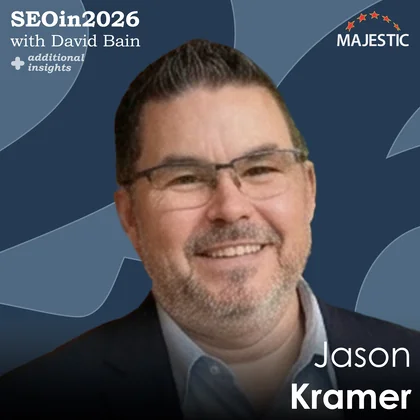
Jason Kramer
Jason Kramer talks about why aligning marketing and sales around rigorous lead tracking and multi-touch attribution is essential for turning SEO and other marketing activities into higher-quality leads, better insights, and more revenue.
« Back to Additional insights
More Additional Insights



Jason says: “My number one tip is all about tracking where leads are coming from. It's so important and so critical to understand – not just for paid marketing but for social, for organic, etc.
Understanding where that's coming from is going to make a huge, pivotal difference. If you do that (I know we're going to get into it in the conversation today), it's really going to help you understand where you should put your time and effort.”
Do you think many marketers who specialise in organic are doing this particularly badly?
“What happens is that, a lot of times, the marketing is doing a good job of driving traffic. We all know that, in most cases. Where the fall happens is when the salesperson gets that lead, and it turns from an MQL (a Marketing Qualified Lead) into potentially a Sales Qualified Lead.
There's a disconnect in understanding, was that somebody who came from some type of social/organic, from a paid campaign, from a trade show, a webinar, or wherever they may have come from? Not only is understanding that really important for the salesperson, because it lets you understand how they found out about you, but it's also important for the marketing team so that they can go back to sales and say, ‘Were the leads we got you from this organic campaign actually good, or were they not good?’
That's a really important factor.”
I guess the challenge with providing exact detail on where a lead comes from is that it’s more difficult nowadays, because you have virtually all referring keyword phrases from organic that aren't provided.
You've got AI search that doesn't provide a great deal of detail in terms of what phraseology/what conversations the user had prior to making a decision to visit the brand.
How granular can you be, and should you want to be, as a marketing team in order to define those leads?
“Great question. For us and our clients (and by the way, we don't provide any inbound marketing services. We help after the leads get captured, and nurturing and converting those), being in marketing for almost 20 years and owning a marketing agency, a lot of it comes to home in terms of the things we used to deal with in conversations.
To answer your question, yes, AI – ChatGPT, Gemini, Claude, Perplexity, etc. – a lot of people are using those systems now to find information. But that doesn't mean that we can't say, ‘This is how much traffic is coming from Perplexity or from ChatGPT.’ We may not know the source prior, but at least we know that the AI is actually driving traffic. We do have a way to use the referring URLs and, when a form gets filled out on a website, we can capture that hidden data into the CRM. That is important.
I do make the distinction between Instagram, Facebook, paid ads, organic ads, etc. Some platforms are a little trickier to capture that from, but in most cases, with most of these platforms, there is referring URL data (not to get technical) that can happen automatically if the website is properly connected to your CRM.”
What do you think about multi-touch attribution, or attribution in relation to giving credit to different referring sources?
Obviously, a customer journey can be quite convoluted nowadays, depending upon the length of the sales journey, and it's not necessarily just the last referring source, is it?
“No, it's not. In fact, I would say about 99% of the clients we work with use first-touch attribution modelling – which means (for the audience), that's the first thing somebody saw in order to find out about your company. Whether it be a paid ad, whether it be on organic, whether it be a truck driving around or a lawn sign, whatever business you're in, that's the first thing they saw.
Many businesses want to attribute the fact that that marketing channel introduced the brand to that person. 1% of our clients don't care about that. I shouldn't say they don't care about it, but what's more important to them – to your point, David – is: What was the last thing they did to interact with that made them go over the fence and become a customer?
They might have started out seeing your free ads on Facebook, but it was a paid ad on Google Ads that got them to actually convert and become a customer. That's last-touch attribution.
However, the full arc of all of the touchpoints is extremely important because I 100% agree, people are absorbing information in multiple different platforms these days, so it's not just going to be one source of lead attribution. That hasn't been the case for a while.”
The primary audience listening to this is SEOs. What do you think SEOs should be doing in terms of their conversations that they're having with other marketing teams to ensure that the traffic that they refer and the leads that they assist with, in terms of actually generating inquiries for a particular product or service, are actually counted?
Obviously, it could be at the start, it could be at the middle, it could be at the end. Where's the most valuable point, in your experience, for SEO?
“The most valuable point is before anything starts happening. If you are launching a new SEO campaign – and again, it could be organic through traffic on the web, it could be through social – having a conversation with whoever manages the CRM at the client and making sure that everything is connected to track that referring traffic is extremely important.
A lot of this traffic (as your listeners know, and as you and I know, David) can't be found retroactively. You can't go back in time six months and fix what was broken. You have to make sure that it's set up properly in the beginning. That's what I would advise: have the marketing people who may be listening today or are in the conversation say, ‘Hey, what CRM system do you use? How is your website connected to the sales team?’
The sales team is hopefully using some type of system. If they're not, it does become a lot trickier if you don't have that technology in place. Not impossible, but it's much harder.”
You've mentioned sales teams a couple of times there as well, and I'm sure you're very experienced with liaising with sales teams to ensure that they're happy with the information that they're provided with.
Why do they need to know the referring source, and how does that assist them?
“Great question. It actually assists the marketing team more than it does the sales team.
Imagine, David, I was doing SEO for your business, and I drove 500 people this month to your website – and that was a combination of people from Facebook, maybe from TikTok, maybe from AI, maybe from Google search/Yahoo, what have you. Well, I would want to know the quality of that traffic.
How do I know the quality of the traffic? Based on the interactions of the sales team. If the sales team qualifies somebody and starts having a business conversation with them, a sales conversation, I know it's a quality lead. It may not be somebody that buys, but it'd be a quality lead. So, I need to know what percentage of those 500 actually spoke to sales, and it wasn't just some BS phone number or email address that didn't exist, and the salesperson can never get in touch with them.
But I also need to know, as the marketing side, how many of those conversations turned into closed-won business, and how much revenue did we generate? If I could understand that, wow, I drove 200 people from Facebook organic to your website, but 150 of them were not qualified, and they were really bad leads.
That allows me, as the marketer and the SEO person, to revise my strategy so that I can bring better quality leads to the business.”
Does it impact the nature of the conversations that a salesperson will have with a prospect?
If they know that someone's an organic lead, they've spent a decent amount of time on your website, then they may have a more in-depth conversation about a particular topic with that prospect.
“Yeah, absolutely. Imagine that somebody searched for you on Google. That would indicate to me that they're probably doing a lot of research, and they probably found you and maybe a half dozen or a dozen other companies that they are also talking to. Versus, if you know that it was a webinar that was promoted organically, and now they're coming in on a specific topic of that webinar, or maybe it was a trade show.
I would consider that organic as well. Even though you paid to be at the trade show, they organically saw you right there. If you knew they were at the event, then that would help you steer the conversation.
I do think it's important, maybe not in every single case, but depending upon what that lead source is, how valuable it could be to the salesperson to really just help that initial conversation.”
As a broad summary, how would you describe the difference between the quality of leads that businesses tend to see between more traditional SEO/Google organic search-type leads and perhaps a different medium – maybe paid advertising, social media, or something like that?
“We work with a lot of home service-based businesses, manufacturers, nonprofits, etc. We work with a diverse group of clients and multiple verticals, but I will say that the people who generally come at the high level of the funnel, when they're doing the most research, tend not to be very qualified because they're too early in the process. The reason that they don't become qualified is that the salespeople don't continue to follow up. If they're not getting that immediate sale, it's harder to convert.
Organically, especially when you're in the home service business, we see a lot of clients generating hundreds of thousands of dollars in revenue from their trucks driving around or a lawn sign in front of the house when they're working on the roof or whatever project they're working on.
That type of organic traffic adds validation because you can see the work being done, or maybe the work's been finished, and now there's a sign telling you who did the work. It's the ultimate referral in a way, because you can see that it was done to your liking.
Those are more of what I would call a warmer referral, rather than somebody just seeing your ad on Facebook that may or may not know exactly what you do, but they click on the ad and they convert in.”
What about leads from AI search? Are you seeing a significant uptick in the number of leads?
Is there any difference in terms of their knowledge compared with more traditional search engines?
“Yeah, that's another great question. One of our clients is a commercial residential brokerage, so they help people find office space. He's building a relationship with residential brokers: people selling homes. We're actually using Claude, and we built a Claude tool for him that does extensive research in a very small geographic area of Manhattan in New York to find brokers of a certain calibre that he's looking to connect with.
In that particular case, AI does an amazing job finding people that would fit his profile, along with who they work for, their email address, their phone number, their LinkedIn profile, and other critical information. I will say this: tools out there like Apollo (and there are tonnes of them out there), they all have a lot of data, but they're not necessarily always good as one source.
I would just say that, in summary, if you're going to be looking for data of potential leads through AI or other data mining tools, I would do something that the audience may have heard of: ‘waterfall nurturing’. You want to look at multiple sources and compare the data against each other to find the best quality data.”
If you were going to get an SEO and a CRM specialist in the room together and they haven't done much talking before, what's one thing that a CRM specialist should really know about SEO and the way that SEO is done, and vice versa, what's one thing that the SEO should really know about and what the CRM specialist knows about?
“The CRM specialist should understand that the world of organic SEO is very vast. Oftentimes, you're just sending traffic to different landing pages, etc., but understanding that every SEO team tracks things a little bit differently for their own internal purposes. Also, being flexible with how that SEO team works and trying to mirror what they're doing to match what the needs are for the CRM is really important. Being too stubborn and too centre-focussed could cause challenges.
On the reverse side, an SEO specialist should understand that there's value – if you're posting video content organically on Facebook, for example, and you're posting articles and you have forms that are being advertised, or other content. You want to be able to offer all of that in a way that we can track to see which specific posts, which specific pieces of information, got people to convert. Facebook, for example, is a vast universe. There's a lot of content on Facebook. Just knowing that you got a conversion from Facebook may not be as useful as knowing this particular post is what actually drove the conversion.”
If a business doesn't have a CRM at the moment, how do they go about selecting one?
“We actually have a CRM research guide at our website. If you go to afterthelead.com, you'll find that there.
The most important thing about finding a CRM is, it's not about the CRM, believe it or not. It's not about the features, and it’s not about what it can do. It's first understanding what the process is for your business. How do you capture leads? How do you engage with your leads? How do you nurture them? How do you bring them through your sales process? If you don't have those processes defined, not even a $100,000 CRM can solve that problem.
A lot of businesses would fail. In fact, the Harvard Business Review did a study which found that 70% of businesses will fail at implementing their own CRM, which is a hugely alarming number. It really just tells us that it's not the technology that's failing; it's that they don't understand how to use the technology, and they haven't defined what their needs are and what their process is first.”
It's tough, though. Many businesses obviously put the cart before the horse and end up getting excited by a piece of technology and then designing their business around that. But at the same time, it's actually quite hard to identify your process without being aware of the parameters around technology and what it can offer.
If you haven't got a really good process in place, do you check out different software to begin with and maybe identify a few ideas in terms of what your key process should be, and then design that, and then select software?
“I would say no to that. What I would suggest is that, if you aren't really aware of what the capabilities are or even how to think about your process, the easiest thing to do is just take out a piece of paper and a pencil or a pen and just write down: When we get a phone call, when we get a website lead, when we have somebody walk into our retail, what's the first thing that happens?
What do we talk to them about? What do we capture? What information do we capture? Who does that on our team? Then, after that first step, you say, ‘Okay, what's the second thing that happens?’ Then, what's the third thing? Then you also write how long it takes to go from step one to step two. Does it take a day? Does it take a week? Sometimes that process could be a couple of hours. Sometimes it could be weeks. Sometimes it could be many months. It depends on what you're selling.
Everybody's capable of writing that process. What I find most interesting and not surprising, David, is that the process, everybody has it. It's just up here in your head, right? It's not documented anywhere. When it's up in your head, it's very easy to pivot and change your process on the fly. ‘Oh, I'm busy today. I don't have time to follow up with David. I'll follow up tomorrow,’ and tomorrow you're busy, and then you don't have time to follow up. Next thing you know, three weeks go by, and you lost the deal because there was no process to remind you to follow up.
That's really what I would focus on first, rather than looking at any features and benefits. The reality is, there are thousands of CRMs out there. Some are better than others, but the CRM itself isn't going to teach you how to build a process. That's what we focus on and specialise in: helping companies do that first.”
Jason, what's the key takeaway from the tip you shared today?
“The key takeaway is to make sure that marketing is talking to sales and making sure that all that marketing effort, all that SEO effort you're doing, is being tracked in some way, other than just impressions and clicks and how many people filled out a form.
That data is gold. If you can get that data, I guarantee you, you're going to see a big difference in your business.”
Jason Kramer is President at Cultivize. Find out more over at Cultivize.com.
Choose Your Own Learning Style
 Video
Video
If you like to get up-close with your favourite SEO experts, these one-to-one interviews might just be for you.
Watch all of our episodes, FREE, on our dedicated SEO in 2026: Additional Insights playlist.
 Podcast
Maybe you are more of a listener than a watcher, or prefer to learn while you commute.
SEO in 2026: Additional Insights is available now via all the usual podcast platforms
 SEO in 2026
Catch up on SEO tips from 117 SEO experts in the original SEO in 2026 series
Available as a video series, podcast, and a book.
Fresh Index

Unique URLs crawled
194,181,258,261
Unique URLs found
618,029,643,510
Date range
07 Apr 2026 to 05 Aug 2026
Last updated
53 minutes ago
Historic Index
Unique URLs crawled
4,502,566,935,407
Unique URLs found
21,743,308,221,308
Date range
06 Jun 2006 to 26 Mar 2024
Last updated
03 May 2024
