-
Site Explorer
- Majestic
- Summary
- Ref Domains
- Backlinks
 New
New- Lost
- Context
- Anchor Text
- Pages
- Topics
- Link Graph
- Related Sites
- Advanced Tools
- Author ExplorerBeta
- Summary
- Similar Profiles
- Profile Backlinks
- Attributions
- Compare
-
Link Tools
- My Majestic
- Recent Activity
- Reports
- Campaigns
- Verified Domains
- OpenApps
- API Keys
- Keywords
- N-grams Near Links
- Keyword Checker
- Search Explorer
- Link Tools
- Bulk Backlinks
- Neighbourhood Checker
- Submit URLs
- Experimental
- Index Merger
- Link Profile Fight
- Mutual Links
- Solo Links
- PDF Report
- Typo Domain
- TLD Checker New
- Free SEO Tools
- Support


Brand is back and it’s bigger than before
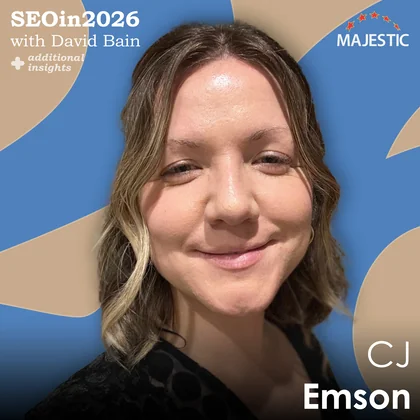
CJ Emson
CJ Emson shares that brand is back and it’s bigger than before. If your branded search footprint isn’t strong, you’re going to lose out in AIO and as we are continually seeing and hearing - traditional organic search traffic is down, zero click search is up.
« Back to Additional insights
More Additional Insights



CJ says: “My number one tip, David, is to really believe in brand and invest in your brand storytelling.
I'm a content SEO, so I would say that, but we heard it at brightonSEO last year, in almost every talk that I attended. We also know, with the increase in AI search, that AI really rewards recognised, trusted brands in the summaries, and with AI comes the repositioning in customer trust.
So, having more of your brand story out there is really going to be key to influencing your audience to buy in the long term, and to find you and your product. Every message about brand building and SEO in 2026, for me, is going to be about building authenticity, creating memorability, and crucially being discovered.
All of the brand storytelling that you can do can adapt your content more easily to multiple platforms as well, which is another key piece: that you need to be wherever your audience is. Increasingly, they have multiple touchpoints; they have multiple devices and largely shorter attention spans. So, the more memorable that you can be with your brand story, the greater reach you'll have in the long term.”
You talk about multiple touchpoints and multiple devices. Does this mean that the way that brand SEO is done in 2026 has changed significantly?
“I think the key SEO principles are still true – keyword search and having all of those baseline principles of good SEO hygiene in place are still true. Ever more so with AI. However, the way that we're telling stories now is across multiple touchpoints, multiple devices, and multiple mediums as well.
Is it video? Is it carousels? What is driving that engagement? It might work differently on a different platform. Something that performs well on social media, like an Instagram or a Facebook, is going to perform completely differently on a more corporate social like LinkedIn.
There's almost a democratisation of search that's come with the diversification of platforms, where you might put a ‘top tips’ blog up before, in years gone by, and put it on your website. Now, how does that translate into your various social media platforms? Are you producing a video? Is there a transcript? And all of that bleeds into that discovery piece that I mentioned before.
Can you be discovered wherever your audience is, and continue that conversation with them in that space?
If you're being discovered where your audience is and that's not on your website, what does this mean for measuring success?
“Overall, we'll have to consider what success looks like in different platforms.
With your engagement rate (which may have been one flat figure before, in a reporting spreadsheet for your C-suite), you're going to have to think about multiple ways to disseminate that to them.
We saw the removal of the blue links last year, so it's not going to be that we're in the first search position on Google. It's going to be that we have a minimum engagement rate on Instagram or we have a huge reach on LinkedIn.
I think it will come down to having different metrics for success for different platforms.”
Okay, and saying the name that some people don't want to say, AI search, what does it mean for AI search results? Does the way that a brand is picked up by an AI search engine mean that the way that brand SEO is done is significantly different?
Are there certain elements that you want to incorporate for a brand that you're working on behalf of, to try and ensure that they're being mentioned as often as possible in relation to a particular question or a particular industry segment?
“I think there are two ways to look at it for AI. You still need your good base SEO content on pages. Specifically for AI, FAQs obviously drive really good summary search, and you're feeding Google results for that as well.
However, within AI, we're seeing the behaviour that customers/prospects go and do the research on an AI platform, and then they come completely off device. They might do that research on their laptop, and then they're on their phone when they get home, and they're doing that research on separate, different platforms.
So, from an AI search point of view, you have to be covering more bases. For brand, I think that looks like, as I said, that FAQ piece on the website, but also, how are you translating it? What is your search strategy for some of these search gardens, like your social medias, which are behind logins and are not turning up on traditional search platforms?
Reddit maybe bridges the gaps a little bit in being discovered in AI versus having a social strategy, for example, just to be discovered there.”
You talk about how brand SEO can fuel demand. What does this mean in terms of the behaviour that you want to encourage?
Are you trying to ensure that people actually remember your brand and come back to your site? Are you trying to encourage more searches on traditional search engines to demonstrate that your brand SEO has been a success? Are you trying to get click-throughs from the SERP, where your brand's mentioned, and there's some kind of link there?
“I think with AI, in the same way as we spoke about the success metrics, there are going to be different tactics for each platform and each area that you want to perform in.
Using Instagram as an example, I'm seeing consistent, almost repeat adverts from multiple different brands. I've set up a consultancy in the tail end of 2025, so I'm seeing lots of ‘new business’, ‘how to gain those followers’ and ‘how to build your base’, but they're all quite identikit.
For me, those brand stories are not resonating because a lot of them are saying the same thing and repeating very similar messages with largely generic handles. For brands across any platform (the example I gave was Instagram), the idea is to stand out.
If you're doing the same tactics as every other brand and sounding the same, how will you be found in an AI result where you might be up against five competitors, and you're all doing similar things? How are you communicating your USP and, more specifically, making it relevant to the audience itself?
I recently did an SEO and content audit for an aviation brand, and the content that they had on their site was very self-focused. It was brand-focused: their successes, their rewards, their reach. But in my initial sort of summary of it, there was no mention of the customer benefit there. So, within that brand storytelling, it has to become more brand and more client-focused to be able to have the brand resonate with the client or customer.”
How does a brand know how to go about standing out? What aspects of their content should be different compared with their competitors?
Because, if you're in a certain industry, perhaps on occasion there's a certain level of expectation of how a brand's going to act within a particular sector. So, you want certain elements to remain the same, and certain elements to stand out.
So, which elements should stand out?
“I'm thinking about it as a business owner myself. When I'm seeing ads, and I'm already bored by them, that's not an ad that's working – be it organic or paid. For some content that's in my feed that hasn't engaged me and stopped me, I've not taken any brand awareness away from that interaction.
It's more about, from a brand point of view, you've obviously got your brand pillars. You want someone to know your brand name and what you actually do, but are you identifying with the problems that your customers are experiencing? If you're not, then you begin to sound like everybody else.
So, telling your brand story in a way that highlights your product or service, but also evidences to the customer that you understand their pain points. I think that's key for me. Those brands are just going to be a bit more memorable.”
Yeah, that's certainly something key to think about there as well. I think brands that are a little bit different, maybe in the UK, are brands that embrace social media and dare to be a little bit different or perhaps do something or say something that will rock the boat.
You don't necessarily want to do that, but I like your suggestion of embracing customer problems a little bit more and identifying that perhaps, as an industry sector, there are certain challenges that many customers face. I guess there are many brands that shy away from even that.
“Well, absolutely. So, how do you stand out in content and brand storytelling now? There are certainly brands that lean into controversy, and there are others that have made more of an emphasis on understanding the client pain points and speaking to clients or customers in the spaces that they are.
Some travel brands do this really well. We've got On The Beach versus a British Airways. On The Beach are talking more about the benefits to customers. ‘Here are the things that you can enjoy when you get there: upgrades, check-in, ease,’ versus British Airways, who are looking more at the experience itself, and this more premium feel.
Both of them have successes because they're identifying what the customer they're aiming to engage with wants to hear, and they're in the spaces where those customers want to engage and hear that message.”
How do you identify the most suitable platform on which to engage and have these conversations?
You mentioned Instagram. Are we just talking about social media here? Do we try to have some kind of communication on our own website, maybe in chat form, or are there other better places? Should there be multiple places rather than a single place?
“I think I mentioned already about the democratisation of SERPs. That's moving away from Google as your homepage and your single source of search to having customers do their own research on multiple platforms. Increasingly, there is a social element being brought into that engagement piece, but it's for each brand to say where they are.
If you're maybe more B2B, and certainly in my previous B2B roles, LinkedIn has been our main social media community – which isn't to say there's not traffic to the site, but often those two audiences are doing different things. They may be passively engaging on a social platform, and they're more intentionally coming to your website to explore a specific product or solve a specific problem, but that engagement could have started on a different channel.
It could even have started with a competitor who mentioned your brand or tried to put your brand down, and it could backfire for some of those firms engaging with clients in a different way, who say, ‘Oh, I didn't know that brand over there also did this product.’ Then, you've got a comparison piece.
There are multiple platforms and multiple ways that everyone is engaging with now, as you'll know from your own search experiences, as I do.
I've mentioned Instagram a lot because, within each of these gated communities, there are obviously sub-communities of SEOs within them. Instagram has its own SEO algorithm, and none of that is appearing in a Google search.”
Because of that – because of the fact that some content does appear within gated communities – do you tend to take some of that content, copy and paste it or embed it from elsewhere and feature it on your own website?
Or do you just accept the fact that there is going to be content elsewhere that you're not necessarily going to be able to publish or feature on your own site?
“I think it goes back to those SEO principles. Whatever you're doing for your site, you're doing for your main search audience. How that translates to other platforms, and how that discoverability is impacted by different formats as well. For example, putting a video together for a long-form piece.
That may be the driest video that's ever been produced, and no one's ever going to look at it. Some things translate well, and other things don't. Certainly, we saw huge engagement rates with carousels on LinkedIn for B2B content, where you can more easily summarise long-form content. Then you're able to use those images in multiple different ways. You can embed them in a newsletter (which we've done), for example.
Make every asset within a brand story or within a more product-led play – ‘sweat the assets’ is still a key message. All of your brand storytelling, all of your content, needs to work hard, and it has to increasingly work harder because it needs to be wherever your audience is – and they're more likely to be in multiple places.”
CJ, what's the key takeaway from the tip you shared today?
“My key takeaway is that your brand story likely has more power than you realise, and it may even convert better than your sales play.”
CJ Emson is Founder at Corporate Narrative. Find out more over at CorporateNarrative.co.
Choose Your Own Learning Style
 Video
Video
If you like to get up-close with your favourite SEO experts, these one-to-one interviews might just be for you.
Watch all of our episodes, FREE, on our dedicated SEO in 2026: Additional Insights playlist.
 Podcast
Maybe you are more of a listener than a watcher, or prefer to learn while you commute.
SEO in 2026: Additional Insights is available now via all the usual podcast platforms
 SEO in 2026
Catch up on SEO tips from 117 SEO experts in the original SEO in 2026 series
Available as a video series, podcast, and a book.
Fresh Index

Unique URLs crawled
194,179,889,723
Unique URLs found
618,026,537,392
Date range
07 Apr 2026 to 05 Aug 2026
Last updated
1 hour 11 minutes ago
Historic Index
Unique URLs crawled
4,502,566,935,407
Unique URLs found
21,743,308,221,308
Date range
06 Jun 2006 to 26 Mar 2024
Last updated
03 May 2024
