-
Site Explorer
- Majestic
- Summary
- Ref Domains
- Backlinks
 New
New- Lost
- Context
- Anchor Text
- Pages
- Topics
- Link Graph
- Related Sites
- Advanced Tools
- Author ExplorerBeta
- Summary
- Similar Profiles
- Profile Backlinks
- Attributions
- Compare
-
Link Tools
- My Majestic
- Recent Activity
- Reports
- Campaigns
- Verified Domains
- OpenApps
- API Keys
- Keywords
- N-grams Near Links
- Keyword Checker
- Search Explorer
- Link Tools
- Bulk Backlinks
- Neighbourhood Checker
- Submit URLs
- Experimental
- Index Merger
- Link Profile Fight
- Mutual Links
- Solo Links
- PDF Report
- Typo Domain
- TLD Checker New
- Free SEO Tools
- Support


In an AI search-first world, brands should move beyond "links for links’ sake"
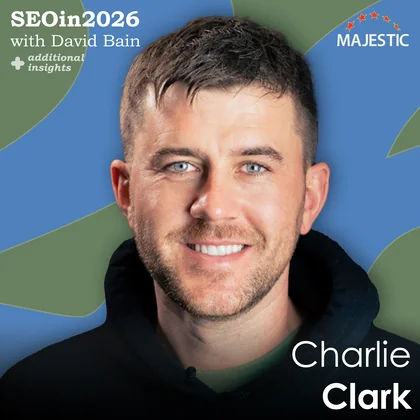
Charlie Clark
Charlie Clark shares that as we move towards an AI search-first world, brands should move beyond "links for links’ sake" and focus on semantically relevant brand mentions that align with key topics and entities, helping AI engines better understand, associate, and prioritise them in results.
« Back to Additional insights
More Additional Insights



Charlie says: “My tip for SEOs in 2026 is that, as we're moving towards an AI search-first world, brands need to be moving beyond building links just for links’ sake. Also, they need to be focussing more on semantically relevant brand mentions and links that align with key topics and entities.
The idea behind this is that this is going to help AI engines better understand, associate, and prioritise you in results.”
We'll get to the positive aspects of what you shared as a tip there in just a second.
One phrase that jumped out was ‘links for links’ sake’. What's an example of a link for links’ sake?
“In the last few years (and definitely in 2025, we've seen the conversation change), the number of briefs that we had, and agencies (including ourselves) would sign up to, would-be link quantity targets.
People will go after, ‘Let's get X amount of DA (80, 70, 50) because our competitors have it.’ The key element that you're missing here is that quantity doesn't always refer to quality.
As we move into this world, where AI search engines are much better able to understand how these links are relevant to your site, this is where companies are going to have to make a big shift in how they approach their link-building strategy.”
Are you still having to educate clients on the fact that there isn't as great a need for links for links’ sake, or are you still getting many requests like that?
“It's definitely slowed down, and I think the trouble that you have is: How do you conceptualise the value of a link to a client? Before, the easy way to do it was quantity and (for argument's sake/simplicity's sake, for this conversation) power.
We all know that DA/DR can be manipulated, but it was always a metric that we could pin to a KPI or pin to a target, and something that was tangible. What we're really trying to explain is something that I talk about a lot nowadays (not even just with AI search engines; Google's been doing this for years). The problem we've had is that it's been relatively easy to game the system, so to speak, just by focussing on the power of backlinks.
However, with AI search engines, what we're seeing is that they're much better at connecting the dots. We work with a lot of travel brands. We want to be featured on travel websites, talking about travel topics. The reason for that is that, when users are asking questions about said topics into AI search engines, they're much more long-tail, they're much more in-depth, and those search engines need to be returning the right results.
If I've been pushing my campaigns across every single website across the web, or random sites just for the authority, I don't think that's going to get people the results that they want.”
One other thing you mentioned was semantically relevant brand mentions. How do we focus on that moving forward?
“What it all comes down to is the strategy behind how you go about not just link building, but also brand mentions/citations. We're not just talking about a backlink here. We're talking about where your brand is positioned across the web.
What brands really need to start doing now – and what they always should have been doing, to be completely honest – is thinking, ‘Where is my audience consuming their news? Where is my audience going to be reading? Is my brand topically relevant? What stories can we create about that, and where can we place them? Where can we place our brand that fits naturally within those topics or within those placements on the web?’
Again, if we're thinking about this from how briefs tend to have been. Not all briefs are like this, but we did see a lot of them over the last few years, where people would come to us, and they'd say, ‘We need X amount of this,’ and we'd be like, ‘Why? Who's told you that?’ and they would say, ‘Semrush report, previous SEO, X, Y, Z.’
It's hard because you have to educate. Normally, for the people that come to us with the briefs, the brief doesn't always directly come from the client themselves. Normally, it's coming from the CMO or someone above, who's read this or had this somewhere else. It is an education that you have to go through.
Sometimes, the easy option would just be to say yes to the quantity. That sales process can sometimes be a little bit more drawn out as you go through that education process.”
I like the fact that you're talking about that. I think it's an important part of delivering a successful modern SEO service, and ensuring that you don't have clients get fed up with SEO or fed up with you because if you just listen to what they're asking you to do and you deliver on that, it's not necessarily going to help them reach the ultimate goals that they're looking for.
What are one or two ways that you go about pushing back on them when they're all set on what they're asking you to do?
“The ways that we do it – it's not always straightforward, every case is different. One of the first things we do, if it's focussed on purely DA, DR or Trust Flow, for example (that used to happen a lot: ‘We need X amount of this variation’), we would show them how that can be manipulated; how a website with a high DA, DR or TF doesn't necessarily mean it's quality.
All you have to do is start looking at basic third-party metrics like the volume of traffic over the last 12 or 24 months. Are there any sharp drops? We've seen sites that have gone from DA 0 to 50 in a matter of months, and it's just a sharp increase, and then it drops again. When you show people the back end on a screen share, and just show them a little bit of why that doesn't work, and then you can run them through some case studies of strategies that you've implemented that have worked – not just focussed on getting the links, but actually business outcomes as well, which is a real big gap that I think people miss.
People will say, ‘We need X amount of links.’ You can deliver it, and then it's like, okay, now what? What happened? You attribute that to any actual viable business goals. If you go back to the C-suite and say, ‘Hey, look, we delivered this,’ how does that equate into business revenue? It doesn't. It's very, very hard to link up. You need to look at the bigger picture.”
In terms of strategies that you recommend that work now, to me, the phrase ‘semantically relevant brand mentions’ tends to allude to digital PR.
Is that a lot of what you're focussing on nowadays?
“It is a lot of what we focus on. One example is that we work with a Greek luxury villa rental company. Their main market is the US.
One thing that was interesting (this actually wasn't initially part of the strategy, but I think it perfectly conceptualises the benefits of running relevant brand campaigns or relevant link building campaigns), what we were doing is that we were running studies, pulling data, and running a series of campaigns that were highlighting why Greece was one of the most affordable yet luxury destinations for Americans to travel to, in the US.
We ran some campaigns with some really great coverage and really great links that were all really, really good in terms of brand relevancy. What we started seeing was that, when we started searching on ChatGPT, AI overviews, and a few other AI search engines, when we were typing in keywords or search terms related to these topics, the brand was not only mentioned in those top results, but it was sometimes the only source that was referenced from the top results.
Say, for example, if you type in ‘top 10 European destinations on a budget,’ it would say ‘Bulgaria, France, etc.’, and then Greece would come up, but our brand would be the only one referenced in the source, and it would link to our study. You can see there how that campaign, and the authority that it was able to build from the coverage we were securing, was helping influence those results in AI search, but also in traditional search engines as well. It's definitely the strategy.
When it's done right, it's more cost-effective for the brands as well. If you get these campaigns right, the benefits you get from them are incredible.”
That certainly sounds like a wonderful outcome. One of the phrases that you just used is, ‘when it's done right’.
Obviously, an SEO's job is all-encompassing nowadays, and it's important that they really understand the true purpose of the brand/entity to begin with, and then work out the key topics that are likely to resonate with the audience that is likely to want to purchase any products and services in relation to the entity, and then create a digital PR campaign in relation to those key topics that are likely to resonate.
Is it an SEO's job to do all of that? What steps do you follow to try and ensure that your campaign matches what the entity represents?
“I think it is. As we move into 2026, this is part of the SEO's role because it's part of the ever-evolving landscape, and AI search is part of the evolving landscape.
I was looking at some studies this morning, actually, before this call, and it's still a long way off, and I am sceptical. I'm not one of these people who think ChatGPT is going to replace Google. I think, with AI Mode, Google are doing a very good job of catching up, and I still think there's a massive place in traditional search for users. The adoption is nowhere near what people are making out, so far.
Either way, this is a channel where people are finding and consuming information. Our job, as SEOs, is to make sure that our brand is visible where people are searching. That doesn't just mean Google; that means across the web.
How that ties in to the digital PR side of things is, to me, this all comes down to the content strategy. Whether you call it link building, PR, or content marketing, this all falls into the idea that you should be creating organic content that's not just driving direct traffic from the search engines, but also picking up links and picking up citations – not even just from outreach as well. If you build the right campaigns, you can just build links naturally from people looking for sources and references.
I really do think it's part of the SEO's job to make sure this is part of the ever-evolving profession that we find ourselves in.”
Does this help to educate AI search engines as well, if we’re building the right content and we're ranking in traditional search engines? Does it assist with educating AI search engines about what our brand is about?
“I think so. The way that these AI search engines work (well, one of the ways they work) is they work with knowledge graphs – with NLP, and the way that they link the information together.
The way I see it, and a lot of people see it, is the fact that we're trying to build a web of information, and we're trying to link the entities together.
Whether it's a traditional or an AI search engine, if I've got a travel brand and there's a digital footprint of various travel brands over time on big publications like Forbes talking about us, talking about travel topics, linking to us, and citing us, then that's going to build that digital footprint and build that relevance over time. It's something that just needs to be part of the equation.
It's no surprise to me that the brands that have been doing very well with SEO over the last few years are the ones that are prioritised in AI search results. We know that some of them use Bing. It's similar algorithms. The whole Reddit thing is another discussion. It's the way people need to be moving.”
Lastly, how do we measure success in a world where people are using many different platforms to interact on and discover new content, and it's more challenging than ever to obtain the data in terms of what people are doing and what those interactions are?
“This is a tough one, right? Attribution is not a recent issue. For the last few years, people have had issues whenever it comes to attributing success to campaigns.
With our clients, we always try to communicate with them to look at the bigger picture. That doesn't mean that we're going to start claiming success from paid channels or any other channels, but as part of our reporting, we do look at: Is there an increase in brand traffic? We don't just need to be looking at clicks and impressions, right? There are other elements that a lot of SEOs miss.
If we just focus on clicks and keyword rankings, I don't think agencies and freelancers are going to keep their clients very long because the metrics will be going down. The key thing for us is, whether it's revenue or number of leads, how can we equate that to the bigger picture and tie that all together from other channels? For us, that's the main thing we focus on.
Another big opportunity that we've seen now (and I think a few of these tools are still a far way off the mark, from what they need to be) is these LLM trackers. There are a lot of LLM trackers that have been released now that are actually almost the new rank tracker. We're finding that our clients are finding them very, very interesting, and really, really useful to understand how people are finding out about their brand.”
Are you able to name one or two of them?
“There's only one I can really vouch for at the moment: LLMrefs. That's the one that I really like at the moment. I've tried a few different ones, and I don't want to say bad things about any of them on the podcast. I've not tried them all, but that is the best one I've tried so far.
What I like about it is that it shows you the prompts, it reverse engineers the prompts, and then it shows you the sources of where the prompts are being sourced from. What that allows you to do is almost reverse engineer where you're getting your citations from, and again, help position you in those places where your audience is reading.”
Charlie, what's the key takeaway from the tip you shared today?
“Focus. If you're running any kind of concept marketing strategy or link-building strategy, it's been said many times over the years, but it's more important than ever: Keep things relevant.
Don't create thousands of pieces of content just for the sake of it. Just make sure that everything you're pushing out is relevant to your brand and the campaigns that you're doing, and they’re on relevant websites. Ultimately, that is the way that people are going to get success.”
Charlie Clark is the CEO at Minty Digital. Find out more over at MintyDigital.com.
Choose Your Own Learning Style
 Video
Video
If you like to get up-close with your favourite SEO experts, these one-to-one interviews might just be for you.
Watch all of our episodes, FREE, on our dedicated SEO in 2026: Additional Insights playlist.
 Podcast
Maybe you are more of a listener than a watcher, or prefer to learn while you commute.
SEO in 2026: Additional Insights is available now via all the usual podcast platforms
 SEO in 2026
Catch up on SEO tips from 117 SEO experts in the original SEO in 2026 series
Available as a video series, podcast, and a book.
Fresh Index

Unique URLs crawled
194,181,258,261
Unique URLs found
618,029,643,510
Date range
07 Apr 2026 to 05 Aug 2026
Last updated
56 minutes ago
Historic Index
Unique URLs crawled
4,502,566,935,407
Unique URLs found
21,743,308,221,308
Date range
06 Jun 2006 to 26 Mar 2024
Last updated
03 May 2024
