-
Site Explorer
- Majestic
- Summary
- Ref Domains
- Backlinks
 New
New- Lost
- Context
- Anchor Text
- Pages
- Topics
- Link Graph
- Related Sites
- Advanced Tools
- Author ExplorerBeta
- Summary
- Similar Profiles
- Profile Backlinks
- Attributions
- Compare
-
Link Tools
- My Majestic
- Recent Activity
- Reports
- Campaigns
- Verified Domains
- OpenApps
- API Keys
- Keywords
- N-grams Near Links
- Keyword Checker
- Search Explorer
- Link Tools
- Bulk Backlinks
- Neighbourhood Checker
- Submit URLs
- Experimental
- Index Merger
- Link Profile Fight
- Mutual Links
- Solo Links
- PDF Report
- Typo Domain
- TLD Checker New
- Free SEO Tools
- Support


Why are journalist request platforms so important for SEO?
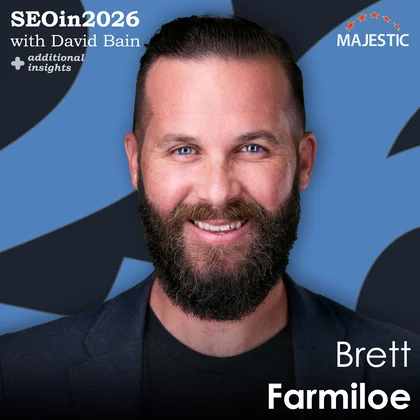
Brett Farmiloe
Brett Farmiloe shares insights on leveraging journalist request platforms for SEO and PR in 2026, emphasizing authenticity, quality, and strategic outreach.
« Back to Additional insights
More Additional Insights



Brett says: “Use journalist request platforms to share your expertise and land media placements.
Ultimately, there are a lot of different journalist request platforms out there, and everyone's got knowledge or expertise to share, and journalists and publications find value in that expertise, so share it.”
If an SEO is listening to this, and they haven't heard of or actually used a journalist request platform, what is one and what does it do?
“Journalists need sources for stories and, oftentimes, when they don't have the Rolodex to satisfy a particular story, they'll turn to a journalist request platform with a particular request.
Say they need to get connected with a very specific source on deadline. They'll put that request out on a platform, and then sources can analyse those requests and reply to the ones that make the most sense.
Journalists can then connect with the source, they can interview them, they can take a quote directly, they can put it in their story – and oftentimes there's attribution back to the source, which is beneficial for both the journalist (because they can push their story across deadline), and then the source ultimately gets cited.”
It would be great to get a feel for what you do, because obviously you run a journalist request platform. You're the founder of Feature.com and you've relatively recently purchased Help a Reporter Out (HARO) as well.
What do those two different platforms do?
“Help a Reporter Out (HARO) is a journalist request service that’s been around since 2008. Three times a day, we will email a summary of journalist requests that we've received, and this is the most popular journalist request source that's been around for decades. Most folks in PR and SEO know of HARO.
We also run Connectively, and Connectively is a journalist request platform that's essentially HARO in a platform.
Then, we also run Featured, and Featured is a co-pilot for public relations. You get connected with (beyond journalist requests) byline article opportunities, journalists to pitch, podcasts to pitch, and a variety of other different media forms.”
You talk about different media forms there as well, like podcasts to pitch. So, it's not just traditional press we're talking about here?
“Yeah, it's everything from speaking opportunities to award submissions to anything that really falls under the PR or SEO umbrella.”
How would an SEO who’s looking for content on a particular subject on their own website use this? Is that a good use case for it?
“Absolutely. The most popular customer/user that we see is typically an SEO agency or an in-house marketing team looking to do SEO themselves.
If you, for example, go to Connectively.us, you're going to see hundreds of different open opportunities, and if you're on one of our paid subscriptions, then you can filter by domain authority and whether or not there is a dofollow or nofollow link associated with that opportunity.
You could essentially say, ‘What are my highest value dofollow opportunities?’ and find the opportunities that make the most sense for you or your clients. You're basically identifying the opportunity and then responding in four to eight sentences, and trying to be very helpful to the other person on the opportunity, at the opposite end.”
Is there a challenge with AI in these platforms, because obviously AI can produce content quickly and easily?
Is there a challenge with AI replacing people or creating fake authorities in a particular subject or, by and large, are we talking about real people that are featured here?
“It's a great question. The reason why HARO ended up in our ownership in the first place was a decline of quality and trust within the system, and a lot of that was targeted through the adoption of artificial intelligence.
When we acquired HARO and brought it back, that was at the core of our mission: How do we maintain and restore the quality and trust behind it so that these connections between journalists and sources are authentic?
In regard to AI, there are a variety of different things that we've done. One of them is AI detection on every single pitch. We'll run a quality score on every pitch that goes through our platform – whether that's HARO, whether that's Connectively – and we'll allow journalists to see those scores. If it's 100% AI-generated, the journalists will see that. They've got a one-click filter (if it is 100% AI-generated) to just opt out of those pitches entirely. That's one way that we help make the connection authentic.
Then, in regard to identity and things like that, there's a long list of stuff that we've done to make sure that these are authentic, real people responding to real, authentic pitches from journalists – on both sides.”
I think you mentioned you had a paid tier where you can easily filter different opportunities as well, and you can also get emails sent out to you to summarise the latest opportunities that are available.
Is the best way to take advantage of platforms like this to be on those lists and jump in immediately once you've received the opportunity, to ensure that you're one of the first people to pitch to submit some content?
“I think the best practices for using journalist request platforms actually follow the HARO acronym (I'll introduce something cheesy, but I think that it works). HARO: be Helpful, be Authentic, be Relevant and be On time.
Being helpful is essentially showing that you've got something of value to offer the journalist. They're trying to write a story. If you can be helpful in writing that story, that's a win. Being authentic is just not using 100% AI-generation to respond to these journalists.
Being relevant is that journalists will, in a very detailed fashion, list out the instructions on a submission. Sometimes they want an exact subject line. Other times they want something specific in their pitch that will help them do their job. It’s about following those instructions and being relevant, as well as making sure that you actually have their credentials. That’s super important.
Then, being on time: understanding that these journalism publications oftentimes are working on deadline. It's not necessarily being the first in line, but it's being at the top of the line with the best credentials and the most helpful response.”
Those are some great tips there. It was interesting that you said that journalists were looking for something specific, be it a subject line or the way that a pitch was actually received by them. I guess many people don't read instructions properly, and that's a great way of filtering initially.
Is there anything else that journalists tend to look for in terms of, for example, experience in a particular sector?
“Yeah, I think it always goes back to the actual query and the actual story that they're writing. Sometimes it's a more general article that relies on experience, so oftentimes storytelling in your pitch is very important.
Then, other times it is all about the credentials. They need someone who specialises in a specific area of health and needs to be licensed in a particular geography and has to have the experience, so leading with credentials and why you're qualified is important in that scenario.
Again, it just goes back to the particular instructions that a journalist has listed, and then trying to reverse engineer what that journalist is actually looking for.”
I guess an outreach specialist could take some tips from this to reach out to podcasters or journalists directly.
What's some generally great practice that works now, in 2026, in terms of outreach to actually get people to open the email that you sent them?
“Less is more in 2026, in terms of being an outreach specialist. What we've seen is that AI has made it incredibly easy to reach out to more people, and it's made it more noisy and less effective as a result.
The outreach that I'm seeing winning on our platforms is the folks who aren't sending out a higher volume of pitches, but they're sending out a higher quality of pitch. What that means is you could use AI to do extensive research and not have to spend hours listening to certain podcast episodes to figure out what the latest thing is that the host is talking about. You could use AI to summarise that and better inform your pitch.
When it comes to outreach, less is more in 2026. It just has to be very targeted to the right person at the right time.”
That's a great tip: use AI to analyse a recent episode. You can get a transcript of it relatively easily, perhaps show notes as well, and pick out one particular element that's been in an episode that you can say has resonated with you.
I get pitched loads of times (as a podcast host), ‘I'd love to be on your show,’ and then they rattle on about what they've done or what they'd like to talk about without actually knowing what's relevant for the show.
If you can say something specific like, ‘I love this element of your show, I'd like to talk about something similar, which is this,’ then it makes it much more likely that I'm going to be replying to them and engaging with them and probably having them on as a guest.
“Totally. When you're doing the outreach, it's: How do you help that podcast host do their job more effectively?
If you're doing AI analysis to figure out what the trends that this host is talking about are, and not necessarily just saying, ‘Hey, because you've talked about this and we can also talk about this, we're a good fit for the show.’ I think it's actually one step deeper: to figure out the overall trend and trajectory that the show is heading. Then, how do you fit into this gap of coverage that hasn't been covered yet, that's still in connection with that line of what the topic is?
That’s where I think it gets really interesting: the forecasting of outreach – and that applies to podcasts, and it applies to journalists. You could see a journalist covering a specific beat and then try to fill in the gaps of what the next story is that that person's writing, so they have a complete narrative.”
You also mentioned that, on the premier version of your platform, you can filter by elements like domain authority. I guess that's one way to measure how successful what you're doing has been or is likely to be on something like SEO.
What are some other metrics that you would encourage people to look at in terms of measuring whether or not what they're doing with you has been a success?
“That's a really good question.
In 2026, the metrics are changing. AI visibility scores are one thing that we're seeing more and more innovators measure against. It's not just an increase in how authoritative their domain is, and it's not just an increase in overall search engine result pages and keyword increases. It's really around: Is my brand visible in AI and LLMs?
There are a variety of different platforms that are emerging that help quantify that, but more and more we're seeing marketers start to shift their metrics towards the new front page of the internet.”
Is difficulty with measuring whether something has been a success or not making it more challenging to persuade decision makers to give this form of marketing a serious go?
“It's not just the metrics that you could take executives back to for journalist request platforms in particular; it's also what you do with it.
When you land a media placement, and you're on a great brand like Fast Company or Inc., how are you taking that placement to your sales team and helping those sales efforts become quantified? In terms of reaching out to prospects and saying, ‘Hey, we've been featured on Inc. Here's an article. Here's our CEO talking about a particular thing that we've been talking about in our sales conversations.’
With anything, there's a primary focus, and the primary focus of using a journalist request platform is better visibility online. But then there are all these secondary elements to say: Is this helping with my sales conversations? Is this allowing our executive team to now go out on social media and share more information that's relevant and helpful for their followers?
With anything, 2026 is a really confusing time, and it's not so much a black-and-white scenario. How do you start to fill in some of those blanks with the initiatives that you're doing?”
How does this fit in with other marketing activities or channels? There are so many things that modern marketers or modern SEOs can be doing, and there are lots of different forms of content.
Do you sit down once a quarter and actually determine what your strategy is likely to be and how often you're going to engage with a platform like yours? Or does it have to be just done reactively?
“It's almost like working out. It's something that we've seen a lot of our customers calendar 15 minutes every single day to, just to see what the latest is from these journalist request platforms and then decide to act on certain ones that are relevant. I would say that journalist request platforms in particular are more of a regular cadence and a regular activity that you practice to make sure that you never miss an opportunity.
If you miss an opportunity that is perfect to talk about what you do in a high-value publication, that's a pretty big miss. Most of our customers use our platforms every single day because it's such a high-value-added activity.
That said, it does take a lot of time, which is why I think that using a monitoring service to ingest all the different opportunities and be alerted is a really smart way to save time and get those placements.”
Is this an SEO role or a digital PR role or a blend – or are the two roles the same nowadays?
“I think everything's blended these days. The job titles that we see subscribe range from PR Manager to Digital PR Specialist to Outreach Manager to just a do-it-yourself Founder.
It's pretty interesting. The thing that I really like about where we're at in 2026 is that PR is accessible. It's accessible by people who have knowledge to share, and that's a really good thing and a net positive for the world.”
Brett, what's the key takeaway from the tip you shared today?
“The key takeaway is that you have knowledge to share, and that knowledge is highly valued by journalists and publications.
Find a way to share that knowledge, and if you share your knowledge in a meaningful way, it will benefit your business.”
Brett Farmiloe is Founder and CEO at Featured. Find out more over at Featured.com.
Choose Your Own Learning Style
 Video
Video
If you like to get up-close with your favourite SEO experts, these one-to-one interviews might just be for you.
Watch all of our episodes, FREE, on our dedicated SEO in 2026: Additional Insights playlist.

 Podcast
Maybe you are more of a listener than a watcher, or prefer to learn while you commute.
SEO in 2026: Additional Insights is available now via all the usual podcast platforms
 SEO in 2026
Catch up on SEO tips from 117 SEO experts in the original SEO in 2026 series
Available as a video series, podcast, and a book.
Fresh Index

Unique URLs crawled
194,181,258,261
Unique URLs found
618,029,643,510
Date range
07 Apr 2026 to 05 Aug 2026
Last updated
56 minutes ago
Historic Index
Unique URLs crawled
4,502,566,935,407
Unique URLs found
21,743,308,221,308
Date range
06 Jun 2006 to 26 Mar 2024
Last updated
03 May 2024
