-
Site Explorer
- Majestic
- Summary
- Ref Domains
- Backlinks
 New
New- Lost
- Context
- Anchor Text
- Pages
- Topics
- Link Graph
- Related Sites
- Advanced Tools
- Author ExplorerBeta
- Summary
- Similar Profiles
- Profile Backlinks
- Attributions
- Compare
-
Link Tools
- My Majestic
- Recent Activity
- Reports
- Campaigns
- Verified Domains
- OpenApps
- API Keys
- Keywords
- N-grams Near Links
- Keyword Checker
- Search Explorer
- Link Tools
- Bulk Backlinks
- Neighbourhood Checker
- Submit URLs
- Experimental
- Index Merger
- Link Profile Fight
- Mutual Links
- Solo Links
- PDF Report
- Typo Domain
- TLD Checker New
- Free SEO Tools
- Support


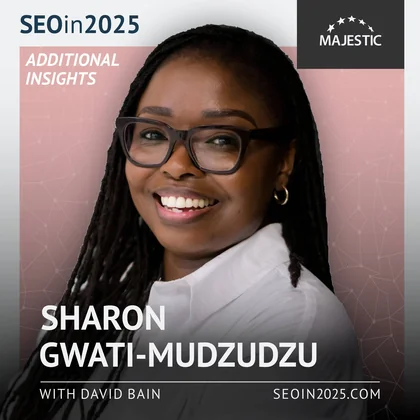
Combine SEO tactics with data insights to personalise the user journey
Sharon Gwati-Mudzudzu
Sharon Gwati-Mudzudzu discusses the importance of understanding user intent over traditional keyword strategies.
« Back to Additional insights
More Additional Insights



Sharon says: “My additional insight is that SEO should embrace behavioural data to optimize and improve the user journey.”
Why do we need to combine SEO tactics with data insights?
“It's pretty simple, to be honest. We've got AI causing havoc in literally every industry. So, you are either using it, working with it, or trying to adapt.
In a very practical way, a lot of SEOs and a lot of companies cannot keep up, but the thing that we can use is the data that we own.
Using our own owned data can inform us about our customers, it can inform us about what they're looking for, and it can inform us about how we can best serve them, if we know how to use that data properly.”
Okay, so you say the data that we own. What data comes under that umbrella?
“Depending on how this is set up, that's usually the biggest issue. People don't know what they don't know.
In most companies, we have a general analytics software. Either it is Google, it is Adobe, or it is whatever else is new out there. We usually have an insight into the analytics of our websites. We have tools like Search Console. We've got tools like Majestic, Microsoft Clarity, etc.
These are all the tools that we can use to optimize, to guide us, and help us gather the data that we need to make informed decisions when we work on our sites.”
Microsoft Clarity is obviously a tool that can make sense of what users are doing on our website. Is that what we're looking to track?
Are we looking to track user behaviour and what users do on our website in order to actually better inform how we should plan our websites for future activities?
“Yes. With the recent changes in how we've got AEO and how AI is serving people, not only full results, but all the information they need before they need to click, in most cases, the need to click onto a website has just gone away.
We've got LLMs like ChatGPT, Perplexity, etc. They are answering people's questions. So, when you actually do get a person that comes to your website, it works to your advantage to understand their journey, to understand their need, and be able to tailor their journey so that they either get the information they're looking for or they convert easily for you – whatever a conversion is.
Using data that we get from Hotjar and Microsoft Clarity, we are able to follow the user through their journey and understand, do they spend much time on a page? What are the hot points? What are the areas that they actually focus on? What is the word or section within the website that causes them to make a conversion? Or what is the section on the website that causes them to leave?
As an SEO, that is what you focus on. What is driving people to make a conversion or to go to the next stage? What is the thing that is making people fall off? Then you start to work from that to make sure that the next journey is more beneficial to your bottom line.”
Why is this an SEO's job? It sounds like a CRO job, or some kind of user experience person's job, to make sure that the user is most likely to converse, and you're serving them with the right information.
Traditionally, SEO was about driving traffic, wasn't it?
“That is the brilliant part about this. SEO is changing. It's not dead – I always say that. There’s a little white flag. It's still alive, and it's going to be alive for a long time.”
But a white flag is surrender, though, isn’t it?
“For peace! Let’s keep it alive.
SEO, when I look at it, it's changing, and we need to be more effective. We need to look at working with CROs, working with our UX developers, and working with the people who can get us clean data. So yes, your job is to get people to the site, but if the people are coming to the site and not staying, that's not a job well done, is it?
At the end of the day, you do want to drive them so that they come to the site, and they get the information they're looking for. We are focusing on intent. What is it that brings them to the site? Let's serve it to them in the way that they will take it in, and then they will make the decision they need that will give us a conversion.
That is wholly an SEO journey, but it does work with other departments. I think that's what is going to make it more effective for a lot of SEOs doing their work.”
The metrics that are obviously very important from a marketing perspective, and from a business success perspective, but how do you actually tie this back to SEO success?
Can you, for instance, tie back any improvements in ranking due to an improved user experience performance?
“That's the other thing, when we're looking at the metrics. We've had traditional SEO metrics – we're looking at ranking, and we've been looking at sessions, and we've been looking at maybe impressions on the page and on the site. They are metrics that still matter, like click-through rate. We still need people to get to the site, and when we do have the clicks, when they get to the site, what is the end of that journey?
Are they converting? Are they falling off? This is what tells us that, okay, this page is effective. When there's an impression, we know that the page has been indexed, and it is ranking. When they click, we know that they have found the title, the meta title, and the meta description to be effective. That's an SEO job. When they go to the site, we've got the sessions. That's all organic, and that is all for the SEO.
Now, when they land on the site, if our bounce rate is high, it means they're not staying on the site. It means that they're not finding it valuable. So, we now need to improve on that and see how they work on it.
Then other additional metrics, like time spent per session. What are they doing? What are they then doing when they're in those sessions? Are we getting conversions? This comes back to, what is the journey that you are creating with the SEO work that you're doing? We're not just chasing keywords. It's not working anymore. We're looking at intent.
If a person's intent is to find information, are you serving it in a way that makes them want to know more or get what they need? If their intent is conversion, have you given them enough within that SEO journey for them to make a conversion? We cannot work blindly. We do need the data. We do need those numbers to be able to make that as seamless as possible for every user that comes to the site.”
What are your tips, your pieces of advice, on how to best determine the likely intent that a user has when hitting your website, and how to serve that intent?
“The first thing is to understand who you're talking to. You need to understand the profile of the person who's coming to the site.
I work with a lot of B2B companies, and all my work is B2B, but a lot of these tactics and frameworks do work for e-commerce, and they even work for a small business. I think they should be used more in small businesses because they have a lot more to lose if they don't do it properly.
Understanding the user profile helps you to be able to guide them. If a person is a decision maker, they are looking for certain things within that journey. If they're going to be signing the check, they need to understand certain things within that journey. They need information that qualifies it as a purchase for the business. If a person is buying a pair of trainers, if they are coming to it, they need to see the reviews. They need to see different colours. They need to combine it with other outfits. That's for e-commerce.
If you understand who the customer is, it helps you to be able to know what the intent is – and, when you know what the intent is, you then design your journey – and you design your content, your call to actions, and your internal linking structure – based on what that person is looking for.”
In terms of likely intent, do you try to establish likely intent based upon the keyword phrase that they use to find your site?
“It's very helpful too. The problem is, you might not have all the resources to be able to focus on basic intent and likely intent. If you've got resources, it could be that, in Q1, you focus on basic intent. We know that people want to buy white trainers, for example, so let's make sure that when they come, they will buy white trainers.
But if you've got something that's viral on social media, a different colour perhaps, it's likely they might be interested in that, but it's not long-term.
If we've got more searches and more intent for something, we focus on that because the data proves that this is what we get as a conversion. But if it's a trend, and it's something that's just going on for the next 2-6 weeks, then we can give it the time that gives us a gain in six weeks.”
You also talk about the importance of personalising the user journey. How do you go about doing that?
For instance, are you talking about doing split tests on individual pages and serving different content to different users depending on who they're likely to be? Or are you talking about simply having different landing pages and paths through your website, based upon who you think you're going to be targeting?
“It would be ideal to just have a different journey for every single person that could come, but everyone knows there's no time for that. So, I would start by segmenting by intent – segmenting the website or segmenting the content, if you are focusing on selling one service.
We segment it by intent: who will likely want to look at this? Are they coming to get information or to make a decision? If they're coming to get information, we give them a landing page that gives them the information. Take them to a page that will support what they've read.
In terms of a SaaS business, we are selling one service. Why is it beneficial that they get that service? We then put in internal links to the integrated platforms or sections that are beneficial to that site. They now have all the information about the service, with the integration and everything that they need for the service that we're trying to sell them. When they drop off, and they decide at a later date to come and then make a purchase, they already know that their informational journey is finished.
If it's a conversion, if we segment it by conversion, we know that this person has been on the site. They have looked at this. Where do we start them off from? We pick it up from, ‘Okay, this is a summary of what this product does, and what the next steps are.’ We're now giving them pricing. We're now giving them a video to watch to say, ‘This is what the platform does.’ We are giving them an option to buy or book a demo or talk to someone who's currently online.
Segmenting by intent is the best way to say, ‘Let's create all our content knowing who is coming and why they are coming.’ If they are coming for this streamline, then we have that content. We've got particular calls to action. We've got our internal linking structure based on that. Even our schema markup is based on what that intent is. We then go through every vertical that we have in terms of intent.
That is far easier than us defining a person as ‘a person in X company’ or ‘a person in Y company’. If you start with intent, it simplifies the whole process.”
When you talk about segmenting by intent, is this something that can be done automatically using some piece of software or AI, or is there a lot of human involvement in order to do this?
“Oh, there's AI for everything, isn't there? There are software platforms that do allow you to say, if a person is using this keyword, then the intent is they're looking for information. If a person is using this keyword on your website, then it's navigational or it's a conversion.
I find that the most useful way to be able to judge intent is, within a company, if you work with your sales people and your customer services, they understand the customer and the customer profile way better than we do in marketing – because they know who they've sold to. This is sales, and when we look at customer service, they know who has churned.
Understanding who stayed longest, how they stayed, and what that relationship is gives us what the intent is, because if we're tracking data from end to end, we know how we got them in the initial journey. We now know that, for a certain particular keyword, keyword structure, or key phrases, this is informational, this is for conversion, or navigational.
So, yes, you can use AI, but talking to the people that you work with, I find, works better.”
How does this all fit into a strategy – what you've discussed about using data in your website to power your user journey and SEO decision making?
Is this something that has to be done every day, in terms of just an analysis of data and then tweaking of what you're doing? Or do you tend to sit down more methodically on a monthly or quarterly basis to review things and build a new strategy from this?
“Depending on resource, firstly, and the size of the business. Usually, you need to have an annual plan.
We know that the business needs to make God knows how much money in that year, and we can work it back to say, for them to make this much money, what do we need to do in this quarter? What do we need to do in this month? For us to be able to get that (I will talk from a SaaS business perspective), we probably need to get 100 people talking to each salesperson. To get 100 people talking to each salesperson, how many people do we need to get in the pipeline?
So, we work with those numbers, and then you start looking at your historical data to say, for us to be able to get the 20 people to come to the website, how did we do that? What were the keywords that they used? How long did they stay? How long was that journey? What can we do to shorten it? There are always plans, and there's always an overall strategy that we need to look at.
The numbers usually guide us to say, we need to hit these numbers, and then with that, we know that, for whatever strategy we are doing, there are things you can tweak every day.
If you are working on creating content, if there is potentially something that's happened in the business or in the country, that can be beneficial. Instead of writing 10 pieces of content that will give us someone five days down the line, if we can do something reactive and get our pages to be ranking today, then we can do that (okay, not today, but sooner than what we would have done with other pages).
There are areas that you can be able to tweak as you go on, but usually the guiding numbers –the main principles – don't change, because if you change those, you usually do tend to lose focus. What can be changed, and what can be done on a day-to-day basis, shouldn't be set in stone.
Looking at the numbers, if we've had a surprise rise in a keyword because someone has done something on social media, use it. If we learn something from the social media team – they tell us that something is trending, and we can do something to support their campaigns – we use it. If the paid team say they've got something that's working and we can use it, I have no issues in using it.
The main guiding principles, the big numbers, don't change, but it is the operational tactics that should be able to be changed as and when there's any opportunity.”
Sharon, what's the key takeaway from the tip you shared today?
“Let's stop chasing single keywords. Let's focus on intent and use the data available to us to create better journeys for the customers on our site.”
Sharon Gwati-Mudzudzu is the Demand Generation Manager at Agilio Software. Find out more over at AgilioSoftware.com.
Choose Your Own Learning Style
 Video
Video
If you like to get up-close with your favourite SEO experts, these one-to-one interviews might just be for you.
Watch all of our episodes, FREE, on our dedicated SEO in 2025: Additional Insights playlist.
 Podcast
Maybe you are more of a listener than a watcher, or prefer to learn while you commute.
SEO in 2025: Additional Insights is available now via all the usual podcast platforms
 SEO in 2025
Catch up on SEO tips from 106 SEO experts in the original SEO in 2025 series
Available as a video series, podcast, and a book.
Fresh Index

Unique URLs crawled
194,181,258,261
Unique URLs found
618,029,643,510
Date range
07 Apr 2026 to 05 Aug 2026
Last updated
56 minutes ago
Historic Index
Unique URLs crawled
4,502,566,935,407
Unique URLs found
21,743,308,221,308
Date range
06 Jun 2006 to 26 Mar 2024
Last updated
03 May 2024
