-
Site Explorer
- Majestic
- Summary
- Ref Domains
- Backlinks
 New
New- Lost
- Context
- Anchor Text
- Pages
- Topics
- Link Graph
- Related Sites
- Advanced Tools
- Author ExplorerBeta
- Summary
- Similar Profiles
- Profile Backlinks
- Attributions
- Compare
-
Link Tools
- My Majestic
- Recent Activity
- Reports
- Campaigns
- Verified Domains
- OpenApps
- API Keys
- Keywords
- N-grams Near Links
- Keyword Checker
- Search Explorer
- Link Tools
- Bulk Backlinks
- Neighbourhood Checker
- Submit URLs
- Experimental
- Index Merger
- Link Profile Fight
- Mutual Links
- Solo Links
- PDF Report
- Typo Domain
- TLD Checker New
- Free SEO Tools
- Support


Combining SEO and CRO and growing collaboration between these functions
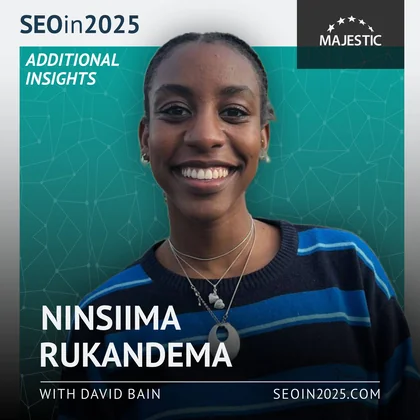
Ninsiima Rukandema
Ninsiima Rukandema emphasizes the importance of collaboration between SEO and CRO to enhance user experience and drive value.
« Back to Additional insights
More Additional Insights



Ninsiima says: “My additional insight is the value that you can drive by combining CRO and SEO.
SEO tells you a lot about how people are getting to the website and what people are searching for to get to the website, but the experience of people once they get onto the website should align with what they were initially searching for.
By combining SEO and CRO, you can drive value on site once people get there.”
What do we mean by combining CRO and SEO?
Is that having both tasks combined as part of the same role, or are you talking about, if you've got CRO specialists (maybe within a larger organisation), working with them and liaising with them on a regular basis?
“I think it's more about the collaboration between them and sharing insights.
Through testing, you gain insights and learnings about what users are engaging with and what their needs are.
Similarly, in SEO, you understand what people are searching for and where they're landing on-site. Combining those learnings and working together in a collaborative sense allows you to streamline and have a consistent journey for those users.”
What would be an example of an insight that an SEO could get from CRO and not necessarily from working within SEO?
“I think it's more the other way around. From SEO, one can understand what people are searching for to get to the site.
Let's say people are searching for certain information around train tickets; for example, the timings of train tickets and what kind of features come with certain ticket types.
With that learning, and understanding that from an SEO perspective, they can tell the CRO team, and the CRO team can look to optimize the landing page and test having different elements higher up on the page and highlighting different bits of information (such as the benefits that you get with certain ticket types) because of the insight from SEO.”
Okay, so SEO can teach CRO more than CRO can teach SEO?
“I wouldn’t say it’s that way round – I wouldn't say that you can only get more from one – but it is beneficial to get from both, if that makes sense.
For example, the other way round, when testing navigation and seeing what kind of key journeys people go through, it might be helpful to give the insight to SEO because it might direct them to certain keywords they might not be aware of.”
What does this collaboration look like?
If you're working within a reasonably sized company with a large marketing department, with unique CRO specialists as well as SEO specialists, what does liaising look like? Are we talking about having weekly meetings with them or something else?
“If it's an agency-side experience, and working on the same clients, it would be a very collaborative team effort that may include those meetings and one-to-ones.
In a broader sense, it's just sharing and collating those insights and making them accessible to teams – whether you have shared drives where you have insights from certain tests that you ran, that you could flag to an SEO team or a CRO team, that are particularly interesting and of interest to that team.
That's the easiest way to allow these different insights from these different teams to come together and drive value.”
What does this mean for the role of an SEO moving forward?
Are we going to see more SEOs becoming internal consultants to other marketing departments, to try and evangelise the value of SEO?
“I don't think the role of SEO will change in this case; I just think that the role of SEO doesn't have to be just within the SEO team.
It can actually give value to other teams by understanding the insights from what SEOs are gaining.”
If an SEO is approaching a CRO team, what are the reasons that the SEO should give for the CRO to listen? Perhaps the CRO is used to working in their own siloed departments. Maybe they have their own marketing team, and they don't want anything to do with SEO.
What are the main reasons that you have to market to the CRO for them to start to listen to SEOs?
“In terms of thinking about what SEO does, it really understands what people are looking for because it's really understanding the intent of why people are getting to the website in the first place.
Having that understanding of what people's intent is will drive value for the CRO teams because they can optimize the website to meet the needs of what people wanted in the first place, when they came to the website.
So, the collaboration of both of them would drive the most value, rather than both of them optimizing blind.”
I like that answer. Obviously, you're looking into specific user insights and assisting the CRO team to ensure that the right traffic is being driven to begin with.
Obviously, the CRO team can optimize on-page for a better funnel to ensure that users flow nicely through the website but, unless the right traffic comes to begin with, then there's no point in doing that.
“Exactly – and unless the right journeys are given to the right traffic at the right time, by getting SEO's input and by getting insights from SEO.
The CRO team could understand that, for example, the majority of the people who are landing on this ticket page are not landing there to buy a ticket but to get information about tickets. So, we need to make it better for them, and easier for them to get information, rather than trying to drive them into the funnel when they're not actually ready yet.
Understanding the balance of what people's intents are and the places they're landing is the value that SEO can give to the CRO team.”
Have CRO teams not traditionally thought of traffic before it gets to the sites?
Has the traditional way of doing CRO simply been on-site and just optimizing whatever they happen to get?
“The space of CRO is evolving and shifting towards what we call experimentation.
It has more of an emphasis on the learnings that you're getting and not just a narrow focus on driving conversion rate and getting better-performing sites in terms of conversion, but actually a holistic, better-performing experience, and understanding what users need.
With that shift towards experimentation and trying to optimize the whole user journey, getting this understanding of what their intent is early on in their journey helps the CRO teams that are moving on to trying to optimize the whole user journey rather than just for conversion.”
You're talking about things from an agency perspective.
Are you finding that clients are generally fairly open and responsive to you saying, ‘Look, as an SEO specialist, we also need to have conversations about CRO as well. We need to think about the whole user experience through whatever is happening on your website, as well as driving traffic to your site.’?
Or do you have many clients pushing back to say, ‘No, SEO's responsibility is to drive traffic. Just focus on that, please.’?
“I think clients are very open to it, and they're actually way more impressed with this integrated approach.
There was a stat I read the other day, that 50% of users don't go back after a bad experience with a brand. It's really key to try and gain loyalty from users, and that comes from consistent journeys.
From an agency's point of view, when servicing a client, by showing you're trying to look beyond the silo of what you're working on at the whole user journey, it does show that you're trying to create a consistent journey for the users and build a consistent picture of the brand, rather than just trying to tweak and optimize a certain element.”
One of the challenges that an SEO has in focusing on an area like this is the fact that, traditionally, they've been able to do things like build links and improve rankings because of links, and add more traffic being driven to a website because of that. So, what they've done traditionally has been very measurable.
If they start having conversations with CROs and getting involved in more intangibles, then it's hard to justify what they're doing time-wise.
What does this mean, in practice, for measuring the effectiveness of an SEO's time and what they're doing?
“In terms of an SEO's time, as I said earlier, it would just be as simple as sharing the insights that they have. In terms of the time there, it doesn't really take away from that.
In terms of measuring the time and the actual impact that they're driving, let's say, setting aside maybe one or two tests a month, that could be inspired by SEO insights, could be a good way to measure the impact that they are having – because the results of the test would either be a cost saved or a positive impact on the site experience.”
If you do deliver a much more positive site experience – if more people end up inquiring or purchasing something from your business, and you feel that you have improved your conversion rates and your user experience because of that – have you ever been able to tie back improved user experience with an improved ranking on search engines?
“No, just because, with improved ranking, the only way you'd be able to measure that would be through improved click-through, potentially.
In terms of tying a test to an SEO ranking, I haven't been able to do that.”
It's a tricky question, and it's not necessarily something that you can definitely put your finger on and say is part of an algorithm. So, it's a completely fair answer.
User experience is talked about a lot more from an SEO perspective nowadays, and it's important to try and measure the effectiveness of what you're doing as well.
How do you see the space continuing to evolve? Do you think that job functions are going to be combined a little bit more? Do you think that the SEO role is going to become less about driving traffic and more about thinking about the users?
“I don't think the roles themselves are going to change. I think there's value in both of these roles: to really focus on optimizing the on-site experience in terms of CRO and optimizing the search experience in SEO.
Those are very key and will probably stay the same, but it's just the way they work together that will change; in terms of the integration of them sharing insights and challenges and trying to go after problems together, rather than staying in silo.”
You talked about CRO changing into more of an experimentation type of role.
Does this mean that CRO is also potentially involved in doing things like running split tests, and that SEO should be talking to CRO about this?
“It’s not necessarily that the shift infers that, it's more just that the CRO space and the CRO role has more emphasis on the learnings that you get, rather than just the impact on conversion – but actually looking at way more metrics to measure success rather than just conversion.”
Is there a certain type of business that can take more advantage of a CRO-type role – for instance, maybe e-commerce that relies on online transactions on your individual sites?
Are there other types of businesses that could really take advantage of what a CRO could do for them?
“I think all businesses in all industries can have an impact from the role of CRO and the role of experimentation, but especially experimentation – because we're just looking at trying to optimize the experience on the site, and that ends up optimizing conversion rates.
Looking at conversion rate (whether your conversion is inquiry or registrations, if you're an event or any other kind of business), it would be beneficial to optimize the experience because it grows user loyalty over time and it allows you to test trying to make consistent journeys, whether it's social or paid search, with the on-site experience.”
Finally, if an SEO and CRO decide that they should be working together a little bit more, how do they decide on what to do first and what's likely to be the most impactful activity?
“Having a shared document or a shared space or platform where they can share insights between each other is a key first step.
With a CRO hat on, looking at SEO's insights, they'll be able to take out certain areas that they can use as opportunities to test online, and the same vice versa.”
Ninsiima, what's the key takeaway from the tip you shared today?
“These two roles don't have to work separately but can work together to drive impact and understanding of what users need, and that is through collaboration and shared understanding.”
Ninsiima Rukandema is an Experimentation Analyst at Hookflash, and you can find her over at Hookflash.co.uk.
Choose Your Own Learning Style
 Video
Video
If you like to get up-close with your favourite SEO experts, these one-to-one interviews might just be for you.
Watch all of our episodes, FREE, on our dedicated SEO in 2025: Additional Insights playlist.

 Podcast
Maybe you are more of a listener than a watcher, or prefer to learn while you commute.
SEO in 2025: Additional Insights is available now via all the usual podcast platforms
 SEO in 2025
Catch up on SEO tips from 106 SEO experts in the original SEO in 2025 series
Available as a video series, podcast, and a book.
Fresh Index

Unique URLs crawled
194,181,258,261
Unique URLs found
618,029,643,510
Date range
07 Apr 2026 to 05 Aug 2026
Last updated
56 minutes ago
Historic Index
Unique URLs crawled
4,502,566,935,407
Unique URLs found
21,743,308,221,308
Date range
06 Jun 2006 to 26 Mar 2024
Last updated
03 May 2024
