-
Site Explorer
- Majestic
- Summary
- Ref Domains
- Backlinks
 New
New- Lost
- Context
- Anchor Text
- Pages
- Topics
- Link Graph
- Related Sites
- Advanced Tools
- Author ExplorerBeta
- Summary
- Similar Profiles
- Profile Backlinks
- Attributions
- Compare
-
Link Tools
- My Majestic
- Recent Activity
- Reports
- Campaigns
- Verified Domains
- OpenApps
- API Keys
- Keywords
- N-grams Near Links
- Keyword Checker
- Search Explorer
- Link Tools
- Bulk Backlinks
- Neighbourhood Checker
- Submit URLs
- Experimental
- Index Merger
- Link Profile Fight
- Mutual Links
- Solo Links
- PDF Report
- Typo Domain
- TLD Checker New
- Free SEO Tools
- Support


Be strategic with your keyword research
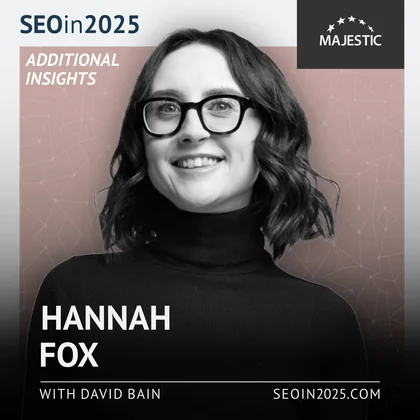
Hannah Fox
Hannah Fox highlights the shift from traditional search engines like Google to social media platforms such as TikTok and Instagram.
« Back to Additional insights
More Additional Insights



Hannah Fox says: “My additional insight is being strategic with our keyword research.
What I mean by that is that, when I started out (much like lots of people listening, potentially), Google was the focus for all of us, all the time.
Anytime you think of SEO, you think of Google – and I think that those were great days in SEO.”
The good old days.
“They really were. I really enjoyed them, to be honest, but now we need to think a bit more strategically about other platforms and how they can be used to target people where they are, which isn't always on Google anymore.”
Let's clarify where people might be, apart from on Google, and whether or not this impacts the way that keyword research is done and deployed.
“Sure, so what I mean is that there are many other platforms now that are being used as search engines, as well as traditional search engines.
Things like TikTok, for example, and Instagram, or even Pinterest a bit too. There are certain industries or topic areas where lots of that search behaviour has moved from Google onto social media platforms. Which means that targeting those customers, readers, or whoever your audience is, just in Google and the blue links, isn't always the best way to get them anymore.
Actually, they might be searching for that thing on Instagram instead, and they might be looking for a video like an unboxing trend or somebody actually physically reviewing something that they can look at and watch. Those people are not using Google as much for the same things that they were back in the good old days of SEO. Things are shifting.
In the context of keyword research, the approach I like to take with my clients is thinking, here's our list of really essential keywords – those primary ones – and then the secondary ones that are a bit more niche, where you've got your modifiers or whatever that might be. But actually, it’s then going through that list and saying, ‘Is Google the best place to target these keywords anymore? Do I need to think a bit differently? Do I need to produce some video content?’ (if you're up for that, for example).
Have a look at the search results as well. Go incognito, do a manual search, put one of your keywords in, and if you see that the whole SERP is videos and a News box, perhaps you need to adapt your thinking there and adapt your approach.
This is what I mean when I say, ‘strategic keyword research’. It is thinking a bit more about where people are and the type of content format to meet them with, because we can't assume anymore that people are Googling everything, because they're not. They're not Googling everything anymore.”
You mentioned the changing SERP, but you also talked about Instagram there as well.
How do you alter the way that you do keyword research and select the keyword research based upon where you think the user is likely to be, and how do you determine where the user is likely to be?
“Obviously, the first port of call for everything, for me, is always data. If you do have that level of data on your customers or your users (depending on the type of business that you are), always start with your customer data.
The second step on from that is, have a sit-down, have a think about who your customer is, what they're looking for, where, and what their intent is when they make that search.
We've been talking about search intent for years, and rightly so, but now there's another layer to apply to this, which is that, actually, it's not just the intent of what they're looking for, but also where and how. Those are the additional layers that I would now add to that intent piece.
As I say, start with the data. If you don't have that level of customer data just now, or perhaps you're just starting out, it is enough to sit down, think about it, and say, ‘If I were my customer or my ideal reader, making this search right now, how would I be doing it?’ That is generally a really good starting point to then get that ball rolling. Think, ‘If I'm this person making this search, how am I doing it?’
Then you can start being a bit more strategic with your content.”
Can you use traditional keyword research tools to obtain all the keywords required for your user, no matter where they happen to be?
Can you use a traditional keyword research tool to uncover, for example, keywords that are likely to result in a desired video and perhaps landing on some social media network, or do you need to use specific tools to uncover those sorts of keyword phrases?
“Great question. If anyone else knows, I would love for them to comment or message me, because I've discovered that this is a real gap in the SEO industry/market at the moment. It's really hard to get specific keyword research for specific platforms.
Not too long ago, I worked at a very, very big global publishing company, and we were hounding TikTok to get a bit of keyword data, and they would not give it. It's really, really private to them. I think a lot of it (to my knowledge anyway), unfortunately, is still extremely manual, which I think is why some clients hear me speak about this and they're like, ‘No, thank you. This sounds huge. This sounds like a big project.’ Actually, it's not.
You should be thinking about your keywords and your volume anyway, but you should also be thinking about your intent anyway, and that is something that no tool will give you. Tools can guess and say, ‘This is what we think the intent of this person is,’ but it will be either commercial or informational.
What I'm talking about is a much deeper version of intent. It’s the context that you need to apply to your own customer, which is you saying that you know that this is who this person is, and this is how they're behaving, on a deeper level – rather than just, ‘This is commercial’ or ‘This is informational.’
Unfortunately, the short answer to your question, to my knowledge, is that there isn't any way of doing it at the moment that isn't quite manual, but it is worth it. It is worth doing it properly”
There's the Creator Search Insights tool within TikTok, but people can perhaps just obtain the keyword data within there, and maybe there's no API for easily getting the data and taking it somewhere that's easy for an SEO to use.
“I’ve found it to be quite a tricky gap area, to be honest. A lot of it still feels like sitting down with my spreadsheet and saying, ‘Well, here are all my keywords that I've obtained, and this is what I'm going to do with them,’ which, as I was saying, is a manual process.
I expect we will get there because, if you imagine, we've got things like Google Ads and, if you're advertising on Instagram or you're advertising on TikTok, for example, you can target people a bit more specifically now, and I can imagine that's only going to become bigger because we have access to that data about people.
Obviously, these platforms want us to spend our money with them, to put it very simply.
I imagine we will get to a place where that level of data is available but, at the moment, the keyword part of it is still pretty manual, unfortunately.”
Maybe there's an opportunity for you to go out there and build your own tool, Hannah. Have you thought about doing that?
“Maybe. Maybe. I think I might need a bit of help.
If anyone listening wants to help with that, then maybe.”
Partner up with Hannah? New business.
“Yes. I mean, I'm very entrepreneurial, so you never know.”
There we go. That's your pitch.
What about keyword volume? How important is that now?
You hear a lot about zero-volume keyword phrases bringing in traffic that you wouldn't necessarily expect. Obviously, traditional keyword tools may guess at keyword volume, but may not necessarily know the exact likely volume, especially for keywords that are relatively new.
How important is that now?
“I think that's such a great question, and I'm really pleased that you asked it, David, because I sometimes feel that my view towards this can be a little bit controversial – particularly when you're working with a client or a decision maker or somebody who's just saying, ‘I really want traffic!’ They want to target the broadest, highest volume keywords out there.
To be honest, my approach doesn't really do that, and this is what I mean when I use the word ‘strategic’. I try to focus on intent (that word keeps coming up), relevancy, and authority. Can you compete for the broadest, highest volume keyword? I think you need to be aware and a bit honest with yourself if the answer is ‘no’ because, quite often, you just end up wasting your time targeting these really, really high-volume keywords.
That's a conversation I often have with clients when they just say, ‘Get me as much traffic as possible.’ One, there's the qualification element of that. Do you want lots of traffic or do you want qualified traffic? Different people have different answers, depending on different things. The second part of that is, are you going to rank for it anyway? As time has gone on, over the last couple of years, I've certainly seen some businesses that used to rank for pretty high-volume keywords, but they're now not able to because EEAT has become even bigger than ever.
At the moment, that's the number one thing we should be optimizing for, or utilising. If you don't have the authority to target the really broad, high-volume keywords, then I don't think you should.
My approach to keyword volume is actually that I don't pay that much attention to it, if I'm really honest. I don't know if people will like that very much, but it's the truth.”
That's good. It's good to have strong opinions – and tell the truth as well, because I think too many people beat around the bush, and it's important to have strong views in terms of your experience and what's worked for you.
It's easy to have a theoretical knowledge and say that you should be going for relatively high keyword volumes, but perhaps that's advice that was more pertinent five to ten years ago.
“Definitely. When I was starting out, and even up to a few years ago, it was pretty black and white: Do best practice and you will rank. But actually, now, as EEAT has become even bigger, I feel like I'm constantly having conversations with people about this authority piece.
To me, the keyword research comes into this then because, if you're targeting loads of things that you can't feasibly compete for, you might as well spend your time doing something else, in all honesty.
Some of them you do need to do – because they're business integral: this is exactly what you do, and that's the keyword – and I completely get that. There are some things that you can't avoid because it's what you do.
But when it comes to secondary keywords, particularly, we need to be thinking a lot more strategically about what they are, ignoring the volume to some extent (not completely ignoring it, but to some extent), and then thinking, are the blue links the place to target that thing anymore?”
Can we just touch upon what you do with your keywords once you've done the research?
So, you've done a lot of extensive research. You've determined what the intent is, who the likely user is, and what the platform is likely to be for the keyword phrase that you've identified.
What do you do in terms of the positioning of the keyword phrases on a web page nowadays? Is there anything different compared with how it used to be a couple of years ago?
“I would say, generally speaking, no. On page is pretty much still the same, in terms of my experience. There are different things to focus on now – again, with EEAT – in terms of the actual content of your content, if that makes sense: what you're including and where and how.
In terms of on-page factors, in my experience, it's very much the same as it was when we started out. It's whether that page is the place to target that thing anymore, if that makes sense.
I would basically have a big spreadsheet with all my keywords in it and group them by platform or by intent, depending on how you prefer to work. Sometimes both can be helpful. Then it would be a case of mapping it to a page – whether that be a page that you already have live on your website or a new one that you need to create. So: keyword, intent, map to a page.
Then, for anything that's off onto a different platform, that's when I'd be having a look manually. Do I need to target this with a video? Do I need to target it with TikTok Shop, for example, if you’re an e-commerce website? Can I target it on Google but, actually, I need to get in the News box, I need to post a video, or this is really dominated by AI overviews, so I need to consider that?
It would be having a real look at what that content is, where it sits, and what the landscape is in terms of where that keyword fits, if that makes sense. Does it need to be video? Does it need to be News box? Do I need to try and get into AIO?
Otherwise, you end up just doing the same thing over and over and over again, and ending up with loads of pages that don't rank.”
Hannah, what's the key takeaway from the tip you shared today?
“I'm hoping that the key takeaway for people would be to just add another layer into their keyword research – which is a bit of a deeper form of intent, that’s actually meeting people where they are.
You've got the knowledge, you've got the data, to be able to create really effective keyword research. It's just applying that next layer of the onion, which is: Where are these people going to be?”
Hannah Fox is a Freelance SEO Consultant, and you can find her over at her website.
Choose Your Own Learning Style
 Video
Video
If you like to get up-close with your favourite SEO experts, these one-to-one interviews might just be for you.
Watch all of our episodes, FREE, on our dedicated SEO in 2025: Additional Insights playlist.
 Podcast
Maybe you are more of a listener than a watcher, or prefer to learn while you commute.
SEO in 2025: Additional Insights is available now via all the usual podcast platforms
 SEO in 2025
Catch up on SEO tips from 106 SEO experts in the original SEO in 2025 series
Available as a video series, podcast, and a book.
Fresh Index

Unique URLs crawled
193,939,622,601
Unique URLs found
617,561,100,771
Date range
08 Apr 2026 to 06 Aug 2026
Last updated
1 hour 15 minutes ago
Historic Index
Unique URLs crawled
4,502,566,935,407
Unique URLs found
21,743,308,221,308
Date range
06 Jun 2006 to 26 Mar 2024
Last updated
03 May 2024
