-
Site Explorer
- Majestic
- Summary
- Ref Domains
- Backlinks
 New
New- Lost
- Context
- Anchor Text
- Pages
- Topics
- Link Graph
- Related Sites
- Advanced Tools
- Author ExplorerBeta
- Summary
- Similar Profiles
- Profile Backlinks
- Attributions
- Compare
-
Link Tools
- My Majestic
- Recent Activity
- Reports
- Campaigns
- Verified Domains
- OpenApps
- API Keys
- Keywords
- N-grams Near Links
- Keyword Checker
- Search Explorer
- Link Tools
- Bulk Backlinks
- Neighbourhood Checker
- Submit URLs
- Experimental
- Index Merger
- Link Profile Fight
- Mutual Links
- Solo Links
- PDF Report
- Typo Domain
- TLD Checker New
- Free SEO Tools
- Support


It's hard to imagine a future in which building a brand is a negative ROI activity
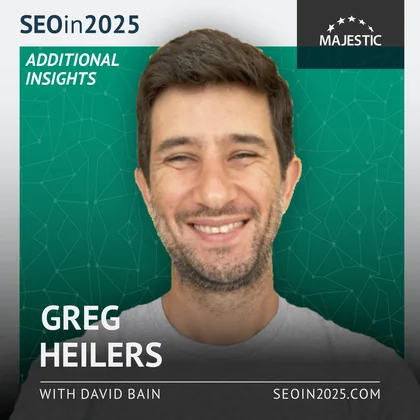
Greg Heilers
Greg Heilers emphasizes the importance of authentic brand outreach, particularly through platforms like Help a Reporter Out, to build brand authority and awareness.
« Back to Additional insights
More Additional Insights



Greg says: “Everyone's talking about: ‘the 10 blue links are dead, or at least returning less and less traffic.’
My take is: it's really hard to imagine a future where investing in your brand is going to have negative ROI. So, for us, that looks like continuing to do outreach (both linked and unlinked) to build your brand – not just in Google anymore, but in the next generation of search.”
Why is building a brand potentially more important in 2025 than it used to be, from an SEO perspective?
“We're seeing, potentially, the closing of an era where you could create top-of-funnel content, load up a bunch of keyword anchor text, backlink to that content, and rank really highly in Google search and bring in organic traffic. Potentially, it’s the end of that era (we still think that's not over yet).
To offset that, or to augment the traffic you're still getting if you are still focussed on keywords, we believe – and actually, for several years now, Google itself has terms like brand entity – if you're forming a brand (and this is just good marketing in general), there's a general recognition now that us SEOs are indeed in the marketing department, and we need to behave like marketers.
It's a little less transactional. We're not just going to get the quick ROI; we're playing a longer-term game now. We're focussed on building a brand, not just in Google's eyes, not just in ChatGPT's eyes, but in the eyes of the consumer – and that means getting our brand out there a lot.
I could keep going, but we've all heard the old marketing adage: ‘You need to be seen seven times before someone can take action.’ This is just an extension of that in 2025.”
Is building a good brand online any different to building a good brand?
SEO, certainly historically, has been about seeing what the algorithms are doing and trying to actually ensure that we're doing the right things on-site and off-site to ensure that algorithms are recognising what the site is about and whether or not it actually wants to rank the site and the page more highly.
You could argue that building a brand for online purposes has certain technical strategies behind it, but are you saying that what a good brand is offline, and what it used to be, has actually completely merged and is the same as it is now to build a successful brand for SEO purposes?
“I'd align a lot with that, David.
I do believe that, when you're portraying your own capabilities, your product metrics, or criteria authentically, you're doing the best service not just to the customer, but to your own company in the long term.
We've seen, pretty much, the end of the affiliate content site era, and certainly the golden age of Amazon a few years ago during the pandemic. A lot of these sites existed on making content that didn't serve the end consumer, but did funnel activity towards others. The brands, they weren't really brands, they were just shells where they funneled people through to things like Amazon FBA. These kinds of business models.
I do think that, if you are in this for the long term, it's less of a lead generation and more of a demand or brand play. Sure, we're marketers talking positively about our own brands, but honestly, and with integrity about what you can and can't do.
I do think it's a little bit going back in time, but it's realigning. People used to write for the algorithms and then they realised, ‘Wait, we do actually need to write for people.’ Frankly, as a consumer, I'm grateful that we're returning to considering the end user of this content that we create.”
What is a key lesson or two that you've learned from traditional brand marketers that you haven't used historically in your SEO activities, but you're starting to apply now?
“We don't do this as a service, but here's one I've seen other people do very well that I've considered: something we've done for ourselves but haven't done as a service is engaging in social media groups.
For years, I've been involved in Facebook groups like SEO Signals Lab or Slack-based groups like Traffic Think Tank. There are places where you can genuinely engage and share knowledge, and in doing so you build your brand. People see you and recognise you. They know what you don't know (because sometimes I'm wrong), but they know what you do know and can help with.
I've seen others, as a service, do this on platforms like Reddit. We all saw (a little over a year ago now, in early 2024) the Google-Reddit deal spawned a whole generation of Reddit marketers. It’s kind of an SEO play, too, because they were ranking so high.
By influencing the Reddit platform, they're still content-based, but they're helping build these brands using these platforms.
In terms of the things that we didn't do as SEOs, and there's no better segue than this: we're all thinking about AI visibility now. There are a host of tools (we're now mid-2025), emerging. Not too many of them seem ready to serve an agency like Jolly SEO, so we created our own dashboard. What we need to do now is combine our ability to use language – so natural language prompting – and seeing where our clients do show up.
It's almost like you would do in the SERPs, but there just aren't the sophisticated tools yet, in my opinion, like the traditional SEO tools that exist, where you can just see rankings.
Instead, we're prompting, engaging with it, and trying to discern, ‘How is it that our client appeared here but not here? And how can we help influence that conversation – with more content externally on the web but we also need to see that feedback loop coming?’
It's early days. We're still learning a lot.”
Talking about prompting, your answer there has prompted me to think about measurements.
First of all, from the perspective of engaging online on places like Reddit that you mentioned, but also within LLMs or various AI search engines, how do you measure the value of interacting in forums and building your brand?
I think most SEOs know instinctively that it's a good thing to do, but how do you actually measure the ROI of that?
Also, secondly: placement within AI search engines like Perplexity. If your brand is being surfaced there, do you measure value based upon click-throughs somehow, or is it just brand visibility?
“That's a really great question. What a lot of SEOs are discussing right now, in the various groups that I'm in (there's free and paid ones, you can search them out. There are some awesome discussions happening), is a decrease in traffic to top-of-funnel content.
We’ve heard about zero click search for years but now, when an LLM is just summarising or when the awesome discussion is happening on Reddit, maybe they don’t need to go to your site – but we’re seeing an increase in branded search to your homepage.
That’s not meant to hype me up as a branded outreach guy, that’s because these people are doing such a great job on Reddit, of getting the brand out there, that the user or consumer is doing a separate search just straight for the brand and clicking into the homepage to go look for it. You might be able to tag properly in GA and see an increase in referral traffic from Reddit or from ChatGPT, right?
You might also just see (like many are seeing), this general trend where, ‘Hmm, my traffic to the pages I was targeting two years ago is way down, but my homepage, interestingly, is way up – and actually, my overall conversions/sales...’ A lot of people are reporting, ‘We're not suffering right now, despite all this.’ So, something's working there.
I think this has always been an eternal conflict between brand marketers and people who drive sales: how do you attribute what the value of the brand is? I would posit that you have to give some recognition to the brand marketers for playing a part in that.”
I guess the challenge is, though, you're entering into some kind of fight against other marketers that also find it difficult to attribute the success of their various activities.
Perhaps it's social media marketers or more traditional radio or television marketers.
How do you know that it's more likely to be an SEO's activities that have caused the uplift in brand?
“Yeah, or a podcaster, right, David? It's tough for us podcasters out there. It's a great question. How do we know when it's unattributed? How do we divide that pie appropriately? This is a kind of a non-answer to be honest, David.
I'm external, I'm not in-house, but we do have enterprise clients, and we do have small and medium-sized business clients. With the small and medium-sized businesses, usually, the marketing channels are less numerous, and we have fewer unattributed leads to divide up and understand where they're coming from.
With the enterprise, I would just, if possible, advocate for an environment that's more collaborative. Like I said, it’s kind of a non-answer, but I would really focus on this being a team effort right now, where we actually don't know what is working or going to work.
Now, that doesn't help you when your C-suite or your controller is like, ‘This line item, or this person, needs to go.’ I just want to say, I understand that's a non-answer, but I think in this environment of uncertainty, I personally believe anyone who says they actually know how to rank in LLMs, guaranteed... I mean, maybe they found a hack I'm not aware of for today, but how can we say that's going to be what's working tomorrow?
I'd pull together and do all the things that have an inclination that they are helping, but not necessarily go for, ‘That was me, and definitely not you. You're worthless. This is where the value is.’ right now.”
Are there certain SEO activities that we should do to make it more likely that we rank more effectively in LLMs?
I'm thinking perhaps featuring images, more text, more mentions of the brand, or better positioning of the brand. Are there different schema, for instance, that we can use in our web pages or different ways of going about how to structure the format or the text on our pages to make it a nicer bite-sized chunk for LLMs to consume?
What are one or two things SEOs can do in order to actually maximise their brand exposure within LLMs?
“Absolutely. I myself have been interviewing people on this topic, and trying to glean what I can.
The best that I have heard from the last couple of people I've interviewed (Roni Calvo at We Do SEO and Dmitry Dragilev at TopicRanker) is that, basically, the traditional SOP checklists are still, by and large, applicable. It's just that we need a few extra steps added.
That's where I say, I think we're still feeling our way. Me, as an off-site guy, I'll focus on what you can do off-site.
I know you mentioned schema, and there's other areas we could get into, but as an off-site guy, one thing that's really interesting is that, as I said, we're building our own AI visibility dashboard for clients. What we're seeing in early returns from all the prompt data we're getting is kind of the return of the relevancy or importance of lower tier websites.
Now, we have a certain pretty high bar, because we do earned link building, not paid, but bear with me.
There's a certain tier that I personally thought was falling out of utility: sites in the 2000 organic traffic range monthly, and sites in the Domain Rating (DR) 55 range. I thought, ‘What's the utility here, long term? Are these sites going to be worth it?’ But sites like that are getting returned in responses to prompts.
As I said, I'm still early in this, but that would be my best answer right now: continuing to get a footprint out there on the internet where you have a chance of landing. Again, as an earned link builder, I still say you do outreach, try to contribute authentically, and these sites may still mention your brand and link back to your website, and that may help you show up in a higher percentage of responses.”
Many SEOs are still feeling their way in terms of what they need to do in order to optimize for LLMs.
How often does an SEO need to review their strategy for trying to conduct this optimization?
If things are changing so often, if LLMs are changing a lot and opportunities are changing a lot, do they have to methodically review what's happening on a monthly basis, for instance, to ensure that they're taking advantage of as many opportunities as possible?
“You know, life isn't fair, right? So, here's my not fair answer: as frequently as you have bandwidth for right now.
I don't think we're in a place (and I think a lot of people feel this way). Not just for the individual in-house SEO, although certainly for them as well, but as agencies, we believe we're literally in an evolutionary bottleneck right now – or heading into one.
For the ones who are going to emerge (I certainly hope my company, Jolly SEO, is on the other side of this when I hear this podcast a few years from now, and I'm not crying), it's as much as we have bandwidth to devote to this next phase.
Personally, I don't think Google's losing that much market share that rapidly. I still think we need to stay very much in touch with what's working on Google, but I think LLMs are in a little pocket moment here. I think consumers are shifting that way. Whether it's a specific company or not, I think you should be developing a skill and understanding this as much as you've got bandwidth for.
So, if you're an in-house team and you've got a whole extra person to become the internal specialist, awesome. If you're like me, where pretty much everyone is fully allocated, well, I'm just trying to carve out a few hours of my week, ask this person, ‘Can you carve out a few hours of your week?’, and collectively see how much knowledge we can build together.
I'm also asking my clients. I'm also reaching out to fellow agency owners. I'm pretty much everywhere I can get input. Then the classic: look for the signal.”
‘Evolutionary bottleneck’ wins the phrase of the day so far. So, congratulations on that!
“Thank you so much. It's still early in your day.”
Greg, what's the key takeaway from the tip you shared today?
“For me, the key takeaway is to get your brand out there in the ways that you can, authentically.
I'm in earned outreach. That means I don't pay my way into outreach. For those of you who are thinking, ‘Great, a little pitch for his company’, not really. I'm in a niche – the ‘Help a Reporter Out’ niche – that is excellent for DIY specialists. It's really super for the in-house marketer or the small business owner who wants to do it themselves.
You can sign up to media opportunity platforms. There's several: Help a Reporter Out, Featured, Help a B2B Writer, Source of Sources.
There are hundreds of opportunities a day to glean at least one or two for yourself, take 15 minutes, and send a decent outreach to someone. As I said, these sites that maybe three years ago you would say, ‘Oh, come on! Do I really need to be reaching out to that site?’ – you'd be surprised which sites are returning in ChatGPT right now (or maybe you won't be, if you get out there and start prompting and asking about your company and these tools).
I would continue to put my company out there, represent my own authority, and build more awareness.”
Greg Heilers is the Co-Founder at Jolly SEO, and you can find him over at JollySEO.com.
Choose Your Own Learning Style
 Video
Video
If you like to get up-close with your favourite SEO experts, these one-to-one interviews might just be for you.
Watch all of our episodes, FREE, on our dedicated SEO in 2025: Additional Insights playlist.
 Podcast
Maybe you are more of a listener than a watcher, or prefer to learn while you commute.
SEO in 2025: Additional Insights is available now via all the usual podcast platforms
 SEO in 2025
Catch up on SEO tips from 106 SEO experts in the original SEO in 2025 series
Available as a video series, podcast, and a book.
Fresh Index

Unique URLs crawled
194,188,717,434
Unique URLs found
618,052,412,077
Date range
07 Apr 2026 to 05 Aug 2026
Last updated
17 minutes ago
Historic Index
Unique URLs crawled
4,502,566,935,407
Unique URLs found
21,743,308,221,308
Date range
06 Jun 2006 to 26 Mar 2024
Last updated
03 May 2024
