-
Site Explorer
- Majestic
- Summary
- Ref Domains
- Backlinks
 New
New- Lost
- Context
- Anchor Text
- Pages
- Topics
- Link Graph
- Related Sites
- Advanced Tools
- Author ExplorerBeta
- Summary
- Similar Profiles
- Profile Backlinks
- Attributions
- Compare
-
Link Tools
- My Majestic
- Recent Activity
- Reports
- Campaigns
- Verified Domains
- OpenApps
- API Keys
- Keywords
- N-grams Near Links
- Keyword Checker
- Search Explorer
- Link Tools
- Bulk Backlinks
- Neighbourhood Checker
- Submit URLs
- Experimental
- Index Merger
- Link Profile Fight
- Mutual Links
- Solo Links
- PDF Report
- Typo Domain
- TLD Checker New
- Free SEO Tools
- Support


Win by being the brand that AI wants to quote
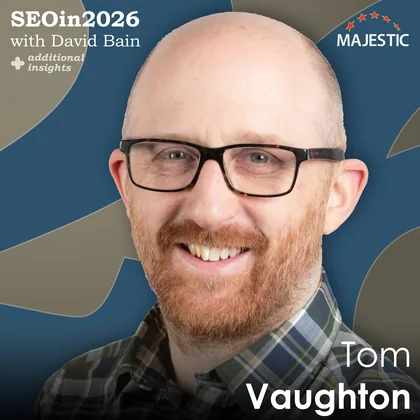
Tom Vaughton
Tom Vaughton talks about creating high-quality products and content in SEO, predicting that AI will increasingly handle basic information and traffic.
« Back to Additional insights
More Additional Insights



Tom says: “Well, it's a strategy, rather than a tip. It's about actually focusing on creating the best product or service you can, and then creating genuinely helpful content about that product, rather than chasing informational traffic – because obviously, in the future, AI and overviews and chatbots are going to take that and answer it anyway.
In marketing terms, AI has massively changed the game, and what SEO, visibility, and discoverability are. For us, our tip for our clients (and ourselves) is to work with businesses for the long term, and they're the ones that are creating interesting products and services and content to support that.”
Okay, and how do you match that up?
How do you know that you're creating the right content that reflects what our product is about, that's going to resonate with your target market?
“Yeah, that's a great question. Knowing your market is a start.
If I can use an analogy, in the past, SEO has been a little bit like drugs in sport. You didn't really need to know the market; you just needed to know the shortcut or what would give you a boost.
Now, because of AI, SEO is: you've got to know the product, you've got to know the market, and you've got to know what the people want and how to answer their needs and try to be a giver rather than a taker, and just doing it as a tick box exercise for the sake of it.”
‘SEO is like drugs in sport.’ That's a T-shirt quote by itself, or maybe the quote of the episode. Hopefully not.
How would you go about sitting down with a client and getting the information that you require about a product? Obviously, if you're an agency, you don't necessarily know as much about the product as the client does, but you know more about content marketing, how to position it, what to write about, and what to include in that.
How do you make sure that you get all the information you need from the client?
“Yeah, that's a really good question. There are two answers to this.
One is, there are some clients we genuinely target for work because we love what they do, or we love their brand. That obviously makes it easier, because someone in the office uses their product or is engaged in that hobby, sport, or business. That obviously makes life easier.
If not, you just genuinely have to immerse yourself in it. In the past, the challenge with SEO has been that it's been a bit one-size-fits-all. You would just spend X hours on this, Y hours on that, and create N number of blogs a month. Whereas, we’ve found, what's worked better for SEO (but also as an agency for client relationships, honesty, and building that long-term understanding) is to just do things like work at the client's office one day a month.
Go to some of the meetings. Obviously, engage in their newsletter and understand their product, what their client wants, and what their competition does. If you've got the right team on that, you've obviously got the technical know-how – which is the same, arguably, whatever sector you're targeting.
Then, the sector content comes down to just good old detective work and getting stuck in and not having that one-size-fits-all approach, is probably the key.”
It's interesting that phrase of yours, ‘N number of blog posts per month’.
I was speaking to a top SEO recently, and he was bemoaning the fact that he'd lost a client because someone else had come in and said, ‘Oh, I can get you so many more blog posts with so many more words for the same amount of money.’ The client went with them instead.
Is that an issue that you're facing as well?
“I suppose there are two things there as well. There are definitely clients we haven't won because we haven't been one-size-fits-all and offered the world and a million blogs for $2.50. But then, is that the climate we want that's going to build us for the long term?
We've had clients on monthly retainers that we've worked with for over 10 years, and that's because we've had a marketing strategy which we're very open and transparent about, and understanding what their product is and explaining why we're doing what we're doing.
If you're just trying to hit targets and churn out content, AI is going to be answering a lot of those questions soon, and it's going to suddenly lose value quite quickly. We try to stick to what we think is the best option rather than the ‘short-term gain but long-term pain’ option.
I'm sure that has cost us the odd win, but it's meant we've had more valuable long-term relationships – and it is cheaper to keep clients than get new ones, isn't it? I suppose we're looking for clients who want to build for the long run, rather than find the next hack.”
You say you have a marketing strategy.
Does that generally come from the client, or is that something that you are more forthright about creating and trying to get them to follow the particular way of doing things that you prefer?
“That's interesting because it depends on the size of the client, actually.
For some clients, if they're smaller, we might almost be their marketing department. Then you end up doing a lot of it and align with what they're doing on their product development roadmap. But if they're a bigger client and they've got a marketing team, we’re then more like a consultancy.
It's how we can help work on what they're doing and help them work harder, and support their strategy from an AI and SEO perspective, and then feed into it with recommendations and suggestions. Some of the clients we work with, we're sort of a part of their team, and that works really well, and normally we try to feed into that and suggest new things, but we're not normally looking for a quick win that's going to kick in tomorrow.
If you understand the client's strategy and their product development or service development over the next one to two years, you can then do the research, competitor research, and then align that with their plan as they put it together. It's always – whether it be in business or in sport or in SEO (or building, actually, like if you're trying to do your own extension) – if you try and do something quickly, it always costs more and ends up worse.
We're trying to work with clients in the long run. We don't normally force a strategy, but we often have debates with clients about why we might suggest something, but then we're very open and honest with why. The great thing with SEO is, it's not print, is it? Do you know what I mean? It's not like you're going to print 10,000 copies of a brochure, then there's an issue and it’s like, ‘Oh no!’
Often, the balance with SEO (especially with e-com) is that we might suggest something and they push back because it damages their brand, look, or something. We're like, ‘Okay, fine. Well, we're saying it because of this reason, but let's see what happens when we go halfway and we've pushed as far as we can within your brand guidelines. Then, if it's not getting the results we all want and the business objectives, then you might need to do everything we've said.’
That's the great thing. You can evolve it, can't you? Which I think is quite exciting. That comes out – if you're open and honest with the client, it's more of a relationship than a supplier and a client, isn't it?”
Going back to the content that you produce as a result of finding out more about the product that the client offers, how does that match different stages of intent/different stages of the buyer journey?
I can understand that product content is something that someone would want to consume when they're aware of what you do and actively considering purchasing, but what about earlier stages in the buyer journey?
“Yeah, that's where the fun bit is, if I'm honest. We work with some clients that, I'm not going to say who they are because they might get offended, but they're not the most exciting sectors, and they're not doing the most exciting things.
When that happens, it's like, ‘Well, how can we get awareness in their sector online and offline?’ Because you've got to join the two together. That's even more important than it was.
Actually, just a quick side point, David: Google's always said it's about the best quality, but I think they've sometimes found it hard to know what that is. I think AI is going to mean they can be better at picking out the best quality, which means having a whole marketing plan.
What we'd normally do is create some awareness, and that can literally be anything. We've done it with one client, who has a product that isn't super interesting, but we worked with them to create some world records, which just created loads of content and brand awareness. The world record was based on some of the products they made, which then fed into longer-term content, which then went into newsletters and got links and got awareness, but that was right at the top of the funnel. However, it also then helped feed lower down the funnel.
So, we'd look at that, or original research. For one client, we created a really interesting book, which again went out to loads of people (and actually paid for itself, weirdly, in sales, which was amazing). Actually, it was more about the top of the funnel – but again, created loads of content and contacts for driving down the funnel as well.
That's the fun end that I think people forget about.”
It's funny that many older school marketing tactics and strategies are actually being implemented in SEO now, including physical copy books (which, of course, this series will lead on from). That's quite incredible.
In terms of the content that you produce, is there any trend in terms of structure, number of words (if you want to go back to that at all), and even the type of content? Are you finding video, text, or any particular style of content resonating with the target audience more nowadays?
“Yeah, that's interesting. It's interesting you mention video. I was going to mention video, for two reasons. One is that it helps drive engagement on the site, and often people now seem to rather watch a video and read the subtitles than read content, wouldn't they?
So, we found that works well, but the second reason we find it works well is because that's the top of the pyramid. This podcast would be an example, wouldn't it? By the time you've done all your podcasts, you've got so much content you could turn into written content, soundbites, social, for conferences even, possibly. Video is certainly an area we're focusing on.
Even then, that might feed into research. Probably, once you've spoken to everyone you've spoken to, you could create some research about people in SEO or managers in SEO, what their trends are, and what they're seeing. That would be original research, which would then get engagement.
A lot of content out there is just – especially if you used AI to create the content – it's just average content, isn't it? It's about creating original content, but video is, we're finding, quite powerful for outreach, but also for being at the top of the content pyramid, and therefore adding value because you can get so much out of it.”
What about where content is published nowadays? There's a lot of content that's consumed not directly on a website now, and it's harder to drive people to your website for every step of the journey.
Do you mind where content is featured? Is there any particular platform that you are preferring at the moment, in terms of where to try to get your content published?
“It slightly depends on the client, actually. If it's quite a sector-focused client – in health and safety, for example, which is quite niche – then (and you use these words earlier) it's slightly old-school marketing, to be honest, David. You're targeting the trusted publishers in that sector, a bit like you would have with PR or marketing in the old days.
Then, with other sectors, you are more looking at the forums and the chat, and even Wikipedia. It's harder than it used to be to get things on Wikipedia, but if you've got a legitimate story and a legitimate brand, you can, and people just aren't really thinking about that – or how they even optimize review sites.
There are a few high-end property companies we work with, or hotels, that work really hard with reviewers who come to their hotels, but obviously we’ll help feed into who they should contact – but then, we help optimize the content they write, because we know that could get fed into AI. Therefore, that helps not with traffic to their site, but with awareness when people search ‘most luxurious hotel in the Southwest’ or something.
For us, it's understanding the competition/the market, and then putting together a bespoke strategy for that client, rather than that ‘one-size, N blogs a month’ approach.”
How do you measure success?
If there are so many different touchpoints, with people interacting on platforms that you don't control, what metrics do you use to demonstrate to your client that you've achieved something?
“There's an ideal world, right? Then there's the real world.
Ideally, if it was a lead gen campaign (so, it was a B2B thing, there's not an instant sale, and it takes a while to convert), you'd ideally have a cost per lead that you can measure against – but that's when we're involved in the whole marketing flow.
If it's e-commerce, obviously, it's impact on sales. Again, that's where we're involved in the whole marketing funnel. If you're not, then it's normally done on the impact of awareness, overlapping a little bit with how PR used to do it, because you can now track where you show in AI Overviews and some answers in AI. Again, we will be actually monitoring that.
We obviously do monitor web traffic to look at engagement, but where possible, we're always linking it back to conversions – whatever a conversion is. That is hard, and sometimes the first thing we do, before the SEO, is benchmark all the tracking. It's amazing – out of the box now, GA4 isn't as easy as the old analytics used to be, obviously. Getting that right first, so we're all looking at the same data.
Then, explain to the client what's happening with the impact of AI – and understanding what the board measures. Often, your search marketing person will say, ‘I want to drive this much traffic or get this much content out,’ which is great. But then it's like, ‘Yeah, but what do the board actually want?’ If all they care about is sales, we need to come up with something – even if it's just a leading indicator – to show how we're impacting sales.
That's how you get long-term clients. We always try to link it back to some sort of business KPI, if we can.”
Tom, what's the key takeaway from the tip you shared today?
“Just do marketing properly.
Stop taking drugs. Do marketing properly, and then implement it with the latest technical know-how, because obviously, there are impacts there. Also, doing schema and that sort of thing properly.”
Tom Vaughton is CEO of Varn. Find out more over at Varn.co.uk.
Choose Your Own Learning Style
 Video
Video
If you like to get up-close with your favourite SEO experts, these one-to-one interviews might just be for you.
Watch all of our episodes, FREE, on our dedicated SEO in 2026: Additional Insights playlist.

 Podcast
Maybe you are more of a listener than a watcher, or prefer to learn while you commute.
SEO in 2026: Additional Insights is available now via all the usual podcast platforms
 SEO in 2026
Catch up on SEO tips from 117 SEO experts in the original SEO in 2026 series
Available as a video series, podcast, and a book.
Fresh Index

Unique URLs crawled
193,615,412,856
Unique URLs found
616,039,689,004
Date range
08 Apr 2026 to 06 Aug 2026
Last updated
23 minutes ago
Historic Index
Unique URLs crawled
4,502,566,935,407
Unique URLs found
21,743,308,221,308
Date range
06 Jun 2006 to 26 Mar 2024
Last updated
03 May 2024
