-
Site Explorer
- Majestic
- Summary
- Ref Domains
- Backlinks
 New
New- Lost
- Context
- Anchor Text
- Pages
- Topics
- Link Graph
- Related Sites
- Advanced Tools
- Author ExplorerBeta
- Summary
- Similar Profiles
- Profile Backlinks
- Attributions
- Compare
-
Link Tools
- My Majestic
- Recent Activity
- Reports
- Campaigns
- Verified Domains
- OpenApps
- API Keys
- Keywords
- N-grams Near Links
- Keyword Checker
- Search Explorer
- Link Tools
- Bulk Backlinks
- Neighbourhood Checker
- Submit URLs
- Experimental
- Index Merger
- Link Profile Fight
- Mutual Links
- Solo Links
- PDF Report
- Typo Domain
- TLD Checker New
- Free SEO Tools
- Support


Focus your AEO strategy on showing up in Dark AI conversations
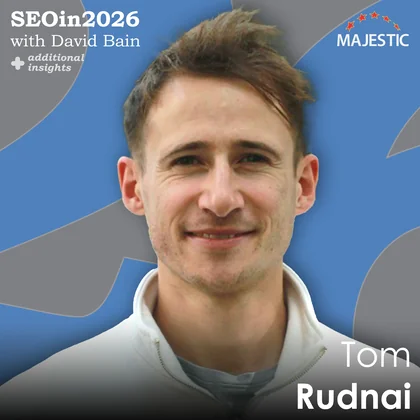
Tom Rudnai
Tom Rudnai says that instead of chasing citations, focus your AEO strategy on showing up in Dark AI conversations where problems are framed.
« Back to Additional insights
More Additional Insights



Tom says: “My number one tip would be to stop optimizing for AI citations.
We've done a big study recently, and we found that only 16% of AI prompts within a complex buyer journey ever produce a brand citation. To give you a little bit of context on the study first, what we did was we were using AI to simulate complex buyer journeys across loads of different B2B categories because we wanted to understand how responses vary at each stage – from awareness to consideration, through to conversion.
What we found was that citations were actually very rare and limited only to the conversion stage. We know that, in a more complex journey, that's a very small part of the overall buyer journey. The majority is a lot more about how we define the problem, how we build requirements, etc.
Understanding that, it told us that citations are a really poor metric for actual AEO influence, because you're essentially measuring the tip of the iceberg. It's the 16%. Then, if you're looking at things like traffic, you're even further downstream from that, so you're capturing a very small amount of the opportunity.”
What are dark AI conversations?
“Dark AI conversations is what we call everything that you don't see when you're tracking, really, SEO metrics. Traffic, citations, etc. – these are metrics that are a holdover from SEO, rather than actually native to AEO and to how AI search works, because it is different, right? It's not a directory. It's much more of a co-pilot and a thought partner.
I like to use my iceberg analogy. If you think of that 16% of AI prompts in the conversion stage that produce a citation, that's what sits above the surface of the iceberg. It's really clear, and it's really easy to track with what most people are currently measuring. That's how they assess the overall impact AI has on their brand – or on their buyers, I should say.
Dark AI is everything that sits beneath the surface. That's all of the conversations where customers are trying to understand the problem that they have, which is relevant to you, understand what solutions are out there, what requirements they have, flesh out the need, etc.
In a complex journey, all of that stuff beneath the surface of the iceberg is where the real bulk of the math is. That's what we call dark AI, and it gets missed by current metrics.”
Understood. So, it's essentially questions that customers are asking AI that you won't be privy to understanding, or seeing what customers are asking and what kind of conversations they're having.
Just to clarify: it's not actually conversations that AI are having between the AI and actually coming up with a solution for the customer. It's not like an AI agent; it's simply the customer interacting with AI, but you not having access to that analytics.
“Yeah, they’re interacting with AI in a way that doesn't show up in the metrics that you're tracking.
What we tend to find is that the more complex the journey, the more of it takes place in dark AI. It's quite useful to have a bit of an example. The way that I like to think about it is to take a CFO of a big business, whatever business you like, and think of three things that CFO is going to purchase.
So, the CFO buys toothpaste. There is virtually no awareness and consideration stage. There is a very short journey from (let's assume that they're not having to be made aware that they need toothpaste, as a CFO), they run out of toothpaste, and then they buy toothpaste, and they get recommended Colgate or whatever is on offer. It's transactional, and there's no complexity to that journey, really. There, everything is happening above the surface, in our analogy.
As you get more complicated – take trainers or headphones – there are a lot more requirements. Do you want them to be noise-cancelling? Do you find that you're talking a lot out on the street? Are you active? Are you mostly office-based? All of that stuff will build into what headphones you are recommended. So, the recommendation produces a citation and sits above the surface. All of that criteria application and requirement building sits beneath the surface, and no brand gets mentioned there.
When you take the next step in the complexity of purchase to a billing platform – before Stripe, Braintree, Zuora, or any billing platform out there ever gets mentioned, there are 10 different stakeholders that are trying to understand how they take payments, all of the different things that go into deciding, ‘Okay, what we need is a new billing platform. Now I'm going to ask for a recommendation that will produce a citation.’
So much more of the math sits beneath the surface. Does that make sense?”
Yes, absolutely.
What percentage, roughly, of buyer journey interactions are impacted by dark AI conversations?
“Based on the analysis that we did, we found that 84% sits within dark AI, because 84% never produces a brand citation. If that's what you're tracking, you are only going to capture that.
Now, this is going to vary a lot from industry to industry, generally based on the complexity of your purchasing journey. If you're selling a product that is multi-stakeholder – so, it takes 10 people to agree to buy that product in order to sell it, and it takes you 12-18 months to sell. A billing platform is a really good example of something like that. It touches the CTO, the CFO, and the CMO of a company that you want to sell to. Probably a lot more than 84% is about how each of those people frames the problem and understands the requirements that they have before they ask anyone, ‘Which billing platform should I actually go and buy?’
Again, if it’s more simple, let's say you're selling an AI search optimization platform. We largely sell to the marketer. There might be a few other stakeholders (maybe at a more junior level, there's a content person and an SEO person), but it's a bit simpler. There's a little bit less requirement framing and a little bit more, ‘Right, which product should I buy?’
It's going to vary from category to category. We studied 14 different categories across B2B, and what we found was that on average, was that it was 84%.”
Is there any hope for the average SEO to regain access to these analytics and actually discover how customers are interacting with AI?
“Yeah, absolutely. I think it just changes. At the moment (this may be a slightly controversial opinion of mine), I think the AI search industry has been largely built and shaped by people who were really good at SEO – the same voices.
It's very logical why those are the people who have adopted it, but they've approached everything through a very SEO lens.
Everything still lives in that world of: you want to rank, and you want to just be seen in order to capture traffic. But there's a very different function in that the funnel itself is not a very useful framework for thinking about AI search because it doesn't just live early in the buyer journey like search did.
Search is a directory, so a user went there to get pushed to your brand quite explicitly. That was what they were looking for. AI is not the same; it doesn't want to push people, so it only pushes people to your brand very late in the journey.
Now, that changes an awful lot about what we have to track and how we have to approach optimizing it because you have to optimize for all of those invisible conversations that came earlier. Is there hope? Yes, it just requires looking at different metrics.
Some of the things that we propose, I can explain in terms of strategy and measurement. In terms of measurement, focus a lot more on demonstrating fit for different criteria. If we're saying that the way AI operates is, over the course of these journeys, it applies criteria. It understands that you're a CMO at a big company with a complex marketing stack – all of these different requirements. What you want to do is really clearly demonstrate that you fit that specific person. You don't want to be broad, you want to be specific.
That's something that you can measure. We can use AI to do that. We can talk to the LLM to understand how it perceives your fit, what it thinks your strengths and weaknesses are, and what it perceives the trade-offs of your product to be, compare that to what you want, and tell you how closely aligned those two things are. If those two things are 100% aligned, you're going to survive all of that problem framing in a really effective way.
It changes the way that you approach optimization because your goal isn't these broad statements of domination: ‘We are the absolute best CRM out there that you could ever have, for anyone.’ It's about being really specific on the trade-offs of your product, who you're for, and how you win.
I could go on for hours about that, but yes, there is hope. It's just a different strategy that you need.”
In terms of who you are and what you offer, you talked about how AI responds to different stages of the buyer journey.
What would be your broad-level summary of how AI responses change at different stages of the buyer journey, and what an SEO needs to do to be able to optimize more effectively for that?
“Let's split it up into those three: awareness, consideration, and conversion. What we find is that, over the course of that journey, the language evolves.
The language in the awareness stage is very exploratory. It explores a broad range of options, so there's very high variability. If we run the same prompt in the awareness stage 10 times, we're going to see different brands every time. So, if you're consistently coming into that stage, it's a really strong signal that the AI considers you an important player in that category. You're helping it frame the problem, not just being visible as a solution. So, in the awareness stage: very open, high variability, and exploratory language.
What we notice is, as you go through the funnel, so to speak, this trend called convergence takes place, where variability becomes much, much lower, language becomes a lot more definitive, and essentially the same brands get surfaced over and over again, and they get surfaced much, much more confidently.
There are a couple of mistakes that this naturally leads you to, as a marketer. It leads you to view that definitiveness, that confidence that the model gives you back, as an endorsement of your brand. It's neither an endorsement nor a problem. It's because the AI does something called intent matching.
The AI is very clever in how it answers the user's query. If the user inputs a conversion-focused query that is essentially asking for a recommendation, then what it gets back is a recommendation. The fact that you were visible there and you were recommended is not in itself an endorsement of your brand; it's an endorsement of the fact that you were one of the available options – and we know that that's a tight option pool at the bottom of the funnel – and it will recommend everything at that point, because that's what the user is asking it for.”
Got you, okay.
You also mentioned beforehand that citations are a bad North Star metric. What do you mean by that?
“You're missing so much of your influence, and you're missing so much of the potential influence that you could have.
If only 16% of AI prompts ever produce a citation, then if that's what you're building your model around (which is how most people have built their business case for AI: ‘We want to get cited more in AI’), you're building it around a fraction of your potential influence.
What I would encourage people to do is try to push back against AI search optimization having the same role within the marketing funnel, or the broader marketing team, as SEO did. It's not something that sits at the top of the funnel, that should have a ranking or visibility metric associated with it. It's something that buyers are using at absolutely every stage, and if you do a better job of it, you improve every metric across the funnel.
Focusing on fit, on sentiment, and things like that are much better reflections of how AI actually views your brand, and of the optimization work that you're doing, that captures a lot more of the impact that you are and could be having.”
Okay, so you said ‘fit’ and ‘sentiment’ there. By fit, I presume you mean relevance to the conversation?
“Yeah, so relevance – or relevance to the persona that the individual is adopting, right?
If I go and prompt it, I'm going to say, ‘I'm Tom, I'm a founder at a startup in the AI search space.’ What you want to understand is, with all of those different criteria – industries, segments, stakeholders, use cases, etc. – that people might apply, and that you want to be viewed as strengths for you, how does the intention of your strengths fit the LLM's perception?
That's something that, within our product, we help with, because we understand the LLM's perception. We get you to tell us what you're intending, and we just track, as a KPI, the alignment between those two things. Your goal, over time, is to create 100% alignment. That means that, consistently, you're going to be presented in the way that you want to be to the right people.”
How do you optimize for optimum fit?
Is it a case of using more case studies and more interviews with happy customers, just to demonstrate that whoever is actually having conversations with AI is obviously relevant in terms of being relatable and similar to the customers that the brand already has?
“Broadly. Generally speaking, you have the same tools in your toolbox as you had in an SEO world to influence AI.
The way that I think of it is you have three levers that you can pull. You have your positioning, your content, and your reputation – and I like to think of those as three points on a triangle. Your goal should be to get those three points as closely aligned as you possibly can.
When your positioning, your content, and your reputation all say the exact same thing about who you are, what you do, who you're for, and why you win. Then you're being really, really clear. There's very little ambiguity and very little inconsistency there.
The position I think a lot of brands find themselves in is because an SEO mindset encourages brands to try and optimize prompts one-to-one, as if they're keywords. What that leads you to do is produce loads and loads of content, because there are so many different variations of every keyword. One keyword could be a thousand prompts, and so we're trying to optimize in a very SEO way. The challenge with that is that it produces this explosion of content.
Now, over time, within that explosion of content, there are going to be lots of contradictions as to who you are. As your positioning shifts, your content is going to be out of sync with it. What you create, then, is ambiguity because you've got all of these contradictions. It's very unclear, looking at you, who you are. That's where you create a lot of opportunity for other people to go and define that, or for the AI to make it up.
AIs want to be confident. One thing I would suggest to people is that they need to have much more of a plan for content maintenance than you did, because AI looks at your entire library to form a picture of you, not just the latest pieces that you've done or the specific piece that relates to that query. It looks at everything. That's where it's quite a big mindset shift, that sometimes taking an SEO-focused approach isn't helpful for.”
Tom, what's the key takeaway from the tip you shared today?
“Stop optimizing for AI citations. Only 16% of AI prompts actually produce one.
Focus much more on demonstrating your fit with different buyer personas and different criteria that you want to demonstrate fit for.”
Tom Rudnai is CEO and Founder at Demand-Genius. Find out more over at Demand-Genius.com.
Choose Your Own Learning Style
 Video
Video
If you like to get up-close with your favourite SEO experts, these one-to-one interviews might just be for you.
Watch all of our episodes, FREE, on our dedicated SEO in 2026: Additional Insights playlist.

 Podcast
Maybe you are more of a listener than a watcher, or prefer to learn while you commute.
SEO in 2026: Additional Insights is available now via all the usual podcast platforms
 SEO in 2026
Catch up on SEO tips from 117 SEO experts in the original SEO in 2026 series
Available as a video series, podcast, and a book.
Fresh Index

Unique URLs crawled
194,188,717,434
Unique URLs found
618,052,412,077
Date range
07 Apr 2026 to 05 Aug 2026
Last updated
1 hour 2 minutes ago
Historic Index
Unique URLs crawled
4,502,566,935,407
Unique URLs found
21,743,308,221,308
Date range
06 Jun 2006 to 26 Mar 2024
Last updated
03 May 2024
