-
Site Explorer
- Majestic
- Summary
- Ref Domains
- Backlinks
 New
New- Lost
- Context
- Anchor Text
- Pages
- Topics
- Link Graph
- Related Sites
- Advanced Tools
- Author ExplorerBeta
- Summary
- Similar Profiles
- Profile Backlinks
- Attributions
- Compare
-
Link Tools
- My Majestic
- Recent Activity
- Reports
- Campaigns
- Verified Domains
- OpenApps
- API Keys
- Keywords
- N-grams Near Links
- Keyword Checker
- Search Explorer
- Link Tools
- Bulk Backlinks
- Neighbourhood Checker
- Submit URLs
- Experimental
- Index Merger
- Link Profile Fight
- Mutual Links
- Solo Links
- PDF Report
- Typo Domain
- TLD Checker New
- Free SEO Tools
- Support


Don't neglect traditional SEO just yet
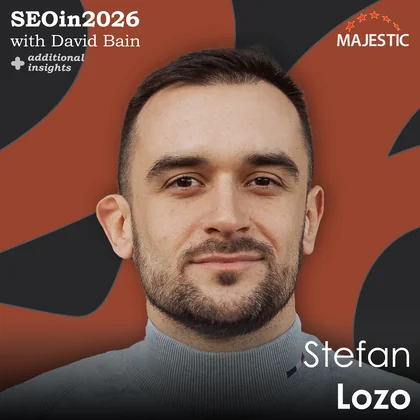
Stefan Lozo
Stefan Lozo argues that while AI and LLM-driven search are rising, traditional SEO remains essential because AI systems still heavily depend on strong visibility in Google and other search engines.
« Back to Additional insights
More Additional Insights



Stefan says: “I would definitely suggest for agencies, freelancers, and companies not to neglect the traditional SEO just yet.
Even though there has been a lot of hype around AI for the past few years, and the clients are definitely going (or at least they want to go) heavily into LLM prompts and results, the thing is, a lot of these LLMs – from ChatGPT to Gemini and Perplexity – they're still heavily relying on traditional search results from Google, primarily, to actually showcase some of the results and the prompts.
I would definitely say that it's not just about the AI results. You definitely still need to be present on Google and other traditional search engines.”
Got you. Even if you're optimizing for AI, AI takes a lot of the results from Google, so you might as well optimize for Google, and then you should hopefully appear in AI search results.
“Oh yeah. There are definitely a few steps in that process. Obviously, you still need to have the optimized content, but it's more about the format. How do you actually structure it?
Nowadays, it's more about making the content on the page more digestible and skimmable for users. This means adding more subheadings – H2s, H3s, and H4s – but also including some important comparison tables, bullet points, or anything that makes it easier to digest the content.
If you remember, several years ago or even before, it was pretty much just enough to have a huge chunk of text that was SEO-optimization-friendly according to some content tools. But now, if you really want to also appear in these LLMs, you need to make your content more digestible for the actual user and for the LLM bots who can showcase your content in the LLM results.”
Going back to what you define as traditional SEO, you started off by talking about not neglecting your traditional SEO just yet.
How would you summarise the core traditional SEO activities now in 2026?
“Nowadays, some experts are trying to create an artificial distinction between AI and SEO, and they will often label AI SEO as something completely different. But in reality, what they define as traditional SEO is primarily being dominant on Google and other important search engines.
To us (at least from what my team is working on), we don't really tell our clients and our partners that LLM SEO or AI SEO is something completely different. It's just one more level or one more layer, if you like, to the traditional, usual SEO.
We don't think that SEO has changed dramatically. There's simply one more way in which results can appear for some users who actually use these LLM results.”
If we're packaging up our services as an SEO consultant or an SEO agency, how should an SEO define their services?
What are the core services that they need to take to a prospective client?
“Are you talking about from the client perspective or from the agency perspective?”
Let's look at both.
What, specifically, are clients looking for and what appeals to clients in terms of the services that they're going to request, and how should an agency package up what they offer in order to likely appeal to the client?
“Got it. So, you definitely should have both, if we're talking about some type of agency website.
I would definitely encourage the agency to have both pages for traditional SEO – or something maybe more specific if the agency is doing it, like local SEO or e-commerce SEO – because some clients will definitely just type something like ‘SEO services in…’ a specific area or a specific town, while some other clients actually will type something like ‘AI SEO’.
It's important both for clients and for agencies to get those clicks and leads, even though they will eventually still end up doing the traditional and actual SEO. I think it's a matter of preference.
Some clients will type something like ‘SEO services’, while others will type something like ‘AI SEO services’, and as an agency or a consultancy, you should definitely have both – but both of them are essentially leading to the same strategy and to the same SEO campaign.”
You're based in Serbia. If a prospective client types in ‘AI SEO’ to a search engine, are they likely to be looking for an SEO service provider based in Serbia? Or are clients more than happy to consider international providers for that particular service?
“I think it really depends on the preference, both from agencies and the clients.
Yes, you're correct. Myself and my team are based in Serbia – although we are working primarily with US clients, so we are not really that present in the local Serbian markets. I think it comes down to the matter of preferences, because some clients would rather work with an agency from their own country, while some of them are more comfortable working with someone overseas.
It's just a matter of preference, nothing else.”
How do you push back to clients when they say things like, ‘We want to just appear in AI search. Google doesn't matter anymore,’ or they're looking for a specific keyword term that you think doesn't have enough volume, for example?
How do you best have a conversation with a client to persuade them that your suggestion is the right path to take?
“If they're more, I would say, enthusiastic around specifically AI and LLMs, we would still, from the first meeting, tell them that it's still important to rank highly on Google – if not in the top position, then at least in the top three or at least on the first page, depending on how competitive the keyword is.
By gradually, over time, telling them from week to week or every two weeks (depending on how often we actually have calls), they are still aware that Google is still big, even though they would like to appear more in AI and LLMs. We are definitely trying to educate them on the fact that Google is still a big player in the market. You cannot really avoid being present on Google, regardless of the industry.
Over time, they understand that it's definitely still valuable to be present on Google. It's not a separate thing where they can appear only in LLMs, because in order to actually appear in the LLMs, not only should you have presence on Google, but you also need to have more visibility online in general.
This comes down to anything from being present on other websites to social media, YouTube platforms, and whatnot. It's the overall visibility on the internet that's valuable at the end of the day.”
Let's talk a little bit about measuring expectations because obviously, clients want results as soon as possible.
How long does it take to deliver a decent result to clients, and what does a decent result look like?
“A decent result will be some type of improvement from the day that we started working on the SEO campaign.
Before we actually start, the first thing we need to address is what the current state of the website is, in terms of the traffic and the leads. In terms of time, it obviously depends on the type of client. It's usually much easier to get some results faster for local SEO clients, rather than some very competitive national or international-level types of businesses.
For measuring something more realistic, we always go for a slightly more pessimistic scenario, but where there’s still an improvement, because if we overdeliver on that first initial expectation, the clients are usually much happier than what we started with.
Obviously, the feedback from their end is very important because we need to understand the current monthly state of their leads and how valuable that is for the business. Some clients are comfortable with sharing average revenue streams on a monthly basis, while others are more hesitant to do so. I think this step of getting feedback from the clients back to us is important because that way we can easily measure what the actual impact of the SEO campaign is.
To summarise, I would say, don't go too crazy with expectations. You obviously need to create some results, and it's usually an ROI from at least two, three, or even more places, depending on the niche and the client – but don't overpromise something that is very unrealistic. Try to be pessimistic at first, and then build on top of that later.”
You also mentioned leads there as well. Obviously, clients will have their own goals/their own targets that they want to achieve.
Is that what you try to do in terms of working towards objectives with clients to look at what their existing goals are, and to help them achieve that?
“Definitely because, before we start doing the SEO campaign, first we need to understand their overall marketing effort in general. You always want to align the SEO efforts with the overall marketing efforts, and the overall marketing efforts need to be aligned with the overall business goals. So, it's actually very important for us to understand the business.
What's the most important thing on their website? What types of services or products? It's usually the case that some products or services are slightly more important than others, and we are trying to understand that hierarchy of their products and services because that way we can know which pages to start optimizing first that will actually generate enough results or enough leads to create the ROI as soon as possible.
This business understanding is definitely important, before you actually start doing SEO, because if you're not doing that part, you're essentially just doing the SEO without the context, and you're just increasing clicks, which doesn't necessarily always mean that they will get the results back.
I wanted to add an example. We’ve had cases before where the client has very good stats in Google Search Console, in terms of the increase in clicks and impressions and everything, but in reality, their sales didn't increase at all. On the other hand, we’ve even had situations where a client had a visually negative impact in Google Search Console, but their sales increased because the quality of that traffic was improving over time.
Even though the stats in Search Console can sometimes look impressive, there can be is something different happening on the business side of things.”
It seems that it's essential to have close conversations with prospective clients to establish exactly what their goals are in order to construct a fairly bespoke service for them.
What happens if you choose to go down the white-label route? If you choose to offer white-label services, do you still want to have one-on-one conversations with clients, or do you then have to rely on a third-party agency to act as the go-between between you and the client? If so, how does that work?
“I would say it also comes down to what the preferences are. In our case, (just to clarify a bit more about our agency), Lozo Digital has two ways of doing things. We can obviously work directly with clients, and we can sometimes work as a white-label agency for another bigger agency, because those are two different models, and they require two different approaches.
Some agencies actually want us to be present and active on the calls. They pretty much give us ownership of the specific account with the client, while other agencies would like us to be completely invisible or behind the scenes.
There's no definitive answer. It still comes down to the preferences of how a certain agency wants to operate to conduct their business.”
How do you see the traditional SEO agency offering continuing to evolve over the next year?
“Well, if you're going to be a so-called ‘traditional SEO agency’ nowadays, it's more risky than before.
There are so many SEO agencies in the world, you always need to have some type of modifier for what you're actually doing – meaning that you shouldn't be a general SEO agency for a long time. Over time, you should become something more specialised, like a local agency, a webshop local SEO agency, or something like that.
When you try to niche down to a specific target or audience, you'll usually be more successful for it. Being a generalist agency is okay at first, maybe for the first year or two or three, depending on how big you are. Over time, you will get a certain amount of portfolio within a specific area, which will allow you to specialise only in that thing.
It's a process. Try not to be a generalist agency for too long. Try to find something that you're really good at. That can be anything from being only good at technical SEO to being really good at content optimization or link building, but try to find your angle where you're really good at it.”
Stefan, what's the key takeaway from the tip you shared today?
“Don't be afraid to test things, because if you're only doing SEO according to some type of checklist, over and over again, you will lose that curiosity that SEOs need to have – even if you're more of a technical person.
Don't be afraid to test things, just be very careful where you’re doing it, because if you find something that works really well after testing, that can make a huge, huge difference for the project.”
Stefan Lozo is SEO Consultant and Founder of Lozo Digital. Find out more over at LozoDigital.com.
Choose Your Own Learning Style
 Video
Video
If you like to get up-close with your favourite SEO experts, these one-to-one interviews might just be for you.
Watch all of our episodes, FREE, on our dedicated SEO in 2026: Additional Insights playlist.

 Podcast
Maybe you are more of a listener than a watcher, or prefer to learn while you commute.
SEO in 2026: Additional Insights is available now via all the usual podcast platforms
 SEO in 2026
Catch up on SEO tips from 117 SEO experts in the original SEO in 2026 series
Available as a video series, podcast, and a book.
Fresh Index

Unique URLs crawled
193,455,881,825
Unique URLs found
615,400,089,379
Date range
08 Apr 2026 to 06 Aug 2026
Last updated
13 minutes ago
Historic Index
Unique URLs crawled
4,502,566,935,407
Unique URLs found
21,743,308,221,308
Date range
06 Jun 2006 to 26 Mar 2024
Last updated
03 May 2024
