-
Site Explorer
- Majestic
- Summary
- Ref Domains
- Backlinks
 New
New- Lost
- Context
- Anchor Text
- Pages
- Topics
- Link Graph
- Related Sites
- Advanced Tools
- Author ExplorerBeta
- Summary
- Similar Profiles
- Profile Backlinks
- Attributions
- Compare
-
Link Tools
- My Majestic
- Recent Activity
- Reports
- Campaigns
- Verified Domains
- OpenApps
- API Keys
- Keywords
- N-grams Near Links
- Keyword Checker
- Search Explorer
- Link Tools
- Bulk Backlinks
- Neighbourhood Checker
- Submit URLs
- Experimental
- Index Merger
- Link Profile Fight
- Mutual Links
- Solo Links
- PDF Report
- Typo Domain
- TLD Checker New
- Free SEO Tools
- Support


Don’t focus solely on the new shiny thing - the fundamentals will always matter most
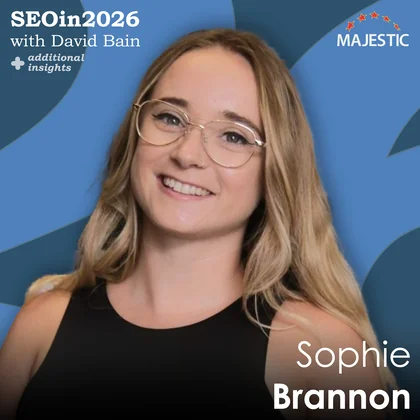
Sophie Brannon
Sophie Brannon shares the importance of balancing awareness of emerging trends with the core fundamentals that drive long-term success.
« Back to Additional insights
More Additional Insights



Sophie says: “My number one SEO tip is to not focus solely on the new shiny thing. The fundamentals are always going to be what matters most.”
How do you know if the new shiny thing is going to radically change the way that SEO is done, and it is indeed something that you should focus on?
“I think we've seen such a constant trend of the new shiny thing not changing the fundamentals – and not really being that big of a problem or even that big of a deal.
A couple of examples off the top of my head: Core Web Vitals. When Core Web Vitals were introduced and Google announced them, I was working agency-side at the time. We essentially had every single client that the agency was managing trying to completely redesign/redo all of their websites.
Granted, probably a lot of them did need doing because they were outdated anyway, but the whole point of them trying to do it was to get their score to 100 out of 100 on PageSpeed Insights, and they were super obsessed with it and throwing all of this money away at it. Then, a few years later, Google turned around, and they were like, ‘Yeah, PageSpeed's obviously really important, but we don't look at the 100 out of 100 PageSpeed Insights score, and we don't really care about Core Web Vitals that much. Ideally, it passes, but you can rank just fine if it doesn't.’ That's one.
We've seen BERT coming out. Everyone was talking about that. Featured snippets. When featured snippets were originally introduced, everyone restructured how their content was created so they would get pulled into featured snippets. Featured snippets disappeared. Reviews schema; that disappeared.
It is important to be aware of what all of these changes are, and all of these things that are happening and adapting and evolving strategies in line with that, but without completely forgetting the fundamentals of SEO being: good technical, user experience is solid, good in-depth content, and authority within your niche, within your brand, and within your space. That's never going to change.
This new shiny thing I'm obviously talking about is AI Search/GEO. Everyone's talking about it, and it has become this obsession where there's so much crossover with those standard fundamentals of SEO as well. We just need to be very aware of that and really educate people that these fundamentals are still just as important – if not more so.”
Got you.
Okay, so what you're essentially saying is that a new shiny thing comes along, be aware of it and perhaps keep an eye on it, but maybe give it a few months before you consider that it should or should not be a significant part of your strategy moving forward.
“Exactly. Yeah.
We should always be testing, always changing things, and always looking at our strategies, but ultimately, don't change your entire business strategy – especially if you're working with a brand, in-house or agency side.
Don't change the entire thing just to jump on the new, latest shiny thing.”
Should you jump on it if your client tells you to do so? If your client says, ‘GEO is where we should be,’ what's your strategy for that? Why is that not leading the way?
“We're seeing so much of that at the moment, actually, and almost every inquiry that is coming through with StudioHawk right now is talking about, ‘I want to show up in GEO, I want to be showing up in ChatGPT. I use ChatGPT all the time; my customers must be using it as well. I don't care about traditional SEO. What's your GEO strategy?’ We're just having that conversation over and over and over again, and I'm sure that's the case with so many other agencies and in-house brands as well, talking to their C-suites and their other stakeholders.
Really, what we need to be looking at is education – making sure we're explaining things in a way that is so clear to people that: ‘This is how SEO crosses over with GEO and AI search. These are some of the nuances that we may now need to be thinking about, but ultimately, let's look at how much traffic and how much revenue your site's currently getting from AI Search versus traditional versus paid versus all of your other channels, making sure that your strategy doesn't just chase the shiny new AI Search thing if it's only driving less than 1% of revenue.’
We’re rerunning this study at the moment (there has been another Black Friday/Cyber Monday, and we ran this late summer last year), where we reviewed over a thousand e-commerce websites and their data to see how much revenue was actually being driven by AI search. It came to around 0.04%, on average, back then – which is a very, very, very tiny amount, as I'm sure you can imagine.
Showing data like that, and really doing that education, is going to be key to making sure that these inquiries, brands, and individuals aren't just running away.”
Yeah, talking about the next shiny thing with clients that come to you, with big bosses that perhaps ask you to do certain things, it reminds me of back in the day, when I used to work in-house, of executives, basically saying to me, ‘We should be ranking for this keyword phrase. That's the keyword phrase that's important for us.’
But first of all, there's no traffic. Secondly, it doesn't convert when you actually get traffic to begin with. Having to educate them on that is a bit of a challenge, and you’ve got to be confident in yourself to be able to bat against that and tell the story of what works more effectively, from an SEO perspective.
One thing that you mentioned there was traffic, and you were comparing looking at how much traffic we're actually getting from a traditional organic search perspective versus AI. However, that's present day – in fact, that's perhaps a little bit historical, because you're looking at traffic from the last few months or so to get those stats.
How can you be sure that your fundamental strategy also has a nod towards what's likely to happen over the coming few months, as well, in the future?
“Yeah, and that's where testing really comes into SEO strategies as well.
When I'm saying ‘don't chase the shiny thing’, you should always be aware of it and be doing this testing and going, ‘OK, what does actually work? Is there an opportunity here? Are we seeing our clients or our competitors showing up in these spaces as well? Do we need to be looking at it, too?’
It just shouldn't completely replace some of those fundamentals because, as I mentioned earlier, technical SEO and the crawlability of a site are going to be vital, whether you're targeting Google bots or you're targeting AI bots. They need to be able to crawl the website.
Speed is going to be important. I was reading a few LinkedIn posts and some articles recently, where they were talking about the fact that AI bots are actually lazier than Google bots are. So, speed is absolutely vital as well. There's a schema argument. Can they crawl it? Can they not? Can they understand it? I don't think it really matters. I think schema is really important, regardless, because it is structured data that bots are able to understand and gain that extra context.
All of these additional fundamentals are going to be core to any strategy, but keep an eye on what's changing, keep an eye on what's coming up, always looking at what's that next opportunity in the space – just don't let it take over.”
Do the fundamentals tend to be the same for every industry, or are fundamentals a little bit different depending on what industry you're looking at?
“The core pillars are all very much the same, in terms of the technical health of the site, in terms of good content, quality content, and not AI slop. That's one of the buzzwords that we've heard over the last 12 months. In-depth content, not content for content's sake – which a lot of SEO companies fell into the trap of doing, because they could get loads of traffic and very little revenue from completely irrelevant articles and things like that being published.
Good quality content is going to be a core pillar still. Authority is going to be a core pillar still, whether that is traditional link building, digital PR, or brand-mentioned citations. If we just group all of that together, that authority is still absolutely clear as well, but when you break some of those individual pillars down, you might then be looking at different strategies for different industries, niches, and business types.
For example, in SaaS, you obviously don't have category pages, collection pages, and things like that, but you want to be building out a solid product-based strategy, talking about your services and talking about the product you offer, whatever that looks like.
Thought leadership is going to be really important depending on the industry. For example, in finance and health, there's going to be real thought leadership there, and in some SaaS companies as well. If you're doing something very dry in a very dry industry, then you might want to think about other content – maybe case studies, something like that – that would work great.
Versus e-com websites, which are probably going to be more focused on product description structures, especially when we're looking at additional trends like organic shopping and even ChatGPT Shopping – if that ever does come out, as something we want to be looking at there. But then, also, collection pages and optimizing those, making sure your internal linking is there and making sure your breadcrumbs are there, because the product inventory is so much wider.
The core pillars are all the same across all strategies, in my personal opinion, but as you niche down into individual niches and things like that, then that's when you're going to end up being more specialised with your strategy.”
You also say that holistic marketing is the future. What is holistic marketing and why is this key to SEO?
“I've always been a big believer that all channels should be working together. I think what's ended up happening is that there's always been this need for brands to segment channels in terms of their performance, and that's led to this segregated marketing approach.
For me, a holistic search strategy is looking more at: how does SEO feed into PPC? How does that also then feed into social media? How can you repurpose content you're posting out on your website across all of your other channels – your email marketing and things like that?
What's ended up happening in the past is that everything's been so segmented, we're then creating a lot of messaging, mismatched tones, different teams being responsible for different things that maybe they should or maybe they shouldn't be, and zero consistency for a lot of businesses within and across all of their marketing channels.
What we're seeing now is that the consumer touchpoint and the consumer journey are extending significantly. We're calling it the ‘new consideration era’, but essentially it's just more touchpoints that we're seeing consumers go through before they then commit to purchasing – and that includes AI Search.
That's a new information channel for people to consume within, but then that's also social media. People are looking more for reviews. They're looking at things like Reddit (that was another shiny thing that everyone jumped on top of very quickly when we saw a big Reddit surge recently).
The way consumers are making decisions is changing, so we just need to make sure all of our channels are sharing data and sharing messaging, and we've got a real consistent approach. That is going to be what search should have been doing anyway, but hasn't been, and then that will really just be the focus for a lot of brands moving forward.”
The ‘new consideration era’ and many more touchpoints is perhaps a good thing for SEOs to be more aware of where consumers are and what steps they're likely to take before actually visiting your website and perhaps making a purchase, but of course it makes measuring a big challenge as well, and the justification of activities that you're trying to do because you're not necessarily focusing on conventional SEO.
What are your thoughts on those two areas there? First of all, measurement. How do you actually measure the value of those various touchpoints? And secondly, is it really SEO when you're looking at holistic marketing?
“That's a great question, and I think that attribution side of things is getting much more difficult. Even with just changes to cookie policies and things like that – with obviously GDPR in Europe, and you've got the CCPA out in California. There are all of these different things that are muddying that water.
That being said, SEO does pretty much hold up the backbone for a lot of these channels and always has done. As you say, though, it is getting a lot more difficult for that budget for each of these channels to then be justified. Especially if, for example, people are finding brands via the SEO work you're doing, but then they're converting later via social media retargeting, because they've already been on your website four or five times. Then, we're having those conversations like, ‘Hey, actually, that lead originally found us via SEO. That is ours.’
So yeah, it's becoming more difficult, and that's a challenge we're going to keep facing, even with AI search coming through as well, and actually seeing where revenue is coming from.
But that being said, I don't believe that should take away from the importance of all of the brand consistency and the brand messaging and all channels supporting each other, because ultimately that's going to be what drives brand revenue moving forward.”
How often should we be reviewing fundamentals? Is this something that we do on a quarterly strategy basis, or when something new and shiny comes along, do we just take a note of it, benchmark it, then determine in a few months' time whether or not it's actually impacted other brands out there?
How do we actually change the elements in our fundamentals?
“I think the fundamentals will always consistently be looked at. For example, technical auditing should be done on a very consistent basis.
We do it sometimes weekly or fortnightly, for some of the larger clients that have a lot more moving parts on websites, sometimes monthly for some of those more static websites – again, just to make sure that pages haven't randomly been de-indexed. Especially if you don't have total control of a website and there are dev teams switching things around or deciding to index stuff for fun. All of these kinds of things. Technical foundation should be an ongoing process.
Content fundamentals, that again should be an ongoing process: looking at competitor content gaps, looking at opportunities where our competitors are visible and we're not, looking at how search and how users in that field are changing and what questions they're asking, talking to customer service teams, making sure that we've got up-to-date FAQs and up-to-date information on our websites, etc. There's nothing worse than delivery times and shipping prices and things like that being inaccurate because they've changed internally and not on websites, and all of those kinds of things as well.
Then, from a link acquisition perspective, that will always just be consistent growth. It's not necessarily a defined: is it quarterly, is it every six months, is it annually? I think it should just be a consistent month-on-month review, looking at your strategy, looking at what's working/what's not working and then continuing to refine that and then bringing in: are there any of these new shiny objects that we need to then actually factor into our strategy, or is it not worthwhile?”
In terms of tracking success, what reports or software are you consistently finding yourself going to at the moment to really assist you with telling that success story to clients?
“Relying on the traditional channels and analytics channels has been something that we're continually doing – so Google Analytics and Search Console. We're building out new dashboards where we're segmenting different traffic types: whether they're coming to collection pages or product pages, and where revenue is coming from, etc. Honestly, traffic is an interesting metric to even still look at now.
For me, it's all about revenue, bottom line, and how many leads are coming through. All of our marketing channels should be aligning back with that anyway.
When we are looking at the AI search stuff, we still use Semrush very heavily. That's always been something that we have looked at to make sure that keyword visibility and all of that's growing – but then their AI search channels (same as Ahrefs' Brand Radar), we've been playing around with that a little bit. Peec.ai, as well, has been another one for more specific prompt tracking.
Again, it's very much testing and seeing which tools out there are the best for our client's needs, based on the data that they're looking for.”
Sophie, what's the key takeaway from the tip you shared today?
“The key takeaway is going to be: always be aware of the new industry changes and what's coming out in the SEO industry, the marketing world, and the search world overall, but don't always just chase that shiny object.
Think bigger picture about the wider strategy, even if you're getting pressure from stakeholders, C-suites, and clients above. Look at your revenue drivers, what works for your business, and what could continue to work in the long term.”
Sophie Brannon is Co-founder and Director at StudioHawk US. Find out more over at StudioHawk.com.
Choose Your Own Learning Style
 Video
Video
If you like to get up-close with your favourite SEO experts, these one-to-one interviews might just be for you.
Watch all of our episodes, FREE, on our dedicated SEO in 2026: Additional Insights playlist.
 Podcast
Maybe you are more of a listener than a watcher, or prefer to learn while you commute.
SEO in 2026: Additional Insights is available now via all the usual podcast platforms
 SEO in 2026
Catch up on SEO tips from 117 SEO experts in the original SEO in 2026 series
Available as a video series, podcast, and a book.
Fresh Index

Unique URLs crawled
194,188,717,434
Unique URLs found
618,052,412,077
Date range
07 Apr 2026 to 05 Aug 2026
Last updated
1 hour 2 minutes ago
Historic Index
Unique URLs crawled
4,502,566,935,407
Unique URLs found
21,743,308,221,308
Date range
06 Jun 2006 to 26 Mar 2024
Last updated
03 May 2024
