-
Site Explorer
- Majestic
- Summary
- Ref Domains
- Backlinks
 New
New- Lost
- Context
- Anchor Text
- Pages
- Topics
- Link Graph
- Related Sites
- Advanced Tools
- Author ExplorerBeta
- Summary
- Similar Profiles
- Profile Backlinks
- Attributions
- Compare
-
Link Tools
- My Majestic
- Recent Activity
- Reports
- Campaigns
- Verified Domains
- OpenApps
- API Keys
- Keywords
- N-grams Near Links
- Keyword Checker
- Search Explorer
- Link Tools
- Bulk Backlinks
- Neighbourhood Checker
- Submit URLs
- Experimental
- Index Merger
- Link Profile Fight
- Mutual Links
- Solo Links
- PDF Report
- Typo Domain
- TLD Checker New
- Free SEO Tools
- Support


In an AI-heavy world, localized and culturally aware content is essential
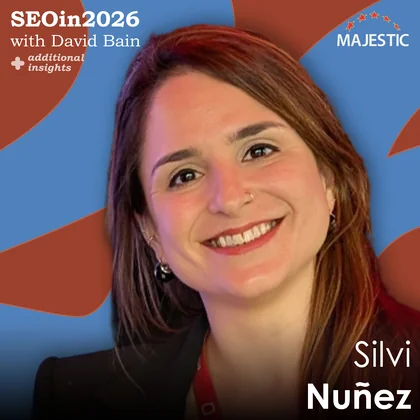
Silvi Nuñez
Silvi Nuñez shares that in an AI-heavy world where content feels generic, localized and culturally aware content becomes a powerful SEO strategy in 2026.
« Back to Additional insights
More Additional Insights



Silvi says: “In an AI-heavy world, where content feels so generic, localised and culturally aware content becomes a powerful SEO strategy in 2026.”
Okay, wow. So, what is localised and culturally aware content?
“Especially now, in 2026, we have an infinite amount of good enough content, but ‘good enough’ doesn't really rank anymore because search engines have evolved, and they now look for (and reward) relevance, depth, and engagement – and talking to people in their language is a huge part of that.
A while back, having your website in English and maybe one other language, that worked. Your company sold. Today, people expect brands that really talk to them. If you don't, they'll just close your site and move on to the next one. It's not just about talking to people in their language, but taking their context into account as well, and this is where the difference between translation and localisation comes.
Basically, when you translate, what you do is you make content available in a new language so that people can read it, right? But when you localise, you make the content relevant to a new culture, to a new context, so that people can actually trust it.
If you allow me, I would love to give an example because sometimes it's a little bit confusing. These terms are oftentimes used interchangeably (I do it all the time).
For example, let's say that a US-based e-commerce store wants to reach Spanish-speaking audiences that live in the U.S. – people who speak Spanish and who live in the U.S. We have the same market, with the same buying habits. We have the same delivery expectations, pricing, currencies, and so on. So, language access would be the main barrier. In this case, the translation from English into Spanish works.
Now, let's say that this same US-based e-commerce brand wants to expand from the US into Spain. Now, here we have a different buying behaviour. For example, in Spain, people typically tend to do more research than in the US. Trust signals matter more. Keywords change because people talk differently, they search differently, and they have different intent.
An example that I love is: say that someone in the US wants to buy a security camera. They are probably doing it for convenience, to see if a package has arrived at their home. Now, in Spain, if a person wants to buy a security camera, perhaps it's because there is a lot of illegal occupation in Spain, which is called ‘ocupas’.
So, rather than doing it for convenience, they're doing it for protection. There's a different intent. If your SEO content only focuses on convenience, then you've actually missed the cultural ‘why’ of the Spanish market.
Additionally, tone must feel local. For example, localising a Thanksgiving campaign for Spain wouldn't make any sense because Thanksgiving is not really celebrated in Spain. Shipping return methods all need to be adapted.
Basically, in this case, translation would not be enough. You need to localise the language. You need to localise the user experience, the trust signals, and so on. To summarise it, translation makes the content understandable – it makes your product accessible to a new audience – but localisation makes it believable. It makes people trust it.
Okay, so how do you make your content as believable as possible with really effective localisation?
Is it essential to have someone with their boots on the ground in the country itself that you want to operate in?
“Yeah, definitely. Ideally, you always want to work with people who live in the country and who are exposed to what's going on: the news, the culture, the terminology that's used there, etc. Ideally, you always want to work with native people.
This is where a lot of companies fail. I've seen a lot of companies that just take the bilingual person from the office, and they're like, ‘Hey, can you make this content available in a new language?’ That person, perhaps they’re not exposed to the culture, or perhaps they’re not a linguist, so they don't really make linguistically correct content, or perhaps they're busy with their tasks. They don't really have time for your project.
A lot of times, the projects end up halfway through or with a lot of inconsistencies. So, yeah, definitely try to always work with an expert/professional from the country you want to target.”
How do you know when it's worth your while to just do translations to begin with? Obviously, it's very easy to do translations nowadays. You can do them mostly with AI and perhaps edit them a little bit afterwards, then get them up there as quickly as possible.
How does a brand know when that's not enough and you have to do the localisation before you hit publish?
“Okay, so, here I would like to make a note. I am not against AI; I actually embrace it. I love it, and I think that you can use it for a lot of tasks in the translation/localisation world, but you have to be smart about it.
Some of the content can be translated even just through an AI workflow, but you have to prioritise what content you will use with that workflow. For example, user-generated content and content that has low search volume, that's not really very important; perhaps you can do some tests with AI for that kind of content.
To determine what content requires localisation, it's all about doing some research. Perhaps you can work with someone who can walk you through it, tell you what can work and what can not work in the new target market. It's also very important to do research early on before starting your localisation process, and to filter your content. Put parameters or priorities on what kind of content should be handled in which way.
And, as always, this is always a test. Test, see how it works, see what kind of results it gets, and then continue.”
How do you measure the impact of being more culturally aware of and incorporating culturally relevant elements within your content?
“I believe this would depend a lot on how you actually measure this in your target language, in your English version, for example, or in your source version.
For example, organic traffic by country or by language. This is the starting point. Also, you can measure engagement metrics, like how much time the user is spending on the page, or the scroll depth. If these metrics increase after you localise a page, then it's a signal that the content is resonating locally.
Also, conversion rates per language/per market. A successful localisation strategy should see higher clicks in the target market. Also, local backlinks and local mentions. If local sites start citing your content, it's because you've provided something of value to their community.”
What would you say to a brand that is struggling to justify spending too much money on localisation/culturally aware content? Is it OK to just translate and get it published to begin with, and then adapt the content towards the end?
“I'm always in favour of doing tests. This is actually a very common issue. It's very difficult to justify localisation budgets because the truth is, localisation is expensive. It requires tools. It requires working with professionals. Companies that usually embrace localisation have a lot of content that requires processing.
Many times, companies come, and they're like, ‘Oh, I want to expand into 10 languages.’ Rather than doing things big, start small. Start with one language. Rather than doing the full website, start with the most important pages. Test, see what kind of results it gets, and then continue with the other languages or with the rest of the content.
You could try different workflows. For example, you could try a localisation workflow in some of your pages, you could try an AI workflow in other pages, and then compare and see what kind of results it gets.
Something that I believe is important to keep in mind is that AI tools lack content, they have errors, and they don't understand your brand. If you embrace AI, you will have to accept the fact that, if there are errors in the content, people will associate these errors with your brand.
Something that you could also do is, if you use AI, you could be open about it. Tell your audience that the content they're about to read is machine-translated. This way, you separate from any bad reputation that the content could give you.
I believe it's all about testing and seeing what works better for you.”
You also talk about how localisation and becoming more culturally aware in your content can actually be a powerful SEO strategy. Why is that a powerful SEO strategy?
“SEO is basically about bringing people to your website, but that's half of the job. You have to make people stay, you have to make people choose your product, and I believe that's where localisation comes in.
It's what ensures that the traffic that you worked so hard to get actually stays and buys. As marketers, our goal is to try to remove any friction – anything that will make your user stop and think, ‘Hmm, should I buy this or not? Should I perhaps leave it for a later time?’ I think that localisation is a great tool to remove that friction.
That's the role of localisation in SEO.”
Lovely, and how does this get integrated into an overarching SEO strategy? Is this something that needs to be discussed once a quarter or as part of deciding a global content plan? How would you go about doing it?
“It depends on what kind of budget you have for this. Many companies, what they do is they allocate a budget at the beginning of the year and then by mid-year, for example, they review the results and see whether or not they continue investing in this. That is one way to do it.
The idea is to prepare a plan, prepare a strategy, set some goals, and then start small. Start putting it out there and then define what the next steps will be.”
Do you have any thoughts on how evolving technologies or the way that SEO is done are continuing to change localisation and what will happen over the coming year or so, in terms of strategy, in order to deal with that?
“I think that AI is doing a better job each day – not only in terms of the content it's generating, but also in the local nuances. It's pretty good at, when you say, ‘Hey, talk in Spanish for Spain,’ ‘talk in English for the UK,’ or ‘for the US’. It's doing a pretty decent job on that. I think it will continue evolving, but I don't think we are there yet.
In any case, I believe that, nowadays, AI tools can be implemented in various parts of the localisation workflow, and I believe that it will get better as we move on.
In terms of SEO, I think it's great for generating content and for asking for ideas, but I still feel that we need a person with actual SEO knowledge involved in the process to continue optimizing and continue implementing the traditional SEO best practices – like inserting keywords in certain places, creating backlink strategies, and so on.
I think that we still need an expert in the process for now, but I believe that, in the future, it's going to be amazing. I can't wait for it.”
You mentioned keywords there as well. Is that still a very important part of it? Obviously, you can't necessarily directly translate keywords and come up with a phrase that a local market is likely to use.
“Yeah, undoubtedly. A very basic example: if you wanted to buy a pair of running shoes in the United States, you would look for something like ‘sneakers’, and in the UK, perhaps ‘trainers’.
Finding out these differences, this is still done through keyword research. Keyword research is still a very important part of the process.
Search engines are doing an amazing job in finding similar phrasing, but still, simply translating keywords is not enough. You have to take psychological aspects into consideration, such as intent and the way people search. I think it's still part of the process.”
Silvi, what's the key takeaway from the tip you shared today?
“I think that, in 2026, relevance is still key for SEO, and AI is an incredible tool for scale, but it's a terrible tool for empathy.
My recommendation is to use AI to build your foundation – to handle your drafts, your speed – but use human cultural insights to win the market. Don't just aim to be readable in a new language, aim to be trustworthy.
I believe that's where you will stand out from the competition.”
Silvi Nuñez is Co-Founder at Optimational. Find out more over at Optimational.com.
Choose Your Own Learning Style
 Video
Video
If you like to get up-close with your favourite SEO experts, these one-to-one interviews might just be for you.
Watch all of our episodes, FREE, on our dedicated SEO in 2026: Additional Insights playlist.

 Podcast
Maybe you are more of a listener than a watcher, or prefer to learn while you commute.
SEO in 2026: Additional Insights is available now via all the usual podcast platforms
 SEO in 2026
Catch up on SEO tips from 117 SEO experts in the original SEO in 2026 series
Available as a video series, podcast, and a book.
Fresh Index

Unique URLs crawled
194,188,717,434
Unique URLs found
618,052,412,077
Date range
07 Apr 2026 to 05 Aug 2026
Last updated
1 hour 2 minutes ago
Historic Index
Unique URLs crawled
4,502,566,935,407
Unique URLs found
21,743,308,221,308
Date range
06 Jun 2006 to 26 Mar 2024
Last updated
03 May 2024
