-
Site Explorer
- Majestic
- Summary
- Ref Domains
- Backlinks
 New
New- Lost
- Context
- Anchor Text
- Pages
- Topics
- Link Graph
- Related Sites
- Advanced Tools
- Author ExplorerBeta
- Summary
- Similar Profiles
- Profile Backlinks
- Attributions
- Compare
-
Link Tools
- My Majestic
- Recent Activity
- Reports
- Campaigns
- Verified Domains
- OpenApps
- API Keys
- Keywords
- N-grams Near Links
- Keyword Checker
- Search Explorer
- Link Tools
- Bulk Backlinks
- Neighbourhood Checker
- Submit URLs
- Experimental
- Index Merger
- Link Profile Fight
- Mutual Links
- Solo Links
- PDF Report
- Typo Domain
- TLD Checker New
- Free SEO Tools
- Support


Inclusive language & LLMs: Why what we feed AI matters
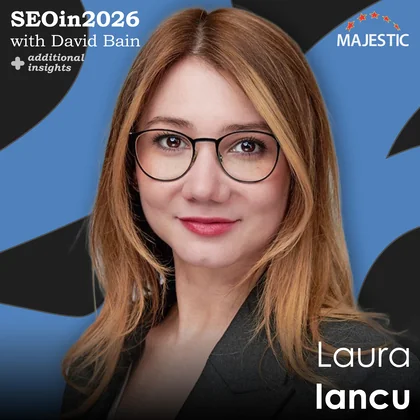
Laura Iancu
Laura Iancu explores the importance of mindful prompting, bias mitigation, and building an inclusive internet through responsible AI use.
« Back to Additional insights
More Additional Insights



Laura says: “All right, so my number one tip for 2026 is a nice, kindly piece of advice to everyone working in search out there, to be creating a more inclusive version of the internet through more mindful prompting.
Because nowadays it's all about AI search, so I know we've done our bit with search and we do it every day – we do our best to make the internet more accessible and more inclusive for all – but it's time to think about how we're prompting as well.”
OK, so a more inclusive version of the Internet. That's a big, worthy goal there, and you also said, ‘through mindful prompting.’
Would you like to expand on those statements slightly?
“Absolutely, yeah. I'll start with just doing a bit of an intro about myself, so I can set the context on a few points that I want to address. I've lived between cultures, pretty much. I'm a Romanian living in the UK. I lived in Europe and Asia for a while, and I've experienced the different culture between East and West, both online and offline, and I found out how it feels to be a bit reduced to stereotypes sometimes.
I know how it sounds, but regardless of where you are in the world, at some point, you are going to be confronted with being reduced to stereotypes, whether you work in marketing or any other environment that you'd probably be in. These stereotypes are very easily translated nowadays into the search environment, and obviously in our own conversational threads with any AI platform of our choice (the ones we would choose to operate the most, whether it's ChatGPT, Gemini, Perplexity, and so on).
The way I'm approaching mindfulness prompting is to address that extra thought that you put in behind writing your own prompt or the way you speak directly with your AI assistant. We know, for a lot of us, we obviously just press the record button, and we have a full-on conversational thread with the AI. It's more about how we approach our own language in that context, and realising that we're actually training these models within some categories that they will then operate throughout the entire platform.
That's the gist of it.”
Okay, and why does feeding what we feed into LLMs really matter?
What are one or two examples of not feeding it good things, and how to feed better things into it?
“I think we're somewhere far off in the game in order to differentiate between bad prompting and good prompting. Most of us who work in marketing have had a bit of time to play with the tools and understand how they work. However, we have to realise that we're only a small percentage of the people who use the AI at the moment, right?
Your grandmother might use AI, your mother might use AI – different generations, different cultures, and so on might use these platforms to start a conversation or look at what to buy, or any of the many, many use cases out there for these LLM platforms. What research has long documented is some algorithm bias when it comes to these platforms.
Obviously, we've got a couple of really good books out there. I'm just going to mention Safiya Noble’s Algorithms of Oppression, (which is obviously based on search rather than LLMs; it's a bit of an older book). We're getting to a point where we're starting to be a bit more in tune with what we're actually feeding out there.
When it comes to writing bad prompts, I mean, come on… We're in the day and age now where we can make a very clear distinction when you work in search, but I feel like we should share our findings with the rest of the world on how to talk to an AI.
For example, avoid gender stereotypes when you're writing, because this way you're feeding categories within the model, which then replicate and replicate infinitely. We tend to address the more vocal searches, the vocal personalities, and the more prominent categories. What I like to say is that we tend to propagate the more vocal categories out there, rather than making sure that the most unheard voices are present.”
You also talk about how LLMs can act as mirrors and multipliers of human language.
What do you mean by that, and what impact does that have?
“We've all had the experience where we've created a bit of a, let's say, relationship (if you want to call it that way) with a sentient creature, which is the AI model. What's important to understand is that the AI model that you're training currently (whether it's ChatGPT, Perplexity, Copilot, Gemini, or whatever) will eventually sound and look like you, and reflect back your own beliefs, your own biases, and pretty much your ethical views of the world.
If you're a white woman aged 30 to 40, same as myself, and I'm only inputting my own personal experience when I'm training the model, that might not be enough. It might not be enough in the sense that, obviously, if I'm working with AI (which most of us do), it has this tendency to replicate what you're already feeding to it, and it might limit your research to the one category.
It's really, really important to look beyond that mirror and include a bit more categories within your research. Regardless of your nature of business – if you're doing search, if you're doing PPC, if you're doing anything really. If you're just doing a blog outline, for example. I can give you a good example, actually, because I recently thought about how I can prove how these categories work within an AI search platform.
I asked a very simple question. I said something along the lines of, ‘If I'm a duck, and the only birds you know at the moment are robins, and I ask you, ‘Would you feed me robin food or duck food?’, what food would you actually feed me, if the only things you know are robins?’ It obviously responded, ‘Well, since robins are the only birds I know, I would feed you robin food.’ Well, yeah, but I'm a duck, so obviously you don't have that bird category integrated within your system, so you obviously wouldn't know my nutritional needs – whether I'm even flying right now, whether I'm a local bird, etc.
That's a bit of LLM bias in a nutshell. That's pretty much the mirror effect that we professionals (and not only us) can have on these platforms – which, at the end of the day, are being trained by us.
There are so many pitfalls, obviously, that could happen from that. The birds example was pretty much harmless, but obviously, you can expand on that and understand how harmful it can be in the long run.”
Is it the inputter's responsibility to try to ensure that there's no bias, or is it the AI's responsibility primarily, or is it both AI and the inputter that have to really get this right?
“That's a very funny question because it comes down to what people understand about AI.
Obviously, you're thinking about intelligence when you're talking about artificial intelligence, but it's not really intelligence per se, if you think about it. You can't necessarily attribute these sorts of elements to it. You have to take responsibility because, at the end of the day, you're the person training it. You're the entity training the model.
I think robots aren't there yet, to be able to take responsibility, so I'd say it does rely on us – and obviously the people regulating these platforms (because we all know there's been quite a lot of scandal around certain platforms, which obviously I'm not going to mention now).
But yeah, it's with the regulators and obviously us as consumers.”
How can we ensure that we're actually not biased? We can have the best will in the world when inputting data, but we have a collective experience. We have a set of experiences based upon what we've done in the past, and we may not necessarily believe that we have bias ourselves.
So, is there a way to check our own biases to ensure that we're not inputting questions or data that is skewed in some way?
“Absolutely, and I think the proof is in the pudding here. I've started questioning myself via the AI system.
It's funny I'm actually mentioning this because, obviously, back in the day, if you were a copywriter, for example, you'd go and double check with your peers and say, ‘Hey, does this sound right? Do you think I'm limiting this experience to myself? Is this a bit of a cliché? For this message, who is centred, or who is missing?’ and so on. Whereas, now, I've actually started communicating with the AI and asked the question myself.
I said, ‘Do you think this is covering all of the categories that you currently have? Do you think I can add a little bit more, or subtract from what I'm trying to convey here?’ What I'm trying to say is, I'm critically reviewing the initial outputs myself, and then I am doing a double tap by critically reviewing the output with the actual AI system.
Obviously, if it's a very important message that I'm trying to put out there, I will involve other people as well – potentially those who are not necessarily from my own category: standard, white female, glasses, nerd, right? That's pretty much it, I think, in terms of trying to make sure you're up there.
Obviously, there's quite a lot of reading on the topic as well, which I always encourage people to do if they've got the time, energy, etc. I'd say just do it because, sooner or later, we'll all accept the fact that this isn't just niche activism anymore; ‘Hey, write inclusive prompts!’ It really isn't. It's becoming almost a governance concern because, if you look at documents like the UK's AI regulation white paper, that's already there. It's just been updating and updating every year.
Now, you've got certain resources out there that you can rely on, and they're obviously updated all the time. You've got the APA inclusive language guidelines, which you can always double-check. There's also the GLAAD, which is the media reference guide that you can always check. It's public record; you can go online and have a look over there. You've got Disability Rights UK, where they've got a very nice section about how to address the community and the language that you should be avoiding, and how to make yourself an ally at the end of the day – because we're all individuals, we're all going through our own thing.
It's just nice when we make the future of AI (if you want to call it that way) less biased and more true to reality, rather than limited to the one category.
I would like to end the whole idea (because this is something I came up with recently and I just love; I just feel like it encompasses everything) with the fact that search – AI search and traditional search – is a cultural infrastructure. We all need to treat it like it matters, because it does. It's as simple as that.”
I'm glad that you used the phrase ‘closer to reality’ as well as moving away from bias, because it's a really tough problem.
You described yourself as being ‘white, female, glasses’, and I'm sure there are certain job roles that have more people who look like you than other job roles. There are more job roles that have certain other types of people – people of colour, male, female, whatever type of mix we're talking about there as well.
We want AI to be accurate, representative, not biased against certain cultures, but also true to what historically has been the case. How do we ensure that we are both honest in terms of the current representation within certain roles, while at the same time not wanting to be biased?
“That's a very good question, David, and I think it all comes down to understanding, first of all, the AI’s limitations and helping break them.
We're not going to help break them just through our own experience, at the end of the day. We have to rely on communities, and we have to make sure that we're keeping updated with everything that's happening out there. If we want to use AI, we need to take on the responsibility of using AI.
There's no going back now; you're either all in and you get involved, and you're out there trying to make things happen and helping it to, as you said, avoid past mistakes. Back in the day, when you would type things into search like ‘short hairstyle for women’, you used to just get white women with bobs, which was completely not the reality, was it?
We need to understand the limitations, try to break them, and counteract it before it starts happening. I think we're actually doing a pretty good job at the moment, especially in search, but I feel like we need to be a bit more vocal out there – even within our own organisations, at the end of the day, because we know everyone's using AI – and be more transparent on practices and share more resources or help create them, if they're not out there.
Treat it as a growing monster, let's put it that way – but a monster that you can tame at the end of the day, not a Hydra with seven heads that you need to constantly cut.”
Laura, what's the key takeaway from the tip you shared today?
“I think the key takeaway is for us, everyone in search and marketing, to start treating this whole AI environment – regardless of the nature of us using it, whether it's just conversational or it's actually building strategies or layouts for our blogs – more mindfully.
Be open and transparent to everyone that we're collaborating with, and try to propagate this idea that, at the end of the day, it is a cultural infrastructure and treat it as such.”
Laura Iancu is an Independent Search and AI Consultant and Founder of SearchPedia. Find her over at SearchPedia.co.uk.
Choose Your Own Learning Style
 Video
Video
If you like to get up-close with your favourite SEO experts, these one-to-one interviews might just be for you.
Watch all of our episodes, FREE, on our dedicated SEO in 2026: Additional Insights playlist.

 Podcast
Maybe you are more of a listener than a watcher, or prefer to learn while you commute.
SEO in 2026: Additional Insights is available now via all the usual podcast platforms
 SEO in 2026
Catch up on SEO tips from 117 SEO experts in the original SEO in 2026 series
Available as a video series, podcast, and a book.
Fresh Index

Unique URLs crawled
194,188,717,434
Unique URLs found
618,052,412,077
Date range
07 Apr 2026 to 05 Aug 2026
Last updated
1 hour 2 minutes ago
Historic Index
Unique URLs crawled
4,502,566,935,407
Unique URLs found
21,743,308,221,308
Date range
06 Jun 2006 to 26 Mar 2024
Last updated
03 May 2024
