-
Site Explorer
- Majestic
- Summary
- Ref Domains
- Backlinks
 New
New- Lost
- Context
- Anchor Text
- Pages
- Topics
- Link Graph
- Related Sites
- Advanced Tools
- Author ExplorerBeta
- Summary
- Similar Profiles
- Profile Backlinks
- Attributions
- Compare
-
Link Tools
- My Majestic
- Recent Activity
- Reports
- Campaigns
- Verified Domains
- OpenApps
- API Keys
- Keywords
- N-grams Near Links
- Keyword Checker
- Search Explorer
- Link Tools
- Bulk Backlinks
- Neighbourhood Checker
- Submit URLs
- Experimental
- Index Merger
- Link Profile Fight
- Mutual Links
- Solo Links
- PDF Report
- Typo Domain
- TLD Checker New
- Free SEO Tools
- Support


Translating SEO into a language of tangible business impact
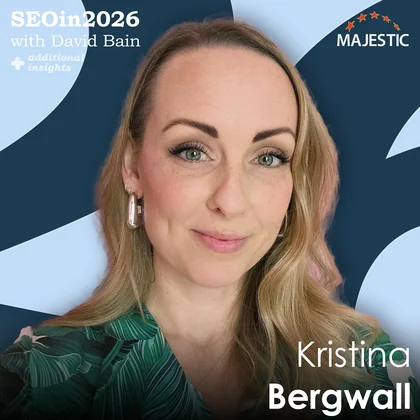
Kristina Bergwall
Kristina Bergwall discusses the importance of translating SEO into a language of tangible business impact in the future AI search landscape, and using that narrative to align all teams such as social, PR, and brand to work together, is what's going to make you win at SEO in 2026.
« Back to Additional insights
More Additional Insights



Kristina says: “My number one tip for 2026 is: stop optimising pages and start optimising organisations.
In the age of AI, SEO leads must evolve into system architects who build the cross-functional infrastructure (like visibility gates, for example) that allows brands to be seen, understood, and recommended by both machines and humans.”
Is this something that every SEO needs to do, or is it more of a strategic Manager/Director of SEO role that you're talking about here?
Because I would imagine an SEO listening to that piece of advice – stop optimising pages, start optimising organisations – then they'll think, ‘What on earth do I have to do in order to do that? Do I have to completely revisit my role here?’
“No, not at all. Fair question.
So, this is more of a tip for people who are in charge of leading a team, but also leading internal teams, both agency and in-house: the people who have that contact, directly, with business and key stakeholders.
It's for them to drive, but it's for everyone – regardless of your level of where you work in an SEO – to jump on this journey that we're on right now, to help organisations to help brands evolve to visibility-first organisations, and we need to hold their hands on this journey.”
What does a visibility-first organisation actually mean?
“Good question. A visibility-first organisation is a business that understands the need right now, where we are with search, to make all the decisions and structure their business to ensure that they cater to where we're going in search – to be able to be visible where people are going to be searching, and in the tools that we're going to be using, and be where their customers are – which is in search in generated answers through LLMs and algorithms, combined.
To be visible as a brand in the future, you need to take AI search seriously and start making all the decisions through that filter.”
How do you measure the value, though, of different types of visibility, because surely being visible on AI search isn't necessarily as valuable as being visible on other search engines as a result of content published on your website?
“Absolutely. My take on that is, even if you're an organisation who don't think about search as a main channel, you're still a business that exists digitally. It's about your brand, and it's about the perception of your brand.
It's still going to be important to think about the perception of your brand in LLMs. What do LLMs know about you as a brand? What do people find out about you? How are you being recommended in different experiences online, which is decided by LLMs?”
You also talk about an SEO's role changing into becoming more of a systems architect. What's a systems architect?
“A systems architect is someone who thinks beyond just the expert role. Right now, a lot of SEOs are acting as strategic partners, internally or as an agency, but we need to go a little bit beyond that.
We need to, as I said, help organisations on this journey to become visibility-first organisations. This is the time for people to step out of the SEO basements and into the limelight, and be that person who actually drives the shift forward.
Just to take a look at some statistics, 91% of decision makers have asked specifically about AI visibility in the last year, according to research through Digitaloft. That tells us that C-Level is taking notes. They understand that this is a shift; it's happening.
This is the time for SEO experts and leaders to step up to the plate and bear that flag of ‘Right now we need to organise ourselves through this.’ We're in a place right now where we need to go beyond that polite collaboration between different departments and try to break the silos.
It's not enough anymore. We need to really work together to create a structure that is catered towards the new reality, if you're a brand that exists in the digital world.”
If an SEO director, say, is listening to you saying this, but they're working in an organisation that's siloed – that is entrenched in more old-fashioned ways of doing things – what would be a few steps that they could take initially to try and push their role forward, to actually become that systems architect and encourage the organisation to change more?
“I think it's about relationships. That's the first thing that I talk a lot about: creating relationships to be able to collaborate across invisible, visible borders. That's the first step.
As a person, there's so much you can do to break down those barriers. I've talked before about the different ways of creating this collaboration (I call it the ‘collaboration blueprint’). You need to find the stakeholders, and you need to build relationships, and you need to find someone who will be willing to test something out with you, see the results from what can happen if you collaborate across these borders, launch it, showcase it, and then build on that.
There are ways that you can start collaborating across different departments to get this going. However, there's only so much you can do before you can hit that wall, because change really needs to come from the top, right? You need to get C-Suite on board. You need the organisations and the brands that you work with (or work within) to really think about: ‘How do we restructure the company?’
It doesn't need to be a massive restructure. One thing you can do, for example, is to really look at the OKRs that you have as a business. Where do we want to be in the future? How do we want to be perceived? Where do we want to be seen and found? There are a few different things that you can do, apart from just creating a vision and giving people OKRs that hold them accountable to drive this forward.
There are a couple of other things I've got in mind. A visibility dashboard, for example. That's a practical example of what you can do within organisations right now to create a space where all the different teams, all different verticals, can see what we are doing together to drive our brand forward, to drive our visibility.
Obviously, when it comes down to it, it's the revenue, right? It's the numbers, it's the leads. But we need a place where we can all see our different metrics come together – in a visibility dashboard, for example.
Then there's a different thing that you can do, which I call the visibility gates. It's basically a way to ensure that everything that you do goes through the lens of visibility. It can be things like product page templates can't go live without making sure that they pass through different sets of guidelines that we have. Does it have schema markup, or does it ensure that LLMs can pass data accurately?
We can look at a brand signals gate: how the PR copy aligns with the entities that we're optimising the website for, or accessibility and readability. How can RAG systems potentially chunk this information? All those kinds of things, to make it a bit more practical for what teams actually need to go through before we make any decisions that pass through this visibility gate.
I'm not sure that answered your question. That was a very long way to answer.”
It's provoked many more questions. I'm trying to decide on which one to move forward with. In relation to visibility gates, I'm imagining that's a role for an SEO executive moving forward – ensuring that every piece of content that does get produced has a template/a set of suggestions that have to be included within that piece of content.
You talked about schema, and you talked about ensuring that the data could be parsed by AI as well. Are there any other elements that absolutely have to be included in every single web page moving forward?
“Oh, that's a good question. I think that depends a lot on what kind of industry/what type of website you're driving. You know, we talked about how some companies – if you're talking about a massive e-commerce website or we're talking about small B2B brands; it'd be very different in terms of how we need to work on the actual webpage.
It's also going to be (as you know, a lot of people are talking about it right now), so much more important to think about the information about your brand that goes on outside of your website as well.
We talked earlier about how your brand is perceived in LLMs. That's obviously about how people are talking about you in loads of other places online. I think it's going to be equally important to look at what we actually do on the website and what we actually do off-page as well.”
I guess the challenge is that you don't want to be a blocker as an SEO department. You don't want to stop things from being published and getting done, because sometimes getting published in a sub-optimal way is better than not being published at all.
Are these metrics – or visibility gates, as you call them – something that can be trained to your content teams, to other people and organisations, so people can just check things themselves and just get things published quickly?
“I think so. I think it comes down to a few things.
One is, like I mentioned, the OKRs: making sure that everyone in the business is on board, and that this is what we're doing now. Then, it's education. It's really important that everyone understands why we're doing this, and that it's thoroughly and transparently communicated throughout the organisation, so everyone is on board and understands what we're doing.
Then I think it's really important for the person responsible (the SEO leader/the SEO expert) to really step into the limelight. Step into the lights. Step into that role of being that go-to person for everyone internally, at least initially, so that people have someone to go to.
For a long time in SEO, we have worked quite separately from a lot of other teams – unintentionally so. I feel like we're at the cusp of the golden age for SEOs to take a lot more presence and be noticed throughout organisations a lot more because of what's happening with AI search.
I'm just really eager for everyone to grab hold of that opportunity and become the systems architect, or whatever you want to call it, to help organisations to restructure themselves, to really think about how we align ourselves to this new future we're seeing.”
What does this mean for software used in the business? ‘Systems architect’ alludes to the selection of software to do different tasks and perhaps even publish content in the business as well.
Should an SEO be in charge of doing that? What are your thoughts on, in general, the software that better assists the type of approach you're recommending?
“I think no one's better equipped than an SEO expert to help an organisation in terms of the tooling – and also AI optimisations internally, for how we can work more effectively – because we're doing a lot of that and we know loads about it.
Right now, we're in a place where there's a lot of change, right? There are a lot of new tools, and there are a lot of new ways of doing things. We need to realign our KPIs to the new reality we're in right now.
It's a bit of an impressions game. How do we measure that? Obviously, we need to move away from rankings. What do we move to then? Some businesses are still there. There's a lot of work that we need to do in that area.
When we're talking about this new vision or reality, it feels like a lot of responsibility falls onto an SEO leader/an SEO expert, but I also think it's important to make the point that a lot of this responsibility needs to be distributed throughout the organisation or the business that you're working with, so that it doesn't solely fall onto SEO.
That's why I feel it's so important that organisations become this visibility-first operational approach, because then the responsibility of driving this narrative doesn't solely fall onto the SEO experts.”
You talk about the necessity to move away from rankings and obviously evangelise the importance of visibility, but how do you measure the impact of visibility when it doesn't necessarily happen on your own website?
“There are a lot of new metrics we need to look at. It totally depends on what kind of business you are, obviously, but the health of your sentiment to impressions over time, and channel authority.
When it comes down to it, though, we're looking at revenue or leads. That's where we need to shift the focus to.
In the past, SEO has, for some businesses, been a bit of a nice-to-have – something that you can pause if you don't want to do it: ‘We've optimised the site a bit now, let's pause it.’ But this is also what we need to move away from and make sure that we translate SEO into a language of revenue, and leads, and money.”
Kristina, what's the key takeaway from the tip you shared today?
“The key takeaway today is that we need to make collaboration non-optional by implementing visibility gates internally to be able to drive organisations to become visibility first.
A decision shouldn't pass without checking for AI readiness, basically.
Also, SEO experts need to become systems architects. The main takeaway is that it's time to stop optimising pages and start optimising organisations for SEO leaders.”
Kristina Bergwall is SEO Director at Precis. Find out more over at Precis.com.
Choose Your Own Learning Style
 Video
Video
If you like to get up-close with your favourite SEO experts, these one-to-one interviews might just be for you.
Watch all of our episodes, FREE, on our dedicated SEO in 2026: Additional Insights playlist.

 Podcast
Maybe you are more of a listener than a watcher, or prefer to learn while you commute.
SEO in 2026: Additional Insights is available now via all the usual podcast platforms
 SEO in 2026
Catch up on SEO tips from 117 SEO experts in the original SEO in 2026 series
Available as a video series, podcast, and a book.
Fresh Index

Unique URLs crawled
194,188,717,434
Unique URLs found
618,052,412,077
Date range
07 Apr 2026 to 05 Aug 2026
Last updated
1 hour 2 minutes ago
Historic Index
Unique URLs crawled
4,502,566,935,407
Unique URLs found
21,743,308,221,308
Date range
06 Jun 2006 to 26 Mar 2024
Last updated
03 May 2024
