-
Site Explorer
- Majestic
- Summary
- Ref Domains
- Backlinks
 New
New- Lost
- Context
- Anchor Text
- Pages
- Topics
- Link Graph
- Related Sites
- Advanced Tools
- Author ExplorerBeta
- Summary
- Similar Profiles
- Profile Backlinks
- Attributions
- Compare
-
Link Tools
- My Majestic
- Recent Activity
- Reports
- Campaigns
- Verified Domains
- OpenApps
- API Keys
- Keywords
- N-grams Near Links
- Keyword Checker
- Search Explorer
- Link Tools
- Bulk Backlinks
- Neighbourhood Checker
- Submit URLs
- Experimental
- Index Merger
- Link Profile Fight
- Mutual Links
- Solo Links
- PDF Report
- Typo Domain
- TLD Checker New
- Free SEO Tools
- Support


Prioritise video-led, verifiable content in 2026
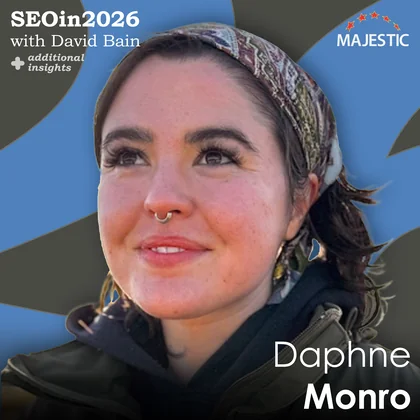
Daphne Monro
Daphne Monro shares the importance of prioritising video-led, verifiable content in 2026.
« Back to Additional insights
More Additional Insights



Daphne says: “My number one tip for 2026 is for SEOs to prioritise video-led, verifiable content in their content creation strategies.”
Lovely. Okay, so let's pick apart video-led and verifiable. Starting off with video-led, what do you mean by video-led content?
“Traditionally, when we do our keyword research, and we start to conceptualise what we want to create, it will typically start with things like a transactional landing page or a blog article. But nowadays, more people are turning to video format – long-form, short-form, nanosecond-form.
We just want to make sure that we're showing up in these spaces, too. Once we've identified what our primary keywords are, it would be starting with the thought of: ‘How can I make this into a long-form video and how can I create the content that answers that keyword's intent?”
You start off with keywords there as well. So, before creating a long-form video, you start off with keywords strategy.
“I still start everything with keyword strategy, especially once we break down our target audiences, our products, our services – whatever that is. We still need to make sure we're using the right language that our customers are using.
For example, I work at Hosting.com. I know lots of people are searching about things for web hosting. I would definitely dive into some of those queries, those question keywords, and use that to start my content creation strategy – just like I would have done traditionally, five years ago.
Then, instead of going into, ‘How can I create this content cluster of words?’ I would think about what different videos we can make.”
When you talk about the questions that people are likely to ask, where do you get those questions from?
Obviously, a good starting point could be People Also Ask on Google, or do you go elsewhere as well?
“Absolutely. I use a plethora of tools. Any traditional SEO keyword research tool. If you'd like to do any plugging here, we definitely can.”
You can share any software tool you like here.
“Yeah, People Also Ask – and I even like to take a look at different social media platforms and see what queries pop up on there. On TikTok and Instagram, there are different ways to see what's gaining traction. Then, of course, things like Semrush or Ahrefs.”
You say you start off with long-form content. I think that's an optimal way to create long-form content, to use a tool like People Also Ask on Google – or AlsoAsked, which is data from there, obviously.
What you can do is take several long-form questions from there, incorporate those as questions within your long-form content, and then break down your video content and share that as snippets on social media.
“Riverside is a great tool for doing just that. There are many different tools. We utilise our webinars (our client webinars), and we can also take our queries from things that are not just search volume, but things that people are engaging with customer care for – going directly to the customer and seeing what kind of questions they want answered.
Then, going back to the verifiable part. Creating videos is easy, but how do we make sure that they're SEO optimised and citable for AI/LLMs (I had to say it at some point)? Working on strategies that are more about showing instead of telling.
It's easy for brands to say, ‘We're the fastest hosting business in the world,’ but it's easier to make yourself citable when you share the data of your uptime or your roadmaps of how you're making your hardware better, how different countries have had different response times, and things like that – which help not only your users, but also crawlers and LLMs.”
You're talking about a lot of data. You share a lot of data there.
Should that be incorporated within video content as well, or are you talking about other forms of content that are created separately, to complement the video content that you do?
“I think data-driven decision-making should be used in every aspect of marketing. Hosting.com is a private equity-backed business, so we have to put our money where our mouth is, show what we're doing all the time, and bring that back down to the numbers.
Sharing whatever data we have that can help us strategically create the right things that drive in new customers and help with retention, that's definitely at the heart and soul of everything that we do.”
Great. I think this is public information here as well, because I just did a little Google search, and I can see that the domain ‘hosting.com’ was purchased for two million dollars as part of its acquisition for A2 hosting. That's obviously the domain name that you're talking about.
As part of a brand member domain, I could take a bit of a tangent down a brand type conversation. In relation to that brand conversation, how much brand content do you think could be created on long-form video as well, or do you think long-form video was all about focusing on specific questions and exactly what the audience wants to know?
“I think it's important to understand that video content is primarily used for entertainment. That's something that can be hard to sell to stakeholders at times, because we want things where it is easy to see the funnel and drive to direct transactions.
However, if you're heading to TikTok or Instagram, most likely you're there to have a little laugh or engage with a brand in a way that you don't feel like is necessarily engaging with the brand.
Going back to this strategy for SEOs (which is why we're here to talk today), I would recommend picking your first five what I would call ‘money topics’: queries that drive leads or trial signups. Revenue-building ideas.
For me, that looks like how-to guides that are segmented for different target audiences. That could be product demos. You could do the ‘Best X for Y’. An example would be ‘The Best Hosting Plan for Small Businesses’ or ‘for Agencies’ or ‘Enterprise,’ etc. Of course, comparison videos get great engagement as well.
You can take these topics, you can be led by keyword search data or customer insight data, and make a 10-minute YouTube video or record a webinar and get people to engage in real time, where they can ask questions with you as well. Then, you can segment those into short-form content and make sure that you're demonstrating your answers and process, and keeping that verifiable aspect at the core.
I do have more steps to this, if you don't mind.”
Yes, I was jumping on your verifiable mention there as well, because you mentioned that at the beginning, but how about hearing your steps here, and we can perhaps delve deeper into verifiable after that.
“Yeah, absolutely. So, of course, we are creating content, and we're putting content out in lots of different places. But there's one thing that I like to tie it all back to: your website.
It's easy to think that social media managers are responsible for socials and SEOs are responsible for what goes on site, but we want to make sure that all this content (and maybe it's a holistic content strategy, which is what I'm recommending here) goes back on our site as well as these different third-party platforms.
Once it's on your website, you can add your own schema data, which helps this content be digested and cited in these different places. Also, making sure that you have a transcript that is available and linked to from this content, either on YouTube and on your site or just on your site somewhere, but making sure that we have all of these things.
Then, tying in that verifiable part again. We need to have our sources, any pricing or policy pages, and all of that interlinked and to our website – back to you.”
In terms of what you mentioned about being verifiable, you talked about incorporating different brand elements within the video as well.
Is that so AI search engines can get a better sense of your brand and what it represents, and then hopefully treat it with more authority and more trust?
“Exactly. It does all come back down to trust. Everything's getting very muddy on the internet right now, with people being able to churn out different things or make large claims.
However, as I said, when I create my own strategy, I'm using data – but also, when I'm engaging with our customers, I want to be using our data and sharing that with them. That is things like exact numbers – so, how many customers we have, how many websites we have, etc.
I like to share that because that's tangible information and it helps reinforce our credibility and trust, but also things like having our author profiles and bios so you can see who's saying what and why they have the authority. It actually all boils down to EEAT.”
You mentioned publishing video content on your site as well.
Would you still publish it on YouTube and then embed a YouTube video on your site, or are you a fan of posting videos elsewhere and reducing the likelihood of people finding a path away from your website?
“I think there's obviously value to hosting on YouTube. It's an Alphabet business as well, so there's that direct link to Google.
I do think having something self-hosted on your site is very important, too, if you have the capacity. I wouldn't say it's fundamental to a smaller business or somebody beginning their SEO journey, but when you have the capacity to host and have a great, quick-loading experience, I would recommend it.
Again, it also allows you to add your own schema data and have that ownership over that content.”
What are your thoughts on measuring success? It's very easy for brands to embrace video – publish lots of webinars, videos, podcasts – and it can do wonderful things for a brand.
It can be a great way to remind someone that you exist if they're not ready to do business with you straight away, but it's sometimes hard to measure the direct impact of that. How do you go about doing that?
“It definitely is. One metric that we use right now is our backlink portfolio, because when we create great content, we're seeing links are naturally building in this space to our video content. I also think having that direct line to your customers, if you are a business that sells products or services, and getting that feedback.
Again, the measuring side is a bit trickier and traditional KPIs probably aren't going to be used for video content. You can look at different things like how long people are watching our videos, if they're dropping off at different segments, if they're hopping to specific chapters, and use that to tailor the content you create in the future.
But again, tracking that funnel from the first touchpoint to making a purchase. Attribution, in itself, could have its own five-hour webinar, but I digress.
We definitely look at it from more of an influence and authority perspective: looking at how people are speaking about us and how our customers are engaging with it. Then, again, traditional things like how many views we have, and that leads us to know that it's working.”
You mentioned webinars a couple of times there as well. I'd be intrigued as to your thoughts on where webinars fit in and how easy or challenging it can be to actually attract an audience to webinars.
When I started off doing live streaming, maybe 10 years ago or so, my instinct is that it was a lot easier to get people to attend live back then. Perhaps during COVID, you could get more people attending, but there seems to potentially be a movement towards on-demand type content and people just wanting to watch video content at exactly, precisely the moment it happens to suit them.
Is it more challenging, now, to get a live audience, and are there any tips that you'd recommend in order to actually get one?
“Yeah, we have actually had great success, and I think we really are in a special place of being a hosting company, because we have a lot to share and a lot of experts in our business – from infrastructure to email marketing, paid marketing, and SEO. We've got the core crew ready to rock and roll and to share their insights.
What we do is, typically, we'll trickle feed through our agency success program. Those are agency owners who we know are likely looking to upskill or offer different services. We've got our niche down, and we know how to speak to them. Then, we'll share our content out through LinkedIn. We're lucky to be a business of a thousand people with very large networks.
Other than that, you can spread your news far and wide, but getting people actually in through the door is something that can be challenging but, by having topically relevant content ready to go and, again, and tying that back to data – we always look at who's attended our webinars, how long for, who dropped off, etc., and use that to strategise what comes next.
I did a webinar last year about SEO for LLMs, and we had about 600 attendees for that in real time, which was phenomenal and exciting. But then I did another one that I thought was going to be very exciting about the migration from A2 Hosting to Hosting.com, and I think we had about 30.
You live and you learn. Just keep listening to your customers and keep coming back to what they are specifically looking for.”
I think you gave another good sneaky tip just a moment ago, when you mentioned your agency success program as well: if you can incorporate case studies as part of your video content and then break that down and maybe publish that, transcribe that and obviously publish that as a separate page on your site, it could be a wonderful way to create case studies for your site on an ongoing basis.
“Absolutely. We do have several video case studies up, but we are working on building our case study portfolio right now because again, it just ties into that EEAT.
It's great when you have customers who want to rave about how great your services are, and it just goes to show what you're doing is the right thing.”
Daphne, what's the key takeaway from the tip you shared today?
“My key takeaway is to make every priority topic citable, by pairing it with a long-form video and a clean transcript.”
Daphne Monro is Head of Websites and Content at Hosting.com.
Choose Your Own Learning Style
 Video
Video
If you like to get up-close with your favourite SEO experts, these one-to-one interviews might just be for you.
Watch all of our episodes, FREE, on our dedicated SEO in 2026: Additional Insights playlist.
 Podcast
Maybe you are more of a listener than a watcher, or prefer to learn while you commute.
SEO in 2026: Additional Insights is available now via all the usual podcast platforms
 SEO in 2026
Catch up on SEO tips from 117 SEO experts in the original SEO in 2026 series
Available as a video series, podcast, and a book.
Fresh Index

Unique URLs crawled
194,188,717,434
Unique URLs found
618,052,412,077
Date range
07 Apr 2026 to 05 Aug 2026
Last updated
1 hour 1 minute ago
Historic Index
Unique URLs crawled
4,502,566,935,407
Unique URLs found
21,743,308,221,308
Date range
06 Jun 2006 to 26 Mar 2024
Last updated
03 May 2024
