-
Site Explorer
- Majestic
- Summary
- Ref Domains
- Backlinks
 New
New- Lost
- Context
- Anchor Text
- Pages
- Topics
- Link Graph
- Related Sites
- Advanced Tools
- Author ExplorerBeta
- Summary
- Similar Profiles
- Profile Backlinks
- Attributions
- Compare
-
Link Tools
- My Majestic
- Recent Activity
- Reports
- Campaigns
- Verified Domains
- OpenApps
- API Keys
- Keywords
- N-grams Near Links
- Keyword Checker
- Search Explorer
- Link Tools
- Bulk Backlinks
- Neighbourhood Checker
- Submit URLs
- Experimental
- Index Merger
- Link Profile Fight
- Mutual Links
- Solo Links
- PDF Report
- Typo Domain
- TLD Checker New
- Free SEO Tools
- Support


Stop trying to reverse-engineer what AI wants in 2026
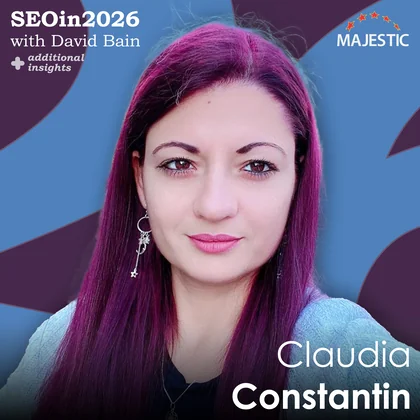
Claudia Constantin
Claudia Constantin explains how to use multiple consumer AI models as a diagnostic tool to uncover why a business isn’t surfacing in AI-driven search.
« Back to Additional insights
More Additional Insights



Claudia says: “My number one tip is that you don't have to figure out how to show up in AI search by trial and error; you can get the AI to tell you directly.
The way this works is you ask the AI the same questions your customers would, and the things they actually type when they're looking for what you've got to offer. You then see how you show up, and if you show up at all, and instead of just stopping at that answer, you treat it as a diagnostic tool, and you interrogate it: ‘What did you base that on? Which sources did you use? If the business didn't appear, why did it not appear?’
Essentially, that's your fix. You get it straight from the source. Rather than trying to reverse engineer AI, you ask it a real customer query and then interrogate the answer, and the answer is going to give you the starting point.”
Brilliant advice.
If you ask AI the question, ‘Why didn't this business appear?’, what are some typical answers it may give to that question?
“Sometimes it could say that it was one of the things that it found; however, it wasn't as strong as the other businesses. It didn't come up in third-party reviews. It wasn't cited anywhere else. So, it had weaker signals, and hence it wasn't one of the choices for the model.
If you do interrogate, it will tell you what sources it used, how it basically analysed the data, and if it even did a live search or it based its response on the training data.”
If it were one of the weaker signals, would you also ask the question, ‘How do you get this business to be one of the stronger signals?’
“Yeah, definitely. Definitely. That's the whole point of it: using it as a diagnostic and asking it directly, ‘What can I do better for you?’
But what's really important here is to keep it as clear as possible. Do it on a new account where it's not contaminated by other information that might have been pulled in other queries, where it doesn't have any information about your business, and try to look at it from different angles. Don’t do one question and then you're done. Look at different models as well, because they all appear differently.
If there's one thing I would say is that I would use the free models, because I'm thinking from a consumer perspective. Consumers are not going to be paying for AI to have a paid subscription to ChatGPT or Claude or whatever. They're going to be using the free models.
Those are the ones where you really want to know how you appear because changing models will actually give you different responses, and it will use a different methodology for doing the search sometimes.”
What answers are you typically seeing when you're asking the question, ‘What can I do to become one of the number one recommendations for this particular sector?’
“The biggest thing is the information that you've got on your website.
For anyone saying content is going to go down or anything like that, actually, no, it's going to be so much more important – but it's going to be important in terms of how it's structured on the page. The AI models tend to go to the source, but when they don't have the source, then they'll obviously look at the wider picture
If you're asking, ‘What's the best brand for trainers if I'm just starting to try running?’ and you don't give it an indication of a specific brand, then it's going to give you different things. But if you're interrogating it, and you're trying to find out what information is out there for a specific business, then it's going to go and dig a bit deeper.
It does really depend on how you ask the questions. That's the most important thing I would say. It's just very, very important not to guide the model to a specific business because then you can start seeing what it’s really showing to users.
But when my audit shows things like what they have on their website – they didn't have enough information on the website, not being cited enough on other websites (not necessarily backlinks, but being mentioned is really important), not having reviews, or not having good schema markup on the website.
That's a big one for my own business, for Switchity. Because we're a comparison website, it's a very competitive space. We're a very small business, and we're competing against Uswitch and Compare the Market. These are very big players, so I needed to find out a different strategy.
What I noticed, while doing these interrogations, is that the model kept picking up on my location, and I thought, ‘Okay, that's interesting.’ That means that there's some space there, if I do specific location pages, where I could maybe appear within the citations.
I went and did everything right. I did the location page, the schema markup, everything as you would, but it was still not appearing how I would have wanted to. Then, when I interrogated more, it was the type of schema. I was missing a specific type of schema that was very important: the ItemList one that allowed me to put the deals and to have everything tagged correctly on there.
What's very important for the AIs is for you to tell them, exactly: This is the answer.”
You also talked about using the consumer version of AI search, so not being logged in yourself and not having a paid version.
How do you ensure that the conversations that you're having with AI aren't skewed by conversations that you had in the past, or perhaps a computer or IP address that you happen to be using?
“Well, that's what I do. I'll have an account that I'll actually open up when I do a new search like this.
When I want to have something that's really clean, and I don't want any interference from anywhere, I'll have a new email address. I'll open a new ChatGPT account – fresh, nothing in there.
For Gemini, you just go in Incognito. For Claude, the same. You can just create a new account and do the interrogations there.”
How do you measure the volume of opportunities? A lot of people interact with AI in very bespoke ways, and you're not necessarily sure how many other people are actually communicating with AI like that.
If you've identified a particular phrase that you're using to see if your business is uncovered for that particular query, how do you know there is a volume of opportunity for that?
“The way I've looked at it is I'm still looking at traditional SEO. I'm still looking at: What is it that is needed on the market? What does the market look like? Then I go and look at: What does my business look like? What do competitors look like?
Then, the AI is essentially just another layer on top of that. I'm not changing anything about what I've been doing. I've just added a layer of diagnostics and going very targeted into the specific things that I found through AI that I was missing on the website. So, it hasn't, from my opinion, moved from that.
You're still looking at the same queries, but people are just going into a lot more detail. You still have to have the answers to the same sort of things you had before; you're just structuring them differently. You make sure that you've got FAQs now, because that's how people ask. They're not going to go with short questions.
So, if the AI identifies a question that's being asked there, you've got a very good answer on your website, and it's got the right schema markup on it, then the likelihood is that you'll be cited in that. It's not a guarantee (none of this is a guarantee), but I've seen it with Switchity. In the space of less than a week, from adding the ItemList schema markup onto it and being really detailed, we started appearing in the AI overview and ChatGPT, Claude, Gemini – everywhere.
With Claude and Gemini, it's a bit more difficult from what I've seen, but in ChatGPT, we’re all over the place – and Google AI overview, which is quite interesting because Gemini and Google AI are the same, you would think, but they do still have different answers and they do still behave a little bit differently, when you start looking into this day in and day out.”
Where else, if anywhere, does AI fit into your process?
For example, do you use an AI agent to help you automate the querying of whether or not there are missing opportunities on your website? Do you use AI to actually produce content or schema markup in order to correct what you've got already?
“I do use AI quite a lot. In terms of research, that's a big one.
Yes, I do use it to create some of the content, but it's all edited by me. It's all double-checked. I go through every single bit that's on the website.
I use it if I do want to automate any of the content, but again, as I said, it does still go through a very rigorous process before it gets put on the website.
What else? I use it for quite a bit. Analysis as well, even competitor analysis. How did they appear? Because I want to see what they're doing really well as opposed to what I'm doing, and is there a gap there, or is there an opportunity? – as it was with the location pages that I mentioned.
So, yeah, I do use it quite a lot. I find it a really useful tool for being able to do so much. For schema markup, as well, it helps in order to be able to just find out the different types of schema markup. I mean, there are hundreds of them. It's really hard to know, off the top of your head, which ones to add. This cuts out all of that work of going through absolutely everything.
It helps with writing the schema markup as well. You can write the code with that, and then you can add it to your website. It makes it very, very easy to implement, as opposed to what it was a few years ago.”
There are probably hundreds of different models out there as well, because obviously you've got things like Claude, Gemini, and ChatGPT, but you've got loads of models within there as well.
You mentioned you go for a relatively simplistic model when identifying or interacting with AI on behalf of a consumer to see what exists. How do you identify which platform and model to use? Because obviously you can't test every single model, can you?
“I use five models when I do this, actually, because I do want to see the cross-reference between them. That is actually a very important point.
ChatGPT tends to pull information from Bing – and obviously, the training model; the data that they've got in there. However, Claude works a little bit differently. Perplexity works a little bit differently. They all work a little bit differently.
When I started doing AI audits – because I haven't only done it for Switchity, I do it for other businesses as well, so I've done quite a few of these over the last year and a half. When I first started doing it on ChatGPT, for example, for every single question that I asked, it did a live search. It doesn't do that today. It doesn't do a live search if, for example, it's a question about, ‘Tell me what you know about this business.’
From my conversations with it… I interrogate it all the time. Whatever conversations I have with AI, it's even told me that it's not experienced that with anyone else, because I go to the extreme. I really want to know why it's giving me those answers.
There is always a crossover between them. There will be one nugget, at least, that you can find when you go over. You take a question, and you put it in a model. You interrogate it as to why it's giving you those answers, you go to another platform, you ask it the same set of interrogation questions (you don't necessarily have to get creative every time), and you do it across the five models.
Because, yes, when I do these questions, I do it on the base model, but then when I do the analysis of it, I take all that data that I have, and I put it in Claude, and I ask Claude, ‘Okay, can you extract from these five models, from the answers, what are the most important things? What are the things I've come across consistently over platforms? What are the things that don't actually align either? Are there things that don't align? And what are the differences?’
You would have to analyse that data because there is quite a bit of it, but the beauty does come in when you can see it from different models, because you can then take it in order. If you do it properly, you can have a plan to work on for the next year off the back of this.”
Another phrase that you’ve come up with is ‘the content bar didn't rise; it split’. What does that mean?
“Basically, it means that the content that is written with AI – that has no value, that is just basically the same thing regurgitated over and over again by everybody – is just not going to rank well anymore. Simple as. But content that is personalised, that is based on businesses' data and information and actual things that they've done is going to become more valuable.
That's the kind of thing that AI wants to see, and that Google wants to see. It’s things that are extremely helpful to the user and are unique from that business perspective, not just the same generic thing.”
Another phrase you use is: ‘interrogation turns AI visibility from guesswork into evidence’. What does that mean?
“Rather than going, ‘Oh, I need schema markup, I need this, I need that,’ you basically go and ask the AI, as I said earlier.
The best example I have is what I did with Switchity, where I built those location pages, and I did the schema markup on it. From an SEO perspective, I could have said, ‘Well, everything's done perfectly there. I've done what I needed to do,’ but because I kept interrogating it and found out about the ItemList schema and how detailed I could potentially go with this, and then applied it, I saw a huge shift – and it wasn't guesswork.
I could go back over something that I actually thought I did well and correct myself, or add more, or learn something new.”
Claudia, what's the key takeaway from the tip you shared today?
“Basically, the key takeaway from the tip that I shared today is that, if you've got one product, take the single most important question that you know your customers might be asking and run it through three AI models without naming your business.
Ask each one of them to name the sources, the data it actually relied on, and tell it not to justify itself and be honest about why it's used that data, and then map out what the fixes are. You're going to get a couple of nuggets from there that are going to really help move the needle.”
Claudia Constantin is Co-Founder and Head of SEO at Switchity. Find out more over at Switchity.co.uk.
Choose Your Own Learning Style
 Video
Video
If you like to get up-close with your favourite SEO experts, these one-to-one interviews might just be for you.
Watch all of our episodes, FREE, on our dedicated SEO in 2026: Additional Insights playlist.
 Podcast
Maybe you are more of a listener than a watcher, or prefer to learn while you commute.
SEO in 2026: Additional Insights is available now via all the usual podcast platforms
 SEO in 2026
Catch up on SEO tips from 117 SEO experts in the original SEO in 2026 series
Available as a video series, podcast, and a book.
Fresh Index

Unique URLs crawled
194,188,717,434
Unique URLs found
618,052,412,077
Date range
07 Apr 2026 to 05 Aug 2026
Last updated
1 hour 2 minutes ago
Historic Index
Unique URLs crawled
4,502,566,935,407
Unique URLs found
21,743,308,221,308
Date range
06 Jun 2006 to 26 Mar 2024
Last updated
03 May 2024
