-
Site Explorer
- Majestic
- Summary
- Ref Domains
- Backlinks
 New
New- Lost
- Context
- Anchor Text
- Pages
- Topics
- Link Graph
- Related Sites
- Advanced Tools
- Author ExplorerBeta
- Summary
- Similar Profiles
- Profile Backlinks
- Attributions
- Compare
-
Link Tools
- My Majestic
- Recent Activity
- Reports
- Campaigns
- Verified Domains
- OpenApps
- API Keys
- Keywords
- N-grams Near Links
- Keyword Checker
- Search Explorer
- Link Tools
- Bulk Backlinks
- Neighbourhood Checker
- Submit URLs
- Experimental
- Index Merger
- Link Profile Fight
- Mutual Links
- Solo Links
- PDF Report
- Typo Domain
- TLD Checker New
- Free SEO Tools
- Support


How to have fun with content formats in 2026
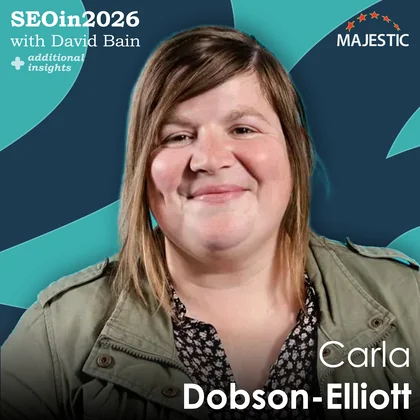
Carla Dobson-Elliott
Carla Dobson Elliott shares how to have fun with content formats in 2026.
« Back to Additional insights
More Additional Insights



Carla says: “My number one SEO tip is that everyone should be having fun with format.
By that, I mean not just thinking about, ‘Is it a video? Is it a piece of written content?’ It's taking it down to a slightly more granular level. Is it a how-to list? Is it a magazine-style quiz like you used to get in the girls' magazines in the nineties? Is it a recipe? Is it a prescription?
How can we display content in a way that really works for the topic we're creating content about, that really works for our audience, and that also just makes things really nice, digestible, and easy for search engines to see what it's about.”
I'm sure the reasons behind doing this aren't just to have fun; it's to actually deliver something valuable to clients or within the business that we're working in.
So, what positive impact is changing up the format of the content that we publish likely to have?
“Absolutely. I mean, I think it's important to have fun with it as well, but there are definitely some useful benefits to having fun with formats. Giving something a really clear format and giving it a really clear form makes a piece of content usable.
If you think about what is probably the most famous format of all, which is a recipe, we all know what that looks like. Everyone who's listening now can probably think, ‘Yep, a recipe: It's a list of ingredients; a step-by-step guide on how to create something.’ It's been roughly the same for hundreds of years, but it's also just a usable piece of content. It works in terms of the flow. You gather your ingredients, and then you go through, working through the process methodically.
If content has a clear format that's been thought about – that's fit for purpose, that's right for the audience – it automatically makes that content more useful. We know that useful content is absolutely the king, both in terms of audience engagement but also ‘happy audience equals happy search engines’. It's going to make you more likely to rank and come up in searches.
Also, then, to keep your audience and encourage people to click through – which, as we know, in the era of zero-click search, it's much harder to actually get people to go through. You can get a snippet of an answer without having to go on someone's website, but if you're providing that really useful, followable format, it's encouraging people to click through as well.”
How do you know your audience is happy?
“I think there are loads of different ways to look at whether your audience is happy. How long are they spending with the content? What are they going through? Are they taking the next step in their journey that you want them to? Are they engaging with the piece of content, depending on what metrics you're looking at? But I think, ultimately, it's: are they then coming back to you again and again as a source?
One of the other really amazing things about formats is that they offer consistency. As much as we like to think that we like lots of new and exciting things, there is a comfort in consistency. If you, as a brand, are producing a weekly roundup every Friday – or, much like this podcast, a top SEO tip for 2026 – people know what they're expecting. They can go back to it again and again without having to go through that level of search.
They'll put you as a preferred provider of information: bookmark you or save you to their favourites or something that will keep them coming back.”
As a business nowadays, many marketers recommend or recognise that it's important to actually be known for something and not be everything to everyone.
How does a business select the type of content that they're going to be known for?
“That's a really good question. It's ultimately that lovely Venn diagram, isn't it, of your business need and your brand and your personality and what suits you. Then, also, what your audience actually wants from you, and that lovely sweet spot in the middle where it's something that reflects your brand personalities.
If you're a fun, quirky brand, you might want to lean into formats that are more quizzes, they're gamified, and they're a little bit unexpected – but it also has to serve and meet the audience's needs, and ultimately give them the information that they would be coming to you for.
It's just maybe in a slightly more engaging way than just another blog that looks the same as hundreds and thousands of other blogs that have been released that week.”
What are your thoughts on different types of content? Would you incorporate audio or video within your content as well, or is it best to just focus on one type of content for a page?
“Again, your format allows you to think about that really clearly, rather than just saying, ‘Oh, we must have some video,’ or ‘We must have some audio,’ or ‘We must have an infographic in this.’
It allows you to take that step back and think, What are we trying to achieve? What does the audience need? What is the ultimate purpose of this piece of content, and what best suits it?
Actually, you absolutely might have a how-to video as well as a written step-by-step guide, because then you're serving people who engage with content in either way. Personally, I always want a written list, which is probably why I'm a writer. I want to follow a written step-by-step guide, but I know that I work with people who will only watch instruction videos. They don't want to take information in with the written word.”
Can you tell me a little bit about how you actually go about selecting the type of audience that you decide you want to serve?
“At Sticky, we encourage clients to profile and segment audiences in a slightly different way than traditional demographics, which have been used for years.
We know people are changing, and the way we live our lives is changing. You might be, for example, targeting a first-time mother, but she could be 20 or 45. Those are very, very different demographics, but very much interested in the same type of content and information and facing the same kind of challenges – i.e., they’re time poor, they're up late in the night, so they want content in the same format.
Rather than segmenting audiences by demographics, we encourage brands to segment their audience by their curiosity type. Based on 70 years of academic research into curiosity, we've devised six different curiosity cohorts, which profile the different ways in which people are curious.
There's a Clarity Seeker who really likes simple, swift answers. They don't want loads and loads of detail or complicated journeys. They just want the information that they need served to them in a really simple way. In terms of format, a lovely little flow chart or a comparison table – something that gives them maximum impact for minimum effort – would be really useful for them.
At the other end of the spectrum, you have your Exhilaration Hunter who really likes things that test the senses, challenge their boundaries, and make them think about things in a different way. They might like a format that’s surprising for the brand or has an element of gamification or is a little bit more challenging of their boundaries.
Another profile is the Socio-Eco Empath, which is what I am. We are really interested in human stories and connection. Therefore, a case study and a story of a customer or someone who's used a product or service is what would appeal to us.”
How do you actually determine who your audience is?
“That can be done in different ways. Obviously, we work with brands, and we take information about their audience that they would have. Then, we overlay that with data from what we call our curiosity engine, which helps us then take their audience's profile and determine their primary curiosity type.
There is also a quiz that people can take, if they head to the Sticky website, to find out their own curiosity type. You can let me know yours later, David.”
Surely it's not the case that all of your audience is the same type. Can you actually tailor your content towards multiple types?
“Yes, absolutely. A hundred percent.
If you take the example of a bank, the reality is, they serve lots of different people. They'll probably have all curiosity types within their audience set. They might have a few primary types. Depending on their branding and their positioning as a brand, that might make them appeal to certain curiosity types. But the reality is, they probably want content across touchpoints that suits all the different curiosity types. Then, we'd recommend a mix.
It's that golden rule: if you create something for everybody, it ends up resonating with no one. It's more: ‘Right, we're going to create X pieces of content. This one's going to be tailored for Clarity Seekers, and it's going to be in this format. This one's going to be tailored for a Socio-Eco Empath.’ You're creating content that resonates with the breadth of your audience.”
When you create a piece of content for a particular personality, how do you know that that right type of person is likely to engage with that piece of content?
If you're targeting a Clarity Seeker, what happens if another personality type lands on that page? Is that not likely to result in a more negative bounce or signal to what you're attempting to achieve?
“It's also important to have multiple different elements woven into your format on key landing pages and key product pages, if you feel like you've got a breadth of different audiences that you're appealing to.
As with anything, there's an element of test and learn. Certainly, with a lot of the brands we've worked with, we've definitely found that their audiences have been profiled into two or three dominant curiosity types. Making sure that we've got elements on key pages or key content pieces that appeal to those different types is really important.
Also, there's an element of: nothing is a hundred per cent with marketing, is it? It's test and learn. It's seeing what resonates with your particular audience and then evolving and iterating until you get the right mix.”
Is this woven into every type of content? Would it be woven into product pages as well as blog posts and other pieces of content on your website?
“Just to take it back to formats a bit, I think you should be thinking about the format of every piece of content. It's just that extra step.
You start to write a product page, but you are actually thinking, How do we want this to be used? How can we make it work for our audience? Thinking about every element. Then, it's about creating consistent rules and guidelines as well. That can be really granular. It can be right down to: ‘Every header should be no more than X characters because we know our audience likes things really short and snappy.’
Once you've created those rules and that format, not only do you have a great level of consistency, but it's also much more efficient to produce content because everyone's got a really clear idea of what things need to look like, what they need to achieve, and what you put in place to help you achieve your content goals. If you're working with a broad content team or you've got different people inputting, it just makes it much easier.”
Is it better to just focus on publishing new content or do a major content audit, determine the content you've got on your website, and actually do a better job of positioning that content to your target audience before moving on and publishing new content?
“I love a content audit, and I'm a massive believer in using what you've already got, if it works.
If you're a brand that hasn't really thought about form as a key part of content, then a really great starting point is to go back and see what you've got. It might be that all of the information that you've got is brilliant, it just needs reformatting, making more consistent, and updating.
Also, test different formats to see what resonates, and see if it has a positive impact on your metrics. Then, obviously, do a bit of gap analysis to see what you're potentially missing as well.
Again, when you've got those repeatable formats – when you've got content that's really, really tailored to your audience – it's easier to see what you're missing and what you might need to create, and also to have that structure where you're able to create what you need quite quickly and efficiently.”
Superb. Is what you're advocating different compared with what's worked in the past?
Obviously, to a certain degree, everything stays the same in marketing, but things evolve in SEO and what actually works in terms of targeting and bringing in traffic changes.
So, is the way that you're recommending targeting content towards these six key audience types, has that changed much over the years?
“When it comes to the targeting piece, I think that is really different. To my knowledge, Sticky are the only people who are doing it by curiosity, and it's born out of changing consumer needs.
We are bombarded with so much content now that something that feels really personal – that piques your curiosity, that encourages you to do one more scroll/one more click – is increasingly important in the marketing landscape.
On the format point, format's been around for a very long time. It's one of the hallmarks of best practice content creation that sometimes isn't focused on as much as it should be, but it's something that has evolved with the times.
In my experience, it’s been incredibly good for SEO, but there's a real place for it in the ‘search everywhere’ landscape as well, when you're having to start thinking about different touchpoints. Are people searching via social, so you need this repeatable format to go on those channels as well?
But also, to give that more engaging level of content that actually encourages people onto your website and to explore deeper, which I know is something that brands are really keen to do in a zero-click world.”
Of course, people consume content on AI search engines nowadays and in many places off a website.
Is the advice that you're talking about applicable there as well, or do you need to be a little bit more consistent and not think of specific audiences so much when you're thinking about content that gets published elsewhere?
“At the heart of it is content that's on websites and in owned channels and, obviously, that's then found in different places and distilled in different ways by your AI engines and things.
For me, having that strong form to a piece of content, in the same way that it makes it more scannable and accessible to a human audience, it makes it more scannable and accessible and easy for AI engines to scrape websites, see what it is you're about, and pull elements into the answers that they're compiling.”
Carla, what's the key takeaway from the tip you shared today?
“My key takeaway is, back to my original point, have some fun with format, but it's about taking that extra step when you're planning your content to think about: What is the way that I can present this content that's going to be right for my audience?
I'm not just rushing straight in; I'm going to take away and add one extra layer of thinking to create something that's really going to resonate with my audience.”
Carla Dobson-Elliott is Director of Editorial Content at Sticky. Find out more over at Sticky.co.uk.
Choose Your Own Learning Style
 Video
Video
If you like to get up-close with your favourite SEO experts, these one-to-one interviews might just be for you.
Watch all of our episodes, FREE, on our dedicated SEO in 2026: Additional Insights playlist.
 Podcast
Maybe you are more of a listener than a watcher, or prefer to learn while you commute.
SEO in 2026: Additional Insights is available now via all the usual podcast platforms
 SEO in 2026
Catch up on SEO tips from 117 SEO experts in the original SEO in 2026 series
Available as a video series, podcast, and a book.
Fresh Index

Unique URLs crawled
194,188,717,434
Unique URLs found
618,052,412,077
Date range
07 Apr 2026 to 05 Aug 2026
Last updated
1 hour 2 minutes ago
Historic Index
Unique URLs crawled
4,502,566,935,407
Unique URLs found
21,743,308,221,308
Date range
06 Jun 2006 to 26 Mar 2024
Last updated
03 May 2024
