-
Site Explorer
- Majestic
- Summary
- Ref Domains
- Backlinks
 New
New- Lost
- Context
- Anchor Text
- Pages
- Topics
- Link Graph
- Related Sites
- Advanced Tools
- Author ExplorerBeta
- Summary
- Similar Profiles
- Profile Backlinks
- Attributions
- Compare
-
Link Tools
- My Majestic
- Recent Activity
- Reports
- Campaigns
- Verified Domains
- OpenApps
- API Keys
- Keywords
- N-grams Near Links
- Keyword Checker
- Search Explorer
- Link Tools
- Bulk Backlinks
- Neighbourhood Checker
- Submit URLs
- Experimental
- Index Merger
- Link Profile Fight
- Mutual Links
- Solo Links
- PDF Report
- Typo Domain
- TLD Checker New
- Free SEO Tools
- Support


Focus on building topical authority in 2026
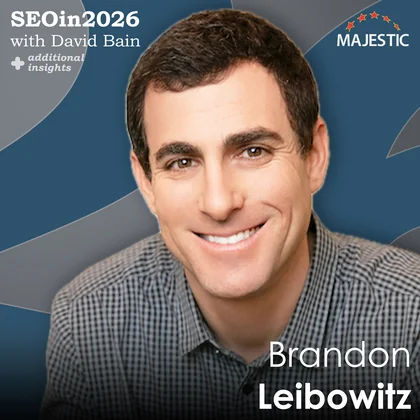
Brandon Leibowitz
Brandon Leibowitz discusses the importance of building topical authority through comprehensive content strategies.
« Back to Additional insights
More Additional Insights



Brandon says: “Topical authority is going to help you move up those rankings.”
Topical authority. So, what is topical authority?
“Topical authority is creating multiple content pieces supporting a topic instead of just having one page on your website about a service or a product that you're offering.
Having multiple pages that support that keyword shows Google that you're more relevant versus just having one page. It's okay, but if you really want to show yourself as a subject matter expert – topical authority – then having multiple articles, and blogs, and content supporting that one subject matter is going to help you move up more.”
Is this structured like some kind of hub-and-spoke model, where you've got your more competitive keyword phrases on your core page and then you've got sub-pages that you publish, and you link towards the main page from the sub-page?
“Yep. So, kind of like a silo, and then you make a main pillar page, and then you have supporting pages that link to that main page. You'd have blog posts that link to that main page. You could have FAQ content or any content pieces that are all related to that. As long as they all interlink, that shows Google that they are related.
Internal linking is very important with this – making sure that you link the right topics to the right subject matter expertise. Linking those blogs to that pillar content, with the right anchor text as well, is going to help show that they're all interrelated.”
Are you talking about linking from the pillar page to the sub-page as well as the sub-pages to the pillar page?
“Yep, you want to interlink them all together.
That way, they see that they're all related. Mainly linking the blogs to the pillar page, but then you can also link the pillar page out to the blogs as well, and then linking the blogs together, and linking the sub-pages together as well.”
How do you decide on what content to cover?
“That is where I would do keyword research; look at what long tail keywords are supporting that main focus keyword, and then also look at Google's People Also Ask section and try to figure out what are high search volume phrases that people commonly ask, that I can incorporate into this content or make it standalone pieces to help support that.
But usually I'll just do some keyword research using Google Keyword Planner, or Ahrefs, or Moz, or other tools to help do keyword research. Putting that main keyword in there, then trying to find those long tail keywords and other variations and topics, looking at AnswerThePublic, so you could see high search volume phrases/questions that people commonly ask, and you can create content support around that, supporting that topic, and just trying to look in as many different places as possible to get ideas.
Taking a step back, thinking, ‘If I were looking for this product or service or keyword, what would I be searching? What would interest me? What would get me to want to use this product or service?’ So, not just thinking about the main keyword, but thinking about keywords that support that main keyword.”
It appears that everything leads from the main keyword. How do you actually come up with the main keyword to begin with?
“The main keyword would come from doing keyword research as well and trying to figure out, should I use a singular or plural or synonym of a keyword?
One of my clients, they’re a personal injury law firm, they want to rank for ‘personal injury lawyer’ – which is great. It gets 20,000 searches in Los Angeles each month, but ‘personal injury lawyers’ gets 200,000 searches each month. So, trying to find the keyword that gets the most search volume that still has the buyer intent and is still relevant, and using that as the main focus keyword.
Then, from there, doing research around keywords that support that keyword. So, long tail variations or the other ones – reordering the words, structuring them differently, and just making sure there's no overlap on the main pillar page versus other pages.”
I guess one main challenge nowadays is selecting the correct audience intent because, using your example of ‘personal injury lawyer’/ ‘personal injury lawyers’, perhaps the plural version gets 10 times as many visits, or at least searches.
But I guess there's a chance that someone searching the plural version could be looking for some kind of comparison site and not want to go immediately to an individual lawyer.
How do you differentiate between a keyword that can bring you a lot of traffic versus a keyword that's most likely to convert?
“That's where you have to look at the keyword and the intent behind that keyword, and realise, if it's going to be a comparison, then let's make it a comparison article or blog or content piece that supports it.
But you've got to make sure the content fits the keywords that you're targeting. Otherwise, it's going to drive the wrong traffic, and you're going to get traffic, but they're going to leave. Google will look at that bounce/engagement rate and see that a lot of people are coming and going, and if a lot of people leave your website immediately, that does not look good either. We don't want that to happen.
So, trying to make sure that the content aligns with that keyword and trying to really look at the competition. Seeing who's on that first page of Google, what type of content pieces everyone is putting out, and trying to make sure that you replicate it. If you see everyone has comparisons, and you're trying to rank for your personal profile on your website, that might not work, but if you see other websites that are showing individual lawyers along with the comparisons, then Google's saying, ‘We don't really understand the intent behind this keyword, so we're trying to show both.’
Then you might have a chance of getting in, but it's much better if it just shows a bunch of lawyers. Then, you know, ‘This is my type of keyword. Google's showing the same type of businesses that are related to me,’ but definitely looking at the competition and saying, ‘Who's ranking?’ so that we can figure out the intent behind that search.”
OK, so I was going to ask you how you figure out the intent, but you finished off there by talking about the competition.
Is that the main way that you figure out the intent?
“Looking at who Google's showing. You could tell the intent by the websites that Google's ranking.
If Google's showing a bunch of different websites where it's not just one similar type – like the lawyer one. If they are showing lawyer profiles, but they're also showing Yelp and comparison websites, then you might be like, ‘All right, Google doesn't really know what the intent is for this keyword. They're just showing a bunch, and they're just trying to guess at what someone's searching for, because it could be either or.’
But if you see that the search results are just full of comparison sites, then you know Google's only going to rank comparison sites, and if you don't have a comparison article or blog or content piece, then you're probably not going to be able to show for that keyword.”
Okay, and talking about keywords again, you talked about selecting your main keyword and then having other keywords that probably come from questions from tools like AnswerThePublic.
You could potentially have hundreds of different possibilities from a main keyword, so how do you prioritise the questions that are best to write content about?
“I would start with the People Also Ask on Google, because this is Google saying, ‘These are high search volume phrases that people commonly ask when they're searching for that one keyword.’
If you could write content about that, that's going to help you show up in a lot of other places: AI Overviews, voice search, Alexa, Siri, etc. – but also Google is saying, ‘This is probably one of the most relevant phrases/questions that somebody is searching. So, I would start with those People Also Ask first.
Then I would start looking at other tools, but I would always go with Google first. People Also Ask, and then also look at the autofill. When you just start typing your keyword in, the autocomplete, you can see that dropdown that appears on Google. These are also high search volume keywords, not necessarily questions, but phrases that you could pull from.
Then, just trying to look at those long tail keywords using tools like Ahrefs and try to pull those ones out as well.”
Okay. You've got your keywords. How do you move on to deciding on what content needs to be produced for each keyword?
“Then I would start Googling my keywords and see who's on that first page of Google, or use a tool like Surfer SEO and see who's on that first page of Google and look at how much text everyone's using, what type of content they're using – pretty much, how they structure their content, what the content is about, and build off that and try to just see what everyone is doing and what type of content, what structure, etc.
Are they starting off with a video? Are they starting off with text/bullet points? How are they finding this content? Just trying to replicate what I see everyone else is doing.
Not copying their content, but copying their structure and copying their ideas, because if Google's saying, ‘Hey, we want everyone to write 800 words,’ and then I come out and write 2,000 words, that might look a little weird. I try to make it blend in and serve that buyer intent/serve that user intent properly.”
So, you talked a lot about competitors there, in terms of what the competitors are doing in terms of the content, the style of the content, the structure of the content, and what type of content they choose to publish.
How do you differentiate your content? Because you also talk about wanting to be the topical authority within your industry. If you're just studying competitors, then perhaps you could produce the best version of your competitors or maybe something comparable to what your competitors are doing.
Do you try and bring in different elements that differentiate what you do to make you head and shoulders above the competition?
“That's where you work on the EEAT. Try to show that experience, expertise, authority, and trust – making sure that you have a good author bio at the bottom.
You can have case studies or testimonials or statistics, or anything to help make your content stand out as being very helpful, very unique, and not just the same cookie-cutter content that everyone else is putting out – but trying to make sure it differentiates and stands out.
So, adding outbound links (when relevant) to authority niche sites, to help also show that relevancy. Trying to make sure that your content is written as well as possible, with unique data points and statistics and things like that, to just help you stand out.
Otherwise, you'll just get lost in that sea of content that everyone else is producing. You want to really make sure that you have the best of the best, and that's where you’ve got to take that extra time, really dive into that content, and look for unique topics and unique talking points to put into that piece.”
Are you seeing any trends in terms of the type of content that seems to be successful at the moment?
Are you seeing more video in there? Are you seeing any typical trend in terms of the length of content or the way it's structured?
“I'd say breaking it into multiple paragraphs, not long, big blocks of text. Header tags, bullet points, numbered lists, etc., but just really looking at the header tags and how you structure that helps out a lot.
The length, it varies depending on the intent behind that search. In general, more is better, but you don't want to overdo it and put too much text there that's just fluff and cookie-cutter content that's not really helpful for the reader. Just trying to make sure that you write for the reader and not just trying to stuff extra text in there just to stuff it in.
A lot of people do that thinking, ‘If I write 4,000 words, that's going to be even better,’ which, maybe 15 years ago, that was the case. But nowadays, Google wants quality over quantity with everything. Just making sure you write for the reader and have their intent.
Hook them at the beginning. Put those keywords at the beginning, if you can, into the header tags as well. Then, focusing on those other pillar pieces or those subpages and making sure that you have content that teases them in a little bit, and linking out to those as well.”
Now, more and more people, or more and more websites, are getting their content published elsewhere, and not necessarily having consumers visiting their website to consume their content because of the advent of AI.
What does this strategy actually mean in terms of the evolving face of where people consume content? Can this type of content be regularly consumed and reproduced by AI search engines, or is your ultimate goal always to drive people back to your website?
“It would be nice to drive people to the website, but ever since Google introduced that featured snippet back in 2013ish, we just saw traffic slowly dropping and dropping, depending on the site. Wikipedia got hit pretty hard because they were just pulling from schema, statistics, or information that people are searching.
AI is doing that even more so, where they're not really putting those links anymore. They're adding links, and they're changing how the results are, but basically, they want to keep you on that platform. They don't want you leaving.
It’s the same thing with Google with the featured snippets. If you're asking the age of a celebrity, there are probably not ads around that keyword. Google's like, ‘Well, we can just give you the answer right there, and then hopefully you might do a search again for something related to that actor – maybe a movie that they were in – and then there's ads there.
Google wants to make that ad revenue, and they'd rather you stay on Google longer rather than leaving and going to your own website. That's something that we just have to deal with nowadays.
It's just trying to build yourself up as, ‘Hey, I saw that Brandon was the featured snippet or in the AI Overview. Even though I'm not going to his website, I see that he provided the content for that.’ Hopefully, over time, that builds your brand up and builds you up as a subject matter expert.
But it is that balance of just realising that traffic has been on the decline since featured snippets came out for people who had schema done really well on their website, and it's going to keep dropping more and more, especially with AI.
We'll have to see how AI and these LLM platforms start incorporating links or letting people click out. For now, you're closed in there, for the most part. They do have links, but they make them very tiny, and it's not the main focus. The main focus is giving you the answer, which then takes away that traffic from your website.”
Where does this fit into an overarching strategy, and how regularly do you do this?
Is this something where you perhaps sit down once a month with a client and create some kind of topical hub on a regular basis, among other SEO activities?
“It just depends on how much content they already have on their website.
Maybe they have a bunch of content. Then we'll go in and try to clean it up, look at their old content, see what's not ranking, what doesn't work, and try to revamp that content. But if it's someone new, who doesn't really have much content on their website, then we'll start off looking at what is low-hanging fruit or what's going to have the biggest impact the quickest.
Working on those keywords and trying to build it all out – but not trying to just put it all together and just throwing it out there. Trying to slowly trickle it out. So, having that main pillar page created first, then maybe a week later, we could have a blog post. A week after that, another blog post, and just slowly trickling it out.
If it's a very competitive keyword, then we're going to have to create a lot more supporting content versus a less competitive keyword, where we could probably get it done with a few other content pieces that support that main piece. But that really tells us how much content and how much time needs to be allocated. We don't want to overdo it. You can just try to think about how to keep it looking natural.
When AI first came out, people were just going into AI and saying, ‘Write me 50 blog posts about this topic,’ to build that topical authority and topical relevancy. They would throw it all up, and it would work temporarily, but eventually Google's like, ‘Hey, what's going on? It's all low-quality content. You're throwing it all up in a couple of days. Very weird. It doesn't seem natural.’
Just trying not to throw any red flags to the search engines to trigger them, because we want to keep everything looking as organic and natural as possible.”
Brandon, what's the key takeaway from the tip you shared today?
“Make sure that you don't just create a page for your service or your product, but make sure you create pages that support that content and support that main page.
The more content that you put out on your website that supports that one keyword, the more relevant you become to that search, the more authority you have – and focusing on that EEAT. Making sure that you're trying to touch on all bases to make sure that Google sees that you are not just throwing up a page, but you actually have that relevancy around that whole entire topic.
Then you could pick up on long tail keywords, variations, singular, plural, synonyms, or industry jargon – other ways that people search, because people don't just search one way. Especially nowadays, with voice search, half the searches are new searches that no one's ever seen. So, if you're trying to rank for every keyword, it's not possible.
Having that main focus keyword and then the supporting keywords, that's going to help you hit all the different variations and not just be stuck on that one keyword set.”
Brandon Leibowitz is the Owner of SEO Optimizers. Find out more over at SEOOptimizers.com.
Choose Your Own Learning Style
 Video
Video
If you like to get up-close with your favourite SEO experts, these one-to-one interviews might just be for you.
Watch all of our episodes, FREE, on our dedicated SEO in 2026: Additional Insights playlist.

 Podcast
Maybe you are more of a listener than a watcher, or prefer to learn while you commute.
SEO in 2026: Additional Insights is available now via all the usual podcast platforms
 SEO in 2026
Catch up on SEO tips from 117 SEO experts in the original SEO in 2026 series
Available as a video series, podcast, and a book.
Fresh Index

Unique URLs crawled
194,188,717,434
Unique URLs found
618,052,412,077
Date range
07 Apr 2026 to 05 Aug 2026
Last updated
1 hour 1 minute ago
Historic Index
Unique URLs crawled
4,502,566,935,407
Unique URLs found
21,743,308,221,308
Date range
06 Jun 2006 to 26 Mar 2024
Last updated
03 May 2024
