-
Site Explorer
- Majestic
- Summary
- Ref Domains
- Backlinks
 New
New- Lost
- Context
- Anchor Text
- Pages
- Topics
- Link Graph
- Related Sites
- Advanced Tools
- Author ExplorerBeta
- Summary
- Similar Profiles
- Profile Backlinks
- Attributions
- Compare
-
Link Tools
- My Majestic
- Recent Activity
- Reports
- Campaigns
- Verified Domains
- OpenApps
- API Keys
- Keywords
- N-grams Near Links
- Keyword Checker
- Search Explorer
- Link Tools
- Bulk Backlinks
- Neighbourhood Checker
- Submit URLs
- Experimental
- Index Merger
- Link Profile Fight
- Mutual Links
- Solo Links
- PDF Report
- Typo Domain
- TLD Checker New
- Free SEO Tools
- Support


Treat your brand as a multi-platform entity in 2026
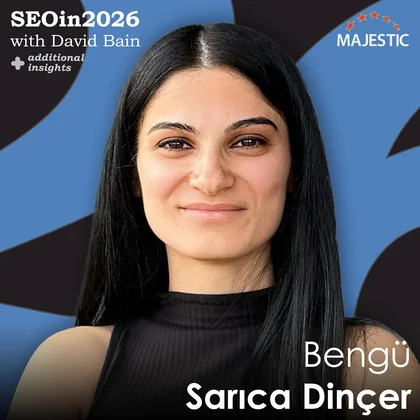
Bengü Sarıca Dinçer
Bengü Sarıca Dinçer discusses the importance of visibility and trust in SEO, particularly in the context of a multi-platform branding strategy for 2026.
« Back to Additional insights
More Additional Insights



Bengü says: “I would say you should set your brand as a multi-platform entity in 2026, because discovery and trust now form across search engines, social platforms, communities, AI assistants, and everywhere else that I don't recall right now.
You should be visible everywhere, but also be discoverable for your audience.”
So: be visible everywhere, but be discoverable for your audience. Is that what treating your brand as a multi-platform entity actually means?
“Yeah, yeah. Actually, being everywhere is kind of easy, but being discoverable is not the same thing, in my opinion.
AI summaries, search engines, and other platforms use your website as a content source, but if the end users don't recall what your solutions are/what you are doing, then it is not about discoverability.”
What's an example of being somewhere but not being discoverable?
“Being visible is like when, let's say, Perplexity summarises a piece of content from your website and doesn't mention that it is because of your solution-related content.
Yes, you are still visible there because Perplexity discovers you, that's true, but when that Perplexity user doesn't know about your brand in that content, then you are not actually discoverable.”
How do you add the context? Are you advocating, in every piece of content that you produce, incorporating a subtle mention of your brand and what you do as well?
“Kind of.
I'm talking about being consistent about your recognition as a brand.”
What does that mean in terms of a piece of content that you publish, and you've got an AI search engine that takes that piece of content and displays that content within its results?
How can you try to optimize your discoverability as a brand, within that?
“You should be clear who you are and what you are known for, then you can be sure to be very trustworthy for your audience.
I'm talking about the content side, by the way, but the content format can be changed for the variety of pages that you have on your website. You should always make sure that your content provides consistency in each format.
This is what I mean, but I'm not sure if I can express it properly.”
I understand what you mean: be consistent across the various platforms that your brand happens to be mentioned on/featured in, and ensure that your brand logos, the name of your brand, and any descriptive text that's part of your brand are consistent across various platforms.
You mentioned search engines, social platforms, AI systems, and niche communities as well, when we talked about this beforehand. What search engines are key in 2026, and why do they like multi-platform entities?
“It depends on your audience's preference.
If they use Bing, then your main focus should be on Bing, or if people are using Google (I mean your audience, as users), then you should focus on Google.
Let's say your market is Russia. Then it could be an edge case, but your main search engine that you should focus on would be Yandex. It totally depends on your market and your audience.”
Okay. Sometimes, you're not necessarily sure where your audience is.
I would assume that you're talking about looking at your analytics, first of all, before deciding on which platform to optimize.
“Yeah, definitely.”
We talked about different platforms there as well. What about social platforms?
Which social platforms are key in 2026, and how do you go about ensuring that the brand is optimized there?
“I think YouTube, Instagram Reels, and TikTok are the main social platforms for users because people usually search from these kinds of platforms before deciding where to go or what to buy.
It is accurate for B2B and SaaS environments as well, which is kind of interesting. I know it sounds interesting, but so far, in my experience, TikTok is a really powerful social platform for SaaS cases.”
Where does that fit into the customer journey? Is that initial discoverability? Is it someone knowing about the brand to begin with, and perhaps going to social platforms to do some further research?
“Yeah, it generally sits on the initial discoverability because people mostly search not for brands, but for their needs on those kinds of platforms.
That's why you should be discoverable on those platforms. I recommend being discoverable there.
They don't know about your brand or what you are offering when they see your content on those platforms, but if you are consistent and provide really helpful content to your audience, then they will start to enter your funnel.”
You talk about being consistent on a platform like TikTok. If you're a B2B brand, if you're a SaaS brand, how do you do that and how do you make it consistent and interesting?
Surely, if you want to be successful on TikTok, you want to be publishing at least three times a week or something like that.
“Yeah, yeah.”
Isn't it easy to dry up, in terms of content?
“No, it's not.”
No? Okay.
“It's not easy, but nothing is easy.”
Okay, so what kind of content should a B2B SaaS brand be publishing on a consistent basis on TikTok?
“I don't know. Again, it depends on their goals.
I would probably create and publish product-related content, which could reach very niche audiences – which is okay, because good content is not for everyone.
When you create solution-oriented, product-related content, then a small portion of users might come to your funnel, but they would probably be very high-quality users. They will have very big potential for your sales funnel.
I can't say that a single solution could be helpful to create the content for social platforms, but I believe that it really depends on your business goals and your solutions.”
Should the same content be published in multiple places? Obviously, with TikTok, you're talking about a 9:16 video, perhaps a video that's just one minute long or so, and perhaps some text within there as well.
It tends to look a certain way and not necessarily work as effectively or look as integral to another platform like LinkedIn, X, Facebook, or something like that.
Should you be publishing TikTok videos, or videos that have been created specifically for TikTok, elsewhere?
“Honestly, I don't think that their audiences are the same because a LinkedIn audience is very different from TikTok.
Also, if you believe that those users have the same interests and the same needs from your brand, then yes, you can repurpose the content that you created for one platform and see if that brings performance for you – but I don't think it would work. At least in my case, it doesn't work.
Repurposing can work for similar platforms like Instagram and TikTok, but LinkedIn and BlueSky, let's say, are very different platforms from TikTok. It's not a very easy job to create content for each platform, but you can also experiment to see if the same content works for you or not, and then decide what to do.”
You also touched on AI assistants as well. Where do AI assistants fit in when it comes to treating a brand as a multi-platform entity?
“It perfectly compounds with search engines, I think, because bots learn everything from the web: from social platforms, communities, and everything on the internet. It actually comes as an initial discoverability platform, and then it directs people to search on our traditional search engines, in most cases.
The thing I strongly say all the time is that people don't Google and decide, or they don't just use one platform to decide what to do, but AI assistants are very helpful in making their time easier to decide.
But also, it's not the final point, I believe, which brings us to another discussion.
Yes, they are very helpful tools for users (and also for us, to make our efforts valuable), but if they don't bring as much really great value as traditional search engines, then you don't need to chase their revenue attributions. Yes, people are using those tools, but in most cases (for now) AI tools are not the final touch point for revenue.”
Interesting that you say you don't have to chase revenue attribution, but of course, many stakeholders and organisations are looking for the impact that different touchpoints have on the user journey.
A lot of what you're referring to can be early stage in the user journey and not the last referring channel, but it doesn't mean that they're not key, they're not important, or they don't have a significant impact on the customer choosing to actually make that purchase.
What are your thoughts on attribution? How do you actually allocate a likely impact of each step along the way?
“It's the question that I get most frequently, from lots of people, but I don't count a single metric for success when it comes to a user journey, which is not linear.
I chase some signals, like branded searches/brand-led searches. If they increase, then I can talk about the fact that people are searching for my brand. This means our strategy is working for that. Also, higher direct and returning traffic means something for me. Also, better conversion rates from organic and non-paid channels, but I don't actually measure the success with one metric for this messy user journey.
I care about making people search for our brand's name and trust us faster, and then convert with less friction. Of course, conversion rates and revenue are very important metrics to track success, but now it's more complicated than before.”
You certainly shared a few metrics there that were useful and will have given the listeners something to think about in terms of how to measure what we're talking about today.
Bengü, what's the key takeaway from the tip you shared today?
“I would say, if someone is looking for a solution that you offer, but they still can't find you, then nothing else you are doing really matters.
You need to be visible where your audience actually looks, but visibility alone is not enough, unfortunately.
When people discover you, it should be clear who you are and why you are worth trusting. That moment of recognition is what turns visibility into trust and trust into action and conversion, I believe.”
Bengü Sarıca Dinçer is SEO Manager at Designmodo. Find out more over at Designmodo.com.
Choose Your Own Learning Style
 Video
Video
If you like to get up-close with your favourite SEO experts, these one-to-one interviews might just be for you.
Watch all of our episodes, FREE, on our dedicated SEO in 2026: Additional Insights playlist.
 Podcast
Maybe you are more of a listener than a watcher, or prefer to learn while you commute.
SEO in 2026: Additional Insights is available now via all the usual podcast platforms
 SEO in 2026
Catch up on SEO tips from 117 SEO experts in the original SEO in 2026 series
Available as a video series, podcast, and a book.
Fresh Index

Unique URLs crawled
194,188,717,434
Unique URLs found
618,052,412,077
Date range
07 Apr 2026 to 05 Aug 2026
Last updated
1 hour 2 minutes ago
Historic Index
Unique URLs crawled
4,502,566,935,407
Unique URLs found
21,743,308,221,308
Date range
06 Jun 2006 to 26 Mar 2024
Last updated
03 May 2024
