-
Site Explorer
- Majestic
- Summary
- Ref Domains
- Backlinks
 New
New- Lost
- Context
- Anchor Text
- Pages
- Topics
- Link Graph
- Related Sites
- Advanced Tools
- Author ExplorerBeta
- Summary
- Similar Profiles
- Profile Backlinks
- Attributions
- Compare
-
Link Tools
- My Majestic
- Recent Activity
- Reports
- Campaigns
- Verified Domains
- OpenApps
- API Keys
- Keywords
- N-grams Near Links
- Keyword Checker
- Search Explorer
- Link Tools
- Bulk Backlinks
- Neighbourhood Checker
- Submit URLs
- Experimental
- Index Merger
- Link Profile Fight
- Mutual Links
- Solo Links
- PDF Report
- Typo Domain
- TLD Checker New
- Free SEO Tools
- Support


Learn to write better content instead of relying on AI
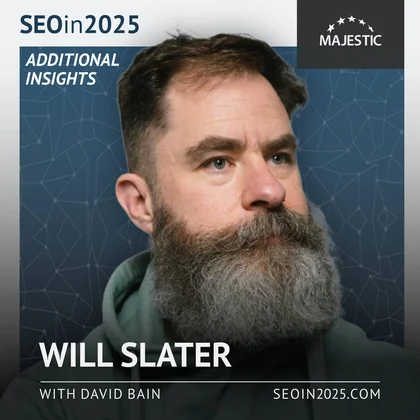
Will Slater
Will Slater emphasizes the importance of human-written content over AI-generated text.
« Back to Additional insights
More Additional Insights



Will says: “My insight is that you should spend more time learning to write, and less time using AI to write.”
Why shouldn't AI be relied upon to write content?
“Well, there are a couple of reasons why I think that it's not a great idea. The first one is that writing is thinking.
You’ve probably all noticed this, when you're listening. When you write something down, quite often you’ll look at it, and you'll see it from a different angle. You think about it in a different way, and that's really powerful.
If you stop writing, if you just let the robots take it over for you (whether it's content for a website, a sales page, or just an email that you're writing to a client or a colleague), you take away that stage of thinking, and you lose a lot from that stage. That level of thinking doesn't really come from anywhere else.
Writing is a way we've always communicated, and it's a fear of mine that we lose that by over-relying on AI. We're coming into a time of AI Mode and Perplexity and wonderful clever tools, don't get me wrong, but if you're using AI to write your articles, and then your articles are being summarised by another AI, there are whole layers of AI going in between the message that you've got in your head – that you want to get out to your audience – and what they're actually reading. I think keeping that personality, that reality, in your writing is really important.
The next thing is that your writing is very much unique to you. AI is getting cleverer, it's getting better, but it’s still learning from what’s already on the internet. That’s essentially how it works.
An awful lot more of the internet is being written by AI. We know it’s easy to recognise – certainly bad AI (there is better AI out there that’s maybe harder to recognise) – but the more AI writes, the more it learns from what it's writing itself (because it's learning from the internet), the more homogenous and generic it becomes.
By outsourcing your writing and your thinking to AI, you lose your personality. You lose what makes you and your brand unique. By learning to write for yourself, by doing it for yourself and cutting out some of that AI, you're keeping your brand unique, and you're immediately going to stand out from all the AI content, all the AI copy that's there, because you're different.
You're right. It might not be perfect, it might not be grammatically amazing, but actually, it's unique to you, and that's more important.”
I like the way you started off by talking about the fact that writing is a form of thinking. It's a form of coming up with ideas, so it's not just getting text on a page, it is actually thinking through what you intend to write, whether it's suitable for your audience, and coming up with an idea that's perhaps a little bit different to what exists already.
What about the content that's published? You alluded to the fact that writing by a human is probably not perfect; it’s your own style and a little bit different. Are there other elements, structurally, to something that a human will produce that tends to be different to the content that's produced by AI?
“We all know how it uses em dashes all the time, it uses American language, and that kind of thing. It tends to be very wordy and very waffly.
Search is changing, with AI Mode and Perplexity and AI search, and one of the things that I’ve found (when I've been researching into what ranks well and what does well in AI overviews and in what's going to be AI Mode) is it wants you to get to the point. Actually, that’s generally what most human readers want as well. They don’t actually want to read what you’ve written; they just want the point of it and the information that’s in that.
AI is really bad at waffling. Now, I’m probably more susceptible to spotting this because I’m a writer, because it’s my job, and because it’s basically most of my life.
I've tried to get an AI to write an article for me, and to then rewrite it in my own tone of voice or in a client's tone of voice, and what I've found is I'll be sat reading through this article, I'll read a paragraph, I'll get to the end of it, I'll read it again, and I genuinely don't know what point the AI is trying to make in that paragraph. I've read four lines, they're all grammatically correct, and all the words together nominally make sense, but it's not actually saying anything
Having that point – actually saying something – is vital because we all know, you get scripts, you have your AI overviews, and it picks out the point from a paragraph, or it picks out the point for AI Mode, or Perplexity pulls it out. If you're not making a point, if your AI writing is not actually saying anything, it's just words. So, it's not going to rank well.
It's also not going to be any good if people do read it, because it's not telling them anything they want to know. Nobody wants to scroll through 12 paragraphs of text where there's actually only a point in two of them. I think that's a huge key point.
Another thing is, it uses long, complex, waffly sentences that are just awful, a lot of the time. You can prompt this out of it, but it's not a guarantee. If you do want to write for yourself (and I genuinely think you should), the best tip I can give you is to make your writing easy to process.
That's what humans want, it's what we want when we read, especially online, and it's what search engines want.”
Easy to process by readers or by AI?
“Both. If you make it easy to process by readers, by definition/by association, that makes it easy for AI and crawlers to process as well.
Use the same kind of structuring. Use a simple H1 heading, H2 headings, short paragraphs, and simple language as much as you possibly can.”
I guess the challenge that many people have with deciding to use AI over human writing is the speed at which it can produce volumes of content.
If you're tasked with getting hundreds or thousands of new pages on a website, maybe product pages, and it has to be published relatively quickly. You're given an opportunity to write it yourself, get a team of writers, or use AI to potentially do the same task in a few hours. You can understand why it's tempting to do that.
Are you saying that it's wrong to select AI in that particular situation?
“Not at all, no. I think, as I’ve said, AI is a hugely powerful tool, and the example you've just described is the perfect example of when AI is really useful.
When I've been tasked with challenges like that, and you're talking thousands of pages that just aren't going to get written if you don't use AI, I think the first thing you want to do (or the way I would do it) is write several of those pages yourself, maybe four or five, and use those pages to train the AI.
The second thing I would always say is question what the point and the value of what you're writing is.
If it's something that's going to sit on a page, it's going to boost authority, it's maybe going to start ranking or it's going to help with rankings, but it's not what I would call a ‘key page’ or a ‘core page’, then you might want to think about using AI for writing because then you can focus your time on the pages that are important.”
Are you not envisaging that in three years' time, for instance, AI content is going to be so good that it's going to be hard to distinguish it from human content?
“No, I don't think that is going to be the case. It will depend on the content.
Like you're saying, with product pages that are probably very quickly knocked up if they are written by humans, there's an argument, absolutely. But for the kind of content where you're actually speaking to your audience – whether it's a guide on how to do something, for example, or a sales page for a larger product – AI can never quite get that last 5-10% that a human writer can.
The reason it can't do that is because it's not a human. Our experiences are what make us human. If, for example, I'm selling a product that unblocks drains. I've probably had a blocked-up drain before. I know what it smells like. I know what it's like sticking my arm down the sink, through the gunge, to try and pluck it out of the plug hole. AI doesn't have that. It hasn't got arms. It hasn't got a sink. It doesn't actually know what a sink is. So, it can't create that empathy with the reader that a real human can. It can get very close, and it will get closer, but it's never quite going to get that last little bit.
That applies to whatever you're doing, and it applies whether you've actually experienced a thing or not, because whatever the thing is, you have experience as a human that relates to that experience.
You might be writing something to sell a piece of an SEO tool. You might not have used that exact SEO tool, but you've used SEMrush or Majestic or whatever, so you've got that related experience.
All AI is, all it does, is it's very good at guessing what letter comes next.”
What does a good human/AI content workflow look like, so you can harness what humans can offer but also harness the power of AI as well?
“For me, the AI comes in merely at the research and planning stage. I find it really useful for doing stuff like getting it to analyse competitor pages. That's really useful. It can pull in the keywords that are used, the terms that are used, and the sentiment that the pages are using.
Also, if I'm researching a topic that I'm not an expert on (I write a lot of different things, so that happens quite often), instead of having to slog through a load of pages that have been not particularly well written by humans, I can get the AI to summarise it.
It may not be brilliantly written, it doesn't matter. It gets those points – bang, bang, bang – down there, which I can then build out from and reference back to the in-depth human-written stuff, to really get right into the nub of things.”
If you're talking to clients about producing content for them, do you get pushback from clients who say, ‘Can we not just use AI for this nowadays?’
Are clients generally quite open to producing less content, but human-written content instead?
“I think, with the clients we have, they are very much open to sticking to the human-written content where it's appropriate, because they've seen the results that our content gets.
We've had clients who've had significant amounts of AI-written content on their websites, which is doing nothing. It's not ranking, it's not getting views, it's just sat there doing nothing.
We’ve stripped back that content, right back, gone back down to the research stage, figured out what keywords we’re going for, built up a human article, and it’s ranked. It’s done well. So, we’ve got that evidence, anecdotally. We’ve not done super scientific testing, but we can show that it does work.”
Do you feel that search engines like Google are still reasonable at being able to detect which content is being written by AI and which is being written by humans?
“That's a really interesting question, actually. I would say, possibly not. But actually, that doesn't necessarily matter.
What matters is that the content is well written. So, if the AI content is as good, then… maybe I've just completely undermined my entire point.”
I guess what you're saying is what matters are user signals – what happens when people visit the page – because Google want to deliver the right result to the right person.
“Exactly, yeah.”
You also talked about using AI tools in the research phase. What AI tools do you actually use for that?
“At the moment, I spend quite a lot of time using Perplexity. I use Perplexity more than I use ChatGPT, just because it's so good at summarising that in-depth, complex data, but also referencing back to what it's summarised from.
I find (again, anecdotally) that Perplexity makes fewer mistakes than ChatGPT, because I'm a bit of a nerd, and I will go back and check what it said and make sure that it is accurate. If I read something and I think, ‘Is that really true?’, I can go check it, and I do find that ChatGPT hallucinates (they call it ‘hallucinates’; it makes stuff up) a lot more than Perplexity does.
But I think that’s because ChatGPT has a different use case. It’s designed very much as a multi-use tool, whereas Perplexity is very much just a research tool.”
I'm just trying to imagine how this is going to play out, and what it's going to look like in 5 years' time, and in 10 years' time as well.
Do you think we're still going to be writing a lot of content as humans for the web? Do you think that, for instance, we're going to have some kind of digital signature that shows that that piece of content has been produced by a human being?
“I think we're in a really interesting time at the moment, and I think it's going to be very, very interesting to look back in five years to now and say, ‘Wow, we got it completely wrong.’
I suspect, whatever we suggest now, new technology and new things are going to happen, and things are going to change. I would like to think that we are going to focus more on high-quality human-written content where it has value.
Maybe we will use AI for, like the example you gave, product pages. Maybe that is going to be a thing, and we'll just stop writing product pages – but again, maybe we won't. I do think that, for those high-value pages, the human-written stuff is going to become even more valuable because it's going to stand out more.”
Will, what's the key takeaway from the tip you shared today?
“I think my key takeaway is just to spend a little bit of time writing and learning how to write better.
You don't need to make yourself into an expert copywriter. Just learn a few key tips about writing, how to make things simple, and how to make things easy to process for readers, and maybe (if you do use AI for writing a lot) focus a little bit less time on generating better prompts.
Start thinking, actually, could I do this myself? Would that be a better result?”
Will Slater is Creative Content Specialist at 43 Clicks North, and you can find him at 43ClicksNorth.co.uk.
Choose Your Own Learning Style
 Video
Video
If you like to get up-close with your favourite SEO experts, these one-to-one interviews might just be for you.
Watch all of our episodes, FREE, on our dedicated SEO in 2025: Additional Insights playlist.

 Podcast
Maybe you are more of a listener than a watcher, or prefer to learn while you commute.
SEO in 2025: Additional Insights is available now via all the usual podcast platforms
 SEO in 2025
Catch up on SEO tips from 106 SEO experts in the original SEO in 2025 series
Available as a video series, podcast, and a book.
Fresh Index

Unique URLs crawled
194,188,717,434
Unique URLs found
618,052,412,077
Date range
07 Apr 2026 to 05 Aug 2026
Last updated
1 hour 1 minute ago
Historic Index
Unique URLs crawled
4,502,566,935,407
Unique URLs found
21,743,308,221,308
Date range
06 Jun 2006 to 26 Mar 2024
Last updated
03 May 2024
