-
Site Explorer
- Majestic
- Summary
- Ref Domains
- Backlinks
 New
New- Lost
- Context
- Anchor Text
- Pages
- Topics
- Link Graph
- Related Sites
- Advanced Tools
- Author ExplorerBeta
- Summary
- Similar Profiles
- Profile Backlinks
- Attributions
- Compare
-
Link Tools
- My Majestic
- Recent Activity
- Reports
- Campaigns
- Verified Domains
- OpenApps
- API Keys
- Keywords
- N-grams Near Links
- Keyword Checker
- Search Explorer
- Link Tools
- Bulk Backlinks
- Neighbourhood Checker
- Submit URLs
- Experimental
- Index Merger
- Link Profile Fight
- Mutual Links
- Solo Links
- PDF Report
- Typo Domain
- TLD Checker New
- Free SEO Tools
- Support


AI is here to stay
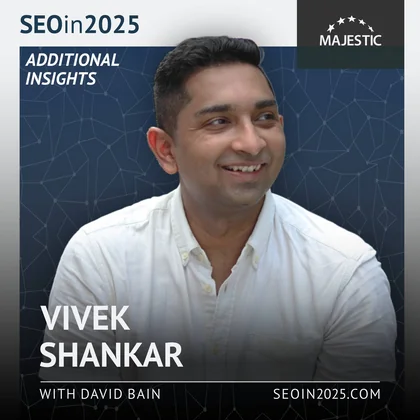
Vivek Shankar
Vivek Shankar emphasizes the importance of leveraging AI in SEO while avoiding hype and ensuring a well-thought-out process.
« Back to Additional insights
More Additional Insights



Vivek says: “My additional insight for SEOs is to lean heavily on AI, but don't buy into the hype and scale everything before thinking through your process.”
What is the hype at the moment? How do you differentiate between the hype and the good aspects of it?
“Well, I think the biggest promise of AI, and the way it's been marketed to SEOs, is that you can get all these things – everything that we do – done in double time and we can produce more articles for clients. We can get results a lot faster, which is a huge pain point in SEO. I think every SEO connects to that.
If I can get results in three months instead of six months, why shouldn't I lean into AI? The problem is that, while AI does all of those things, the way a lot of companies (and individual SEOs, sales consultants, or agencies, what have you) have been leaning into AI is just by scaling every single thing out there, and they haven't really taken the time to think through the steps in their process.
As a result of that, we have this wave of low-quality, really bad content online, which I think everybody is pretty familiar with at this point. The result of that is that people have started blaming AI and saying that AI does not work. But what really is not working is the process.
I think SEOs have not taken enough time to think about where their process fails, what the weak links are, what needs to be manual, and what needs to be automated. They've just scaled everything. While they've scaled the good things, they've also scaled the bad things, and that is compounding as well.
As a result of that, we have this wave of content that is just not hitting the mark, and it's making AI synonymous (some might say it has made it already) with bad content, which I think is a real shame because AI has so much to offer for SEO and, personally, I use it a lot. I just think we need to take a step back and think about how to scale it and remember that scaling is not just scaling the good things.
If you scale the bad things, that will overcome the good things as well. That's something to keep in mind.”
What's an example of something really good and effective to scale? Also, on the other hand, what's an example of something that you absolutely should not scale?
“I think that's a good question and it ties into the bigger point, which is that you need to break down your process and think about how to automate and how to introduce manual friction in there.
An example of automation would be research, right? I'm not talking just about keyword research. I'm talking about research as a whole: researching your clients, researching their problem areas, and researching their audience. I think AI can do that really well and cut short so many hours.
One of the common sticking points that a lot of SEO agencies and consultants have is when you ship niches. Speaking personally, my primary niche is fintech and finance. Now, if I started writing something for cybersecurity, in the past before AI, it was a bit of a slog because I wouldn't know where to begin. AI cuts that learning curve down massively. It helps me speak the language, maybe not 100%, but it gets me up to speed really quickly.
I know which questions to ask, I know how to ask them, and I can drill into those insights a lot quicker. So, using AI for that initial research by asking it to, for example, ‘Give me a brief of this particular industry. Tell me all about this particular client and their competitors.’ I can even use an AI flow to plug into one of the keyword research tools. ‘Give me a quick overview of organic search. Which positions are they ranking for? Where are the gaps?’
All these things that used to be done manually, AI does it brilliantly. I would also say, and this might sound a bit controversial, but I think the actual writing and the actual generation of the article needs to be done by AI. I think the best way of ensuring quality is actually by having a human edit it.
Now we're getting into the manual side of things, which is the second part of your question, which is where do you introduce friction? I think every automated process that we use with AI has to be paired with some friction. There needs to be some sort of human review over there.
For example, AI does all the research and it generates a huge body of knowledge. You need a human being to go in there and actually reduce it to, let's say, an article outline. Use AI to generate an article outline, but then have a human being review it to make sure that it actually makes sense and we're actually talking about things that will ensure a good quality article.
After that, use AI to generate the article, but then have a human edit it and review it and fact check it and make sure that we're not saying things that are a bit dodgy – because we know AI can hallucinate. I think that's an example of how you break down the process, introduce friction at the right points, and automate the right things. That's how you can generate quality at scale and minimise all the bad things that create garbage content.”
You talk about the importance of fact-checking articles that AI is writing for you, but you initially talked about research.
Do you also have to fact-check research? Are there hallucinations that AI can make in terms of actually determining who your competitors are or where the gaps in the market are?
“I wouldn't call it hallucinations, I would call it ‘mismatches’. A lot depends on the model you use. For research purposes, there are dedicated models that actively scan the web. I think some models even scan academic journals and these kinds of things, the ones that have been opened up.
The possibility of hallucinations over there is not too high. Let's say you're looking up a stat. You go on Perplexity and try to look it up. It brings back an actual web page with the stat on it. The chances of hallucination are low. What does happen at that stage is it can cause mismatches, like you mentioned, which is it might tag Company A which is not really your competitor.
This was something that happened with a client recently. They are competing with one company in SEO results. But you could say, outside of SEO, the company that they're competing with is actually their partner. So, they're talking about a lot of similar things. The average SEO would go in and say, ‘Company A is your competitor’ but, from a marketing perspective, they're not. I think the AI makes those kinds of judgments – and fair enough because you're only giving it an SEO context.
That's where a human being needs to go in and say, ‘Okay, this is not a competitor. These kinds of companies are the real competitors, so scan them.’ That sort of feedback is important.
Hallucinations occur when you're generating something from scratch. So, with a model like ChatGPT or Claude, when you're writing the article, you're generating something from scratch. You've given it information but, when the AI needs to generate something, that's when hallucinations come into play.
When it's simply retrieving information, there's very little chance of hallucination because it's accessing a fixed body of knowledge. That's why I think human review is still needed. It's just that you need to be aware of where hallucinations can occur because of the generative aspect of it.”
You talk about different models as well. Are there certain industries that you need to use different models for? Do you tend to favour one LLM, for example, or do you have to judge it based on your own individual needs?
“I don't think there's an industry-wide breakdown. I think it depends on your needs and your use case.
For research, you would definitely use certain models, like Perplexity is pretty good at this. For writing and generation, personally, I prefer Claude and their Sonnet and Opus models. Let's say you want to turn a LinkedIn post into a Twitter post, ChatGPT is pretty good at that. Now, of course, we have DeepSeek that is doing all of these things so, who knows? Maybe we'll all be shifting to one model.
I think it depends on your use case. That is an underrated part of using AI – which is you need to understand what the model is for. I don't think you need to understand how it works, in the nuts and bolts side of things, but you do need to understand what it's best at. Otherwise, (this is an exaggeration) you might end up using an image LLM for article generation, which is obviously the wrong use case.
You do have to start with your use case and then explore the LLM and see how that works.”
How do you know the right tool for your own particular use case? It sounds as if it's quite obvious to you, but it might not be obvious to a lot of SEOs.
How do you actually determine the right tool for the job that they've got in mind?
“That's a good question. I think there is a bit of a learning curve. There is some experimentation.
I've been experimenting with AI for 1 to 1.5 years now. That's probably why it came across as me being a bit obvious about it, but it's a good question. I think you just have to experiment. Let's say you need to test your use cases across a few different platforms, and then just see the output and work on it.
The interesting thing is, there are actually a lot of tools out there which help you choose the best model for your purposes. For example, there are a lot of these AI workspace tools that are coming up these days, which help you connect different blocks – an LLM block to a code block, for example – and you can build an app on top of it.
What a lot of these tools actually do is you tell the tool what kind of task you want to execute, and it tells you which the best LLM is. Of course, you can also get really meta with this and ask an LLM which LLM is the best to ask for that. There are multiple ways around it.
If all of that fails, I would say just go on social media and search for it because there's so much information out there. Finding the right LLM is not the challenge; the challenge is how you build a process on top. That's the real challenge, I would say.”
Another challenge, I think (you might tell me differently) is for content marketers/SEOs to actually differentiate the content that they're producing. Because, if the same tools are available to everyone, then you would imagine that lots of content is being produced on the same subject.
How do you differentiate your content in this day and age?
“It goes back to introducing fiction and that human review at the right stage.
Going back to our research example, the LLM can do the research, but then a human being reviews it, defines the right competition (in my personal example), and defines the right angle for the content.
You could write an article about how to build a cash flow statement, which is a pretty generic fintech SEO blog. It's very straightforward. It's just: how do you build a cash flow statement? How do you do this? How do you do that? It's very templated. But the ways to differentiate in there would be perhaps inserting some kind of SME quotes, maybe interviewing a few actual accountants and/or a few bookkeepers and getting some tips from them.
You can introduce this information to your AI flow and say, ‘Use these quotes to enrich my content’ or ‘Use these quotes as a base to expand upon the existing information.’ That's why human input is so valuable.
A good analogy for this would be that carpenters around the world have the same tools. There's not much differentiation in tools, but you can tell what a good piece of furniture is versus something ordinary. Nobody ever talks about tools over there but, for whatever reason, everyone is in a rush to blame AI (which is just a tool) for the lack of differentiation.
It's not the tool. It's the person running the flow. It's a person using the tool. The way to solve that is to think about your process, break it down, and introduce friction in the right steps. You don't need to automate everything that's out there. That's an easy pitfall that many people fall into.
That's how I would differentiate: introduce a human being at the right points, and you won't have issues differentiating – and you'll be able to scale it as well.”
Where is your primary place to publish content nowadays? Is it simply on a website's blog with a view to actually getting organic traffic through Google?
Also, how do you measure success? Is it all about organic traffic click-throughs from search engines or are there some other metrics that are more important now?
“It's a good question. I think the blog is still the primary form of publication, especially when we're talking about SEO. YouTube is great in DTC or B2C channels, but when we're talking about B2B (which is where I primarily operate), video has been one of those formats that's been promised for too long, but it hasn't really taken off – mainly because of the way the B2B buying process works, which is a different conversation.
From what I'm seeing, the website blog is still the most prolific acquisition channel. In terms of metrics, I think the answer is pretty much the same as it's always been, which is it depends on the client's goals.
Some clients are chasing more awareness, so you can measure your brand awareness searches, your branded searches, referral traffic, social traffic, etc. Some clients are prioritising conversions, so you probably need to hook up into some kind of CRM and then measure your contribution to revenue, etc.
I'd say, in terms of metrics, it comes down to the clients.”
I would say that, I agree with you to a certain degree about video from a B2B perspective but I think, personally, that it has to be integrated into a holistic strategy.
I've got this book in my hand here, SEOin2025, which is part of the sequence of content that I'm producing for Majestic, and the fact that it's produced as a podcast, a video series, and a book gives you that level of authority when you're talking about the story and when you're sharing the content at industry events, and you can give prospects a physical hard copy.
I think, if you're doing something a little bit different with your content, then that lifts you head and shoulders above what other people are doing with content in that particular industry. What are your thoughts on that?
“I completely agree. You should never be on just one channel. I think, when you're starting out, you do want to find that one channel where your voice can be amplified. But, as you're growing, you definitely want to have different formats. You want to have different ways of people connecting to you.
I listened to this other podcast with Daniel Priestley, who is pretty famous on the YouTube circuit, and he's an entrepreneur for those who are not familiar with him. He said something interesting which is, you need to have about seven hours' worth of content out there for people to feel familiar with you.
It's not literally a time stamp. It's just that you need to have this volume of content where people can interact with you in different ways, and that's how they feel familiar to you. That's when your content is going to start working because people will have spent so much time with you and become familiar enough to trust you and then they'll reach out to you, which is what content marketing is all about – whether it's SEO or video or what have you, whatever the channel is.
You need to use that as a benchmark, and you definitely have to have different ways of doing it. A book, as you’ve produced, is a fantastic way of getting reach. I mean, it's a pretty hefty one-time effort but the key is, once you produce it, it always lives and it gives you that authority.
Yeah, having a mix-and-match of channels is definitely important. Having said that, you don't want to over-diversify and spread yourself too thin. If you're starting out, maybe one to two channels is great – and, thinking of a company, it depends on the company's maturity. You want to diversify when you're getting a good stream of leads, or whatever results you're tracking, from one channel, and then you want to start diversifying to another.
Take it that way. Give people different ways of interacting with you, different downloadables, and different ways of consuming your content. It's always a good strategy.”
Absolutely. I can completely agree with that. I love the advice of perhaps starting with an audio podcast, getting comfortable with what you're saying and what your message is, getting comfortable with using a microphone, and then maybe switching on the video camera and starting to use video. But if you're doing everything at the same time, there's so much competition out there that it's potentially a recipe for doing everything badly.
“Yeah. Absolutely. Focus is the key, isn't it? I think that's what you're trying to say.”
Absolutely. Focus and knowing what you're doing and what your plan is.
In terms of plans, how often should you update a content strategy nowadays? It used to be perhaps just done once a year at the beginning of the year – this is the mapping out of what a brand intends to do.
With LLMs and different models changing so often, do you have to be a little bit more reactive with your strategy nowadays?
“There's no set answer to that, so the answer is ‘it depends’, which is the most frustrating answer one could give. I don't think AI has changed refresh timelines so much. I think it has changed how much content you need to refresh.
So, there are two levels here. There's refreshing individual pieces of content and then there's refreshing your strategy, as you mentioned. For the strategy, I wouldn't call it a refresh. I would call it a review. I don't think the timelines for that have changed. Some companies review and revise their strategy every quarter, some do it once a year, and some do it every six months. It depends on the broader marketing goals. I don't think those timelines have changed.
I think what has changed is the refresh timelines for individual pieces of content because we can produce so much more (assuming we're doing the right things). We can produce high-quality content at scale. There's just more volume involved. I can recall times, before GenAI hit the mainstream, when we would look into content refreshes maybe once a quarter or something like that.
Personally, I'm conducting refreshes maybe every other week for pieces of content because we're able to publish so quickly, and we're able to gather feedback. Contrary to popular perception, there's no Google penalty for this kind of stuff because, really, if it's high-quality, that's all Google cares about.
I think the timelines for refreshing individual pieces of content have definitely shrunk. At the strategic level, I don't think much has changed. You still need to conduct your regular reviews. You need to make sure you're hitting your metrics, and just revise based on that.”
If an SEO is struggling for time, what should they stop doing right now so they can spend more time doing what you suggest in 2025?
“I think keywords and focussing on keywords and keyword research – which is a weird thing to say because it's been central to SEO for so long.
Focussing on individual keywords, starting from keywords, and optimizing entire articles around a few keywords, is all becoming a waste of time (if it hasn't already) because it's it does not gel with the way Google works anymore.
Google is semantic. Even if you don't have a single targeted keyword in the article, it is smart enough to figure out what the article is about and you will get traffic, as long as your information is good and your content is of good quality. The rest – keyword research and optimizing your H2s and H3s – gives you marginal results.
Starting from a single keyword and then using that as your base for an entire article, I think it's a waste of time. You're far better off focussing on being as helpful as possible and delivering as much value as possible.”
Vivek Shankar is a Content Strategist for fintech companies, and you can find him over at VivekShankar.net.
Choose Your Own Learning Style
 Video
Video
If you like to get up-close with your favourite SEO experts, these one-to-one interviews might just be for you.
Watch all of our episodes, FREE, on our dedicated SEO in 2025: Additional Insights playlist.

 Podcast
Maybe you are more of a listener than a watcher, or prefer to learn while you commute.
SEO in 2025: Additional Insights is available now via all the usual podcast platforms
 SEO in 2025
Catch up on SEO tips from 106 SEO experts in the original SEO in 2025 series
Available as a video series, podcast, and a book.
Fresh Index

Unique URLs crawled
194,188,717,434
Unique URLs found
618,052,412,077
Date range
07 Apr 2026 to 05 Aug 2026
Last updated
1 hour 1 minute ago
Historic Index
Unique URLs crawled
4,502,566,935,407
Unique URLs found
21,743,308,221,308
Date range
06 Jun 2006 to 26 Mar 2024
Last updated
03 May 2024
