-
Site Explorer
- Majestic
- Summary
- Ref Domains
- Backlinks
 New
New- Lost
- Context
- Anchor Text
- Pages
- Topics
- Link Graph
- Related Sites
- Advanced Tools
- Author ExplorerBeta
- Summary
- Similar Profiles
- Profile Backlinks
- Attributions
- Compare
-
Link Tools
- My Majestic
- Recent Activity
- Reports
- Campaigns
- Verified Domains
- OpenApps
- API Keys
- Keywords
- N-grams Near Links
- Keyword Checker
- Search Explorer
- Link Tools
- Bulk Backlinks
- Neighbourhood Checker
- Submit URLs
- Experimental
- Index Merger
- Link Profile Fight
- Mutual Links
- Solo Links
- PDF Report
- Typo Domain
- TLD Checker New
- Free SEO Tools
- Support


Create content that AI can't create
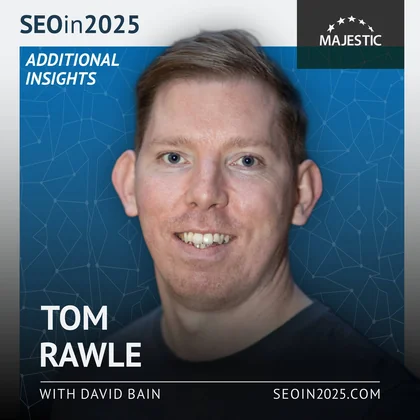
Tom Rawle
Tom Rawle emphasizes the enduring importance of high-quality, human-generated content in SEO, despite advancements in AI.
« Back to Additional insights
More Additional Insights



Tom says: “Forget about the AI models.
Create content that is genuinely engaging, interesting, and most importantly, hard to replicate by not only AI, but also humans.”
What kind of content can humans create that AI can't?
“Well, when we're thinking about SEO and authority, my view is that, regardless of whether it's a Google algorithm or if it's a new language model or AI model in the future, the best quality content always rises to the top. That's usually something that is written by humans/is created by humans.
Quotes from experts create the level of authority needed to be found through key search terms. That's also the way that AI would source it.
Relevancy in relation to where the content sits is obviously going to play a big factor in that as well. I guess the design of the content is dictated by the substance and the depth of it, rather than just creating thin content, which is always going to be overlooked or often depreciated by any kind of algorithm or AI model.”
You mentioned expert quotes there. I guess that's an element in producing higher-quality content.
How would you summarise what a great human-written piece looks like, including those elements?
“Well, it depends on what you're writing it for. On-site and off-site are obviously very different in terms of what you're trying to achieve from those pieces.
In relation to on-site, there is a bit of a wave at the moment of people talking about writing in a more informal way, so that AI models in the future can pick it up, because that's the way that it reports back to any kind of query.
But I think, in terms of off-site, it's always about building the most engaging type of content. For any human that's reading it, and for any audience that it's going to and wherever it's sitting, it's: Who's actually going to be engaging with that content? Not sitting there where the dwell time's minimal. It's who’s going to be sitting on the page, running through it, and understanding it – and taking people on that journey through the content, first and foremost.”
Do you have a preferred content generation strategy in terms of how you come up with ideation, how to incorporate different thought leaders' quotes within there, and how to ensure that that piece of content is unique and authoritative enough for it to be perceived as something that Google (and, of course, AI search engines) want to rank?
“If we're talking about it from a digital perspective, with my background, a lot of the knowledge that we have at Press Box (being largely from a journalism perspective and background, for the majority of us), we've been built on content.
We've grown through content, throughout our careers, to then come into a PR world where we're always looking at a lot of content the other way around, in terms of: What is newsworthy? How do you create content that is based on what an audience wants to read? Because that's ultimately what coverage is and how you build backlinks in the world of digital PR.
The main thing is that, as I said earlier, it's creating that content that becomes your currency. If it's content that is driven by quotes, driven by people, and driven by interviews, that is one way to do it, where it's not going to be replicated.
It can't be changed; it's not a listicle that can just be pulled off the internet or put together in terms of a quick fix for something. It's content that takes a lot of time, thought process, and creation to engage with your audience and the person reading it.
Try to think about, with every piece that you do, it has a purpose to it, and it's not just creating it for the sake of it. Some people are obviously using AI models to create as much content as possible on a certain subject matter. It's probably not going to be the thing that stands the test of time.”
It's interesting that you talk about listicles in a negative light, because maybe five plus years ago, that used to be the form of blog posts that could get quite a bit of traction.
You used to be able to reach out to people and incorporate them within your blog posts as recommended resources in a particular sector. Perhaps you had 20 different websites and people featured, and maybe quotes from them as well. Because you'd done that, the people who were featured were likely to promote the piece as well.
Are you saying that style of content is not as effective as it used to be?
“In digital PR, it really depends on the type of industry you work in and the type of client you have/the type of publisher that you're trying to attract. But for the sake of most of the content that we produce, much of the listicle work has fallen on deaf ears, I think.
The problem is, as I was talking about earlier, it's quite easy to build content unless you're putting your own spin on something. A lot of data can be gathered by journalists themselves. Sometimes the angles aren't quite right. Obviously, you can pick and choose when you're sending this to a journalist, but for the most part, when they're using it on their site, they're wanting something that is going to be really hard to recreate. It's got to be something different.
We're finding the same with a lot of surveys. Surveys have their own spin to it because, obviously, they're human-devised, but still that level of content where it's more on a basic level in terms of engagement and what's of interest. That interest is starting to wane as well.”
It sounds like you're really gravitating towards content that incorporates quotes from experts in the field.
How do you go about identifying who the experts are, and what metrics do you use to determine that?
“That's a very good point. Again, it really depends on your industry.
Where we work with a lot of brands, they have a lot of in-house experts – if you'd like to call it that. Working in the world of finance, you have people working fairly high up who have a profile built already.
That's a very easy way to determine whether they're an authority in a space. You can look at previous work they've done, you can look at previous places they've featured: conferences, podcasts, interviews, etc., that they've featured in.
You also have people who are experts by association. You'd be classed as an SEO expert, David, in that sense, when featuring yourself in any kind of SEO content, because of your profile. That's the best way to look at it, I would say.”
Okay, so it's not necessarily a specific metric that you're looking for. It's researching individuals who are prominent in the space that you want to operate in, and then it's reaching out to them and trying to incorporate them in your content as well.
“We have the aspects from a digital PR standpoint as well, where a lot of the experts that we use are in-house, and they would have their own pages to build up authority for that one site. So, we can use that as a bit of leverage in terms of referencing back to that as well, and sometimes gain links to that, which will help with that on-page authority for the brands we're working with.
But ultimately, yeah, it's trying to find the people who are the most – well, somewhat the most – vocal. Not always the most vocal, but are interested and engaged and interactive in those spheres and those worlds.
For journalists, I guess it's now trying to validate that because, with AI, that's becoming a feature. There are recent reports of a lot of fake experts being used in the world of PR, in terms of people who never existed or never created.
I guess it's on us to build that confidence and build that validation that a journalist might need to cover a certain person or a certain level of quotes.”
How do you go about doing it then? How do you validate that someone is a real, authoritative expert in a particular area?
“For the majority of our content that we build, on a quote level, we know the people. They're either in-house at the brands we use, or they're external experts that are semi-famous (they might be celebrities, they might be ex-sports stars).
We've worked in a lot of different industries for that reason. It's someone who would have a public profile most of the time. It wouldn't be someone who would just approach us, give us the spiel, and tell us that they're an expert in whatever field, without us doing any kind of research on it. We'd always vet them, know them, or often meet them in person if we're going to do interviews.
The other part of the quality of the content that we build at Press Box, in particular (and I think it's happening a lot in the world of digital PR), is more interactive content. So, video content which is now being used on-site. We’re trying to elaborate on that and trying to expand that process where the content is not only just the written content that AI models and Google can see, but also the interactive content in terms of any other assets such as videos, graphics, etc.”
You did mention the phrase ‘external experts’, but you also mentioned the phrase ‘internal experts’ a lot more; probably three or four times already.
Are internal experts better? Will they deliver more for your brand than using external experts with even more perceived authority?
“It's a good question. I think it depends on how you align an external expert with your brand.
Often, with internal experts, they're working within the firm, they're working within the company, they have a position, they have a profile, and they're already established in that sense. You know what their expertise is, they've probably been quoted elsewhere, and they're used in a day-to-day make-up for that reason anyway, internally, as an internal spokesperson for the company.
When it's an external expert, as I said, you have to try and work out what campaign they're part of and how they fit with the relevancy of the brand. If you're matching a sports star with a finance brand, it’s going to be quite difficult to find the middle ground.
There are ways to do it. We've worked with a coffee brand in the past, and we've interviewed sports stars about their diets, particularly where coffee comes into it, and it creates a level of relevancy about the interview in terms of nutrition, but it does become that much harder to establish that.”
You've also talked about creating authentic content. What does authentic content actually mean, and what does it mean to you?
“I think authentic content is human-written content.
With much of the AI content that you see, that is being pulled or being drafted… We've used AI, for example, to test out different ways of writing and see how human it can be. You put it in front of, and test it in front of, various people (myself included), and you can definitely see – just from the language used, the context found, and the information that is presented – it’s not written in the way that we write, in a news sense.
Writing a news story is a skill in its own right, rather than just plucking data out and presenting it. I think the format it's written in is often the way that you can determine how authentic it is and whether it's human-led authentic.”
That might be the case nowadays, but are we not going to get to a stage in two or three years' time where we just can't tell the difference between human content and AI-written content?
“It's a very good point. We may definitely get to that point. I think we're not quite there yet. I would say that everyone should hold on to the fact that humans do have that touch, which is very different: the emotional intelligence, the understanding of an audience, etc.
There's an element of AI which is starting to learn a lot more about that. I think the latest updates from Google and how that AI rollout is going to happen are going to become more and more advanced in that sense.
I always think that (and I speak from a digital PR perspective still) the content that we're building has to be liked by journalists to be used for their audience. Provided that's authoritative enough – that it sits on those sites that have that level of authority that a lot of the national or international newspapers that we work with have – that should always be plucked into the AI model anyway, so that's probably the way to look at it.”
You also say that human-created content can also create off-page SEO that can't be replicated. What do you mean by that?
“Off-page in terms of the types of content that we're using for digital PR. I guess we go back to quote-led content, as one example.
An AI model can't interview someone, for example. They can't get new quotes from a human. They can't talk about (or get someone to talk about) something new or that is trending in the news. This is something that only a human can do, or we can only do in a human setting.”
In terms of the digital PR realm, has that changed significantly over the last couple of years? Do you see that significantly changing over the next couple of years?
“In relation to AI or just in general?”
Just in general. Obviously, in relation to AI, a lot has happened over the last couple of years, but it's always interesting. Certainly with SEO, SEO has been changing a lot. It's still absolutely essential, but it never stays the same.
In your particular niche of digital PR, what's your perspective on that?
“I definitely think it's changed in relation to the way we look at how we manage our clients through it. The content is pretty much like-for-like. It’s newsworthy content that is produced in whatever field/industry is most relevant to that client. If it's a sports company, we're using sports content to get into sports publishers. That's the main aim.
But I think the way that we can manage our clients through a lot of the SEO updates is becoming ever more important – particularly with the move to more relevant content, and probably more relevant publishers and more authority built in that space.
Then we have things such as the change in relation to follow links, nofollow links, and brand mentions, and how that has become much more of a technical game for us, as ex-journalists, to become more sound about how much we know about that world, and therefore relaying that back to our clients to give them the confidence in what we do, the journey that we're taking them on, and where we're trying to get to with them.”
What are your thoughts on whether or not an SEO should be learning more about PR?
Do you think any SEO should know more about PR, or do you think it's quite acceptable for an SEO to be technical in their focus and the nature of their focus, and it's fine for some SEOs not to be creative?
“I think it's very dependent on the type of company you work for, and the type of person you are in particular.
I'm always one for learning. I'm always trying to find new ways to understand SEO from a content level or from a technical level. I'm not the most proficient at all of it, but I will still try to understand it where I can.
For most SEOs, it's the differences. The way I look at it is that a traditional SEO is more of a numbers person, and a PR person is more of a content person. This is probably why my point for today, and my tip today, is related to creating good, authentic content.
I would say that, particularly what we have at the moment with clients in our space, it's gone from being very much a KPI of ‘How many links can you hit?’ to what the quality of those links is and ultimately what content comes through with that.”
Tom, what's the key takeaway from the tip you shared today?
“Don't be scared of the changing nature of AI search, LLM search, or even an AI Google algorithm. Good quality content will always stand the test of time.
The cream always rises to the top and, if you're providing good content that can't be replicated on-site and off-site (providing that it's within the relevant nature of what you do as a business), it will always reward you at the end of the day.
Maybe that will change in five or ten years’ time but, at this point, it will always still be the best way of building your SEO.”
Tom Rawle is Director at Press Box PR, and you can find him over at PressBoxPR.co.uk.
Choose Your Own Learning Style
 Video
Video
If you like to get up-close with your favourite SEO experts, these one-to-one interviews might just be for you.
Watch all of our episodes, FREE, on our dedicated SEO in 2025: Additional Insights playlist.
 Podcast
Maybe you are more of a listener than a watcher, or prefer to learn while you commute.
SEO in 2025: Additional Insights is available now via all the usual podcast platforms
 SEO in 2025
Catch up on SEO tips from 106 SEO experts in the original SEO in 2025 series
Available as a video series, podcast, and a book.
Fresh Index

Unique URLs crawled
194,188,717,434
Unique URLs found
618,052,412,077
Date range
07 Apr 2026 to 05 Aug 2026
Last updated
1 hour 1 minute ago
Historic Index
Unique URLs crawled
4,502,566,935,407
Unique URLs found
21,743,308,221,308
Date range
06 Jun 2006 to 26 Mar 2024
Last updated
03 May 2024
