-
Site Explorer
- Majestic
- Summary
- Ref Domains
- Backlinks
 New
New- Lost
- Context
- Anchor Text
- Pages
- Topics
- Link Graph
- Related Sites
- Advanced Tools
- Author ExplorerBeta
- Summary
- Similar Profiles
- Profile Backlinks
- Attributions
- Compare
-
Link Tools
- My Majestic
- Recent Activity
- Reports
- Campaigns
- Verified Domains
- OpenApps
- API Keys
- Keywords
- N-grams Near Links
- Keyword Checker
- Search Explorer
- Link Tools
- Bulk Backlinks
- Neighbourhood Checker
- Submit URLs
- Experimental
- Index Merger
- Link Profile Fight
- Mutual Links
- Solo Links
- PDF Report
- Typo Domain
- TLD Checker New
- Free SEO Tools
- Support


Get expertise straight from the source
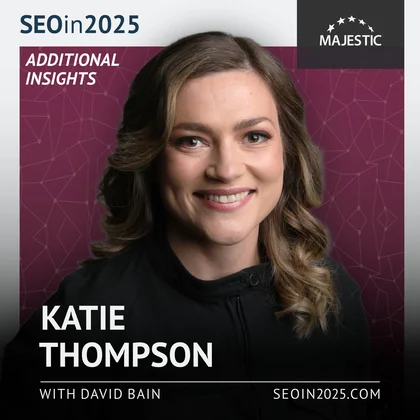
Katie Thompson
Katie Thompson talks about the importance of trust signals, the evaluation of expertise, and the strategies for interviewing experts
« Back to Additional insights
More Additional Insights



Katie says: “My additional insight for SEOs in 2025 is to get expertise straight from the source. EEAT is still important, and the most valuable content will come from those who've interviewed real-life, human experts.”
Straight from the source. How do you know who the best source is?
“I think there are various, in SEO terms, ‘trust signals’ – be that the very simple badges on a website (Law Society for a law firm, for example) or it could be any kind of credentials. It could be an author bio, or it could be seeing their name cited in other sources.
Anything that actually shows that they are a real human, they've done their homework, and they are an expert in their field.”
Does it make any difference if you interview an internal in-house expert or some external expert that you haven't necessarily encountered before?
“Again, the proof is in the pudding. Be they internal or external, what can they show me to prove that they have had success in their field?
If I've worked in-house on a brand and I've driven XYZ campaign and generated this many sales or whatever, and I have proven case studies, then yes, okay, I'm an expert in that – but equally, you could say, ‘I've worked with many different brands,’ ‘I've appeared on this many podcasts,’ ‘I've been on these panels.’ Things like that.
I always say, ‘Show me, don't tell me,’ – which is a copywriting principle that I apply. The proof is in the pudding.”
Do you look at specific metrics, or is a lot of it instinct and experience in terms of knowing who's the right person?
“A little from column A, a little from column B. Particularly in the world of SEO, there are big names that we hear of, like Lily Ray or Mark Williams-Cook, for example (just to name drop some people out there).
In terms of metrics, it could be something as simple as the number of LinkedIn followers or the number of times they've appeared on Search Engine Journal or various press cuttings – things like that. But equally, your own instinct. I think (and I'm sure you'll agree) you get a feel for who's the real deal and who's a bit of a cowboy.
It might be someone that you've never come across before, but then, when you delve deeper into their online footprint – their LinkedIn profile, their website, where they've appeared – then, while I've never come across them, for whatever reason, I can see that they do have first-hand experience in their field.”
I think that, to a certain degree, people are self-selecting.
In other words, if you ask someone to be interviewed for something, for a project, and they feel that they're not an expert, then they'll often decline and perhaps suggest someone else instead.
“Yeah, definitely. Unless they have the bravado and just think that they can get away with it anyway.
But hopefully anyone with integrity would say, ‘Look, I'm perhaps not best placed to do this, but I can recommend you this person instead.’”
Do you do anything to make it more likely that they will accept the invitation that you are providing them?
“I wouldn't want to say, ‘Here's the exposure you'll get,’ because this is something that freelancers hear all the time, and we always say, ‘Exposure won’t pay the bills.’
It's almost about showing gratitude and saying, ‘We would really appreciate your insights.’ Kind of buttering them up a little bit, honestly, and saying, ‘We've seen your expertise in XYZ and we'd love to have your thoughts on this,’ if there is no monetary incentive – rather than just saying, ‘Oh, you’ll get loads of exposure,’ which doesn't mean anything really.
Again, just flattering them and saying, ‘Actually, you'd really be helping a lot of people in your community who are perhaps starting out in this field.’”
Is there any format that makes it more likely that someone's going to say yes?
“I think they've got to see what's in it for them. If people were to come to me – obviously, you've invited me on this podcast, and I've been on the BBC World Service, who came to me to talk about AI. In that sense, it’s the association. Obviously, I'm going to say yes, because it's the BBC. That's a massive deal. In that sense, it is about exposure.
The credibility of the source, wherever you're being published, would be a big incentive. Equally, I just think your approach: if you're polite about it and you are honest. ‘We can pay you,’ ‘We can't pay you,’ or ‘This would be really helpful.’ The best approach is to be transparent.
However, you approach them (over email, phone, or whatever), just say, ‘We'd really, really appreciate your thoughts on this. This is how you'd be helping out.’ and if they're a good person, and they've got the time… And being clear about how much time it would take, if there would be any travelling involved, and stuff like that. Again, just being completely transparent.”
Is it becoming more normal to pay experts now?
“Nowadays, if you look at the way journalism is going – people talk about paid links, paid guest posts, and stuff like that – I wouldn't say it was normal, but I would say that people see that as a shortcut, because it's so hard to get people's time nowadays. Particularly with things like journalism, everything's behind a paywall or everything is funded by ads or whatever, so there might have to be that monetary incentive.
But then, is that ethical? Is that just buying links? Are they just appearing because money has changed hands?
I'd rather see it where no money changed hands, but someone is appearing on whatever podcast or contributing their thoughts to an article because they want to contribute and help their community.”
In terms of assisting with EEAT – assisting with building up that experience, expertise, authoritativeness and trust, in terms of how your site's perceived by Google – is there a best way to publish that content?
Is it better to focus on the written form and perhaps include multiple experts within a page on your website? Or have you noted that another form is more effective?
“I've tried both approaches. If it's a really, really niche topic that one particular expert might have a lot of experience in, I might do it more in a question-and-answer format – more of an interview, specifically, so the focus is almost on them and their first-hand experience.
If it's a slightly broader topic, then I might speak to two or three people, and in both cases, have the bios down the bottom and external links out to their website as well. I think it is on a case-by-case basis, but generally, I would put my journalist hat on (because I trained in journalism, so I'm used to interviewing people).
It's nice to get a broad range of perspectives if it is a more lower-level and accessible topic, that a lot of people can share different experiences on. But if it's something really, really specific, let's say a medical topic, then it might be better just to home in on one person.”
Do you have a preferred interview format? For instance, do you send them questions beforehand? Do you like to stick to a certain length?
“What I normally do is, for example, we do a lot of work with Reuters – the second-largest news agency in the world, (hopefully still). We do a lot of work with their supply chain arm, and what they do is they will source various experts and we’ll put together a white paper. We'll have three or four chapters and, within those chapters, four or five questions – but these are loose questions.
It might be the same set of questions for different people, but we might say, ‘Actually, that's not as applicable to you as it is to this one, so don't worry if you don't want to answer that.’
Then it turns into a bit of an organic conversation. So, it's not rigidly question-and-answer. It might be like, ‘Okay, well, that's interesting,’ and then we might just go off on a tangent, but bring it back around to the theme of the chapter, if that makes sense.
So, semi-rigid, I suppose.”
Does this get managed like a project, in that you maybe sit down once a quarter and decide what your content marketing strategy is going to be and then decide, ‘Okay, as part of this, I want to interview a dozen people on this particular topic,’ and then reach out to people from that?
Or is it simply a case of, on an ad hoc basis, reaching out to thought leaders, reaching out to experts, and once you get them available, simply featuring them as a blog post on your site?
“Probably more the first option. That way, it's just easier to plan things with time constraints and stuff.
So often, the biggest hurdle is just trying to find these experts – they're all on different time zones and different schedules – and just trying to get it within that eight-week window. It's best to have the questions planned ahead and then source the experts, but obviously be a little bit fluid with that.
If it's a case where whoever's available might not be as well-versed in this topic as they are in that, then maybe slightly adapt the questions. Have an idea in your head, but be adaptable with it, depending on the people that you manage to reach out to.”
Do you have a publishing and promotion strategy for each piece of content? For instance, in terms of publishing, do you try and incorporate certain elements of schema?
In terms of promotion, do you tend to bite-size it and incorporate it in social media or involve digital PR in order to actually get more eyeballs to it as soon as possible?
“With schema, obviously, you’re definitely using things like the author tag.
In terms of promotion, I think it's really important to leverage the expert themselves. So, collaborate with them on any social media posts, because if they are an expert, in theory, they will have a large network, so they can share it as well.
Equally, having a list of publications in mind who might be interested in hearing from this person, so planning it all in advance. How are we going to hit it from a social media point of view, from an SEO point of view, and from a digital PR point of view? And, like you say, repurposing as well.
If we are writing an 8,000-word white paper, there are all sorts of snippets we can take out of that and turn into a social media post or an infographic or whatever. It's very valuable to have that one piece of content from that expert source.”
When you talk about an 8000-word white paper, would that potentially be from the one interview or would that be from multiple interviews?
“In that particular example, that would probably be from three or four people. Again, I'm just thinking back to things we've done with Reuters. Some of them might be a write-up of a huge conference. So, it'll be trying to condense all these different talks that are half an hour each, and trying to pull out the salient points and putting it all together. Some might only have three or four people.
Again, because of the chapter format, it might be a case of one expert being better at talking about, let’s say, logistics as opposed to another expert who might be better at talking about supply chain visibility and the technology that comes with it. So, yeah, three or four, I'd say, in that size white paper.”
How does this all come together in terms of the different marketing roles that you have to work with?
You mentioned that you've got a journalistic background. Do you have to work with technical SEOs or other content marketing/social media teams in order to really maximise the opportunity of working with top experts in your niche?
“It's a tricky process because (I'm sure you've seen it before) we call it ‘approval by committee’. It's just a nightmare because there's obviously sourcing the experts, there's getting the client themselves to check it off editorially, then later on they might be working with the designer as well, and the designer might say, ‘Actually you need to change the content because this graph doesn't match up with this caption,’ or whatever.
So yeah, it is a large process. It's a very iterative process, and there's a lot of back and forth, and it’s perhaps not the most efficient, but I think it's so important that everyone is on the same page.
What I always say, ahead of any of these projects, is, ‘Let's look at exactly who is involved. How many people are involved here, and at what stage will they be involved?’ We don't want to get lost in version control and think we're ready, and then, actually, another five stakeholders are going to get involved.
To save time, it's good to plan it out and see who's doing what.”
How do you measure success, because a lot of this could be quite intangible?
For instance, do you ideally look at trying to rank for different expert names and drive more traffic for particular keyword terms within the interview? Or do you somehow measure an increase in authority on your website/perceived domain authority based upon what you've published?
“Probably more so the last one, but I'd also measure how valid they are as a source before I've even produced the content. So, how many publications have they been featured in? What credentials do they have? How many views does their website or blog get?
I'd measure that first, and then I would look at your standard engagement metrics – be that on social media, likes and comments, things like that. Then, perhaps looking at keyword rankings as well.
If you're going to hang your hat just on the name, then I would make sure that it was one of those interviews we talked about before, where it is just one-on-one and you're talking about a really niche topic – because they've got their own authority, and I'd sooner not rank just for a name; I'd rather rank for the topic that we're discussing.
This is something that's happened to me before. I've got a portfolio section of my website, and now I rank for someone's name because it just happens to be an interview with someone, which is great, but that doesn't necessarily showcase my copywriting services. So, yeah, it's tricky.”
We're obviously focusing our attention on EEAT, and by default Google, but there are new up-and-coming search engines. There are AI-driven search results as well.
Where do they come into play? Do you think about them in terms of publishing content and where else the expert-driven content might feature?
“I could talk about AI all day. I won't, but it is obviously something that's on my radar.
Fundamentally, a lot of the same principles that you would apply to standard SEO, before AI overviews even came along, still apply.
This is something that I practice, and you can call it narcissistic, but if I Google, ‘Who is Katie Lingo?’ I make sure that I've got a knowledge graph coming up there. I make sure I have a good About page, author schema, my name on other publications, podcasts, etc. – it's all there. It’s about building your own personal brand online as well.
I’m very wary of LLMs and, as such, I would just try to optimize my sites as much as I would in a general SEO sense. So, making sure that my name can be associated with everything I want it to be associated with – with content marketing expertise, copywriting, and stuff like that.
We don't need to reinvent the wheel here, and I think that's the problem. A lot of people talk about GEO and stuff like that, and actually, as long as you just adhere to the same EEAT principles, your name is going to show up in those knowledge graphs.
It annoys me when I see people using fake testimonials, getting an AI image of someone, and saying, ‘John Smith said this.’ Then, if I were to Google ‘John Smith’ or do a reverse image search, I would see that it wasn't a real person.
I think it's really important to invest in your personal brand as well.”
Katie, what's the key takeaway from the tip you shared today?
“In a world where we're always trying to save time, it will be worth the time invested in speaking to a real-life human expert with first-hand experience. Otherwise, you'll just spend your time trying to correct the errors that have been made from taking shortcuts.
Always go directly to the source, and people will trust you more.”
Katie Thompson is Managing Director at Katie Lingo, and you can find her over at KatieLingo.co.uk.
Choose Your Own Learning Style
 Video
Video
If you like to get up-close with your favourite SEO experts, these one-to-one interviews might just be for you.
Watch all of our episodes, FREE, on our dedicated SEO in 2025: Additional Insights playlist.
 Podcast
Maybe you are more of a listener than a watcher, or prefer to learn while you commute.
SEO in 2025: Additional Insights is available now via all the usual podcast platforms
 SEO in 2025
Catch up on SEO tips from 106 SEO experts in the original SEO in 2025 series
Available as a video series, podcast, and a book.
Fresh Index

Unique URLs crawled
194,188,717,434
Unique URLs found
618,052,412,077
Date range
07 Apr 2026 to 05 Aug 2026
Last updated
1 hour 2 minutes ago
Historic Index
Unique URLs crawled
4,502,566,935,407
Unique URLs found
21,743,308,221,308
Date range
06 Jun 2006 to 26 Mar 2024
Last updated
03 May 2024
