-
Site Explorer
- Majestic
- Summary
- Ref Domains
- Backlinks
 New
New- Lost
- Context
- Anchor Text
- Pages
- Topics
- Link Graph
- Related Sites
- Advanced Tools
- Author ExplorerBeta
- Summary
- Similar Profiles
- Profile Backlinks
- Attributions
- Compare
-
Link Tools
- My Majestic
- Recent Activity
- Reports
- Campaigns
- Verified Domains
- OpenApps
- API Keys
- Keywords
- N-grams Near Links
- Keyword Checker
- Search Explorer
- Link Tools
- Bulk Backlinks
- Neighbourhood Checker
- Submit URLs
- Experimental
- Index Merger
- Link Profile Fight
- Mutual Links
- Solo Links
- PDF Report
- Typo Domain
- TLD Checker New
- Free SEO Tools
- Support


Start building your brand authority and direct audience relationships now
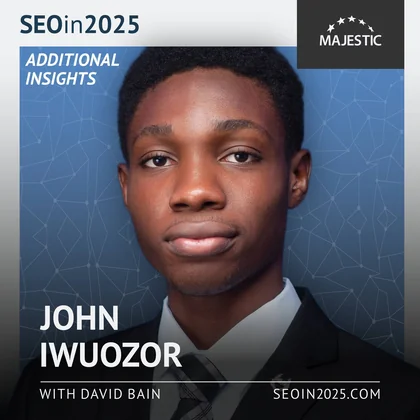
John Iwuozor
John Iwuozor emphasizes the importance of building brand authority and direct audience relationships in the era of AI-powered search.
« Back to Additional insights
More Additional Insights



John says: “My additional insight is that we need to prioritise building brand authority and direct audience relationships, especially in this era of AI-powered search and generative experience.
That's just it, in one sentence.”
What does brand authority mean to you, and why is it so important?
“I feel like brand authority is especially important in this time and age because the way people search is becoming very different – and I'm going to get a bit technical here and give a scenario/example.
Two/three years ago, if you wanted to search for a particular top-of-the-funnel keyword, like ‘what is cybersecurity?’, when you searched for that keyword, it would basically give you a list of search engine results. You would have the first link, second link, third link – the blue links – and you would have multiple pages.
People would search for a particular query, and then they would pick one, two, or three pages, and they would find their answer. That was it. Now, if you're searching for that same keyword, you have AI overviews just giving you the answer right off the bat. So, you have zero clicks, which is a common problem in the SEO community.
Now you have things like AI Mode, you have LLMs, you have ChatGPT, you have Perplexity; you have all of these generative LLMs. Some people no longer use Google to look for these queries. They simply put the query into these LLMs, and then they get their answer straight away.
In previous years, search was deterministic: you created good content, and then you would rank. That's what I was trying to explain before. You were either the first, second, or third, so you ranked really well, and then people would select you – but now it's very probabilistic because LLMs are not simply looking for the first, second, or third; they are looking for something relevant to whatever you have.
Now, I've been studying the AI Mode patent (I wrote it in a piece for Moz), and then I looked at what was happening behind the session. What I discovered was that, when you search for a particular query – let's say you're using AI Mode and putting in a particular query to look for a solution – what it does is that it uses some kind of maths. It converts your words to embeddings, and then it uses cosine similarity, or maybe a dot product – it's basically maths to just look for documents that are semantically related to whatever you're searching for.
It's not necessarily bringing out the top result; it could bring out something from the 25th page or the 26th page. So, it is probabilistic. You might appear or you might not appear. You might do everything right, and then you still might not appear.
I'm saying all this to say that we need to prioritise brand recognition because you can no longer just depend on search traffic/organic traffic. We need to be looking beyond Google’s ecosystem because search is now probabilistic; it’s not deterministic. You could do everything right, and still not appear.
The reason for branding is that you need to find a way to have these direct audience relationships with your customers and with the people who are searching for you. You need to build your brand in such a way that people keep you top-of-mind so that, if they have a particular query, they can come directly to you. In that way, you get to keep them, and that obviously leads to more revenue.
That is why I think it is very important, and it is not a new subject. People have been talking about this over the past few years, but I feel like, right now, it is so, so important because search is not deterministic; it is probabilistic. That's why we need to prioritise this.
So, that's basically what it means to me. That's the best way I could explain it.”
That's brilliant. You talked a bit about semantic relevance, about how a brand could potentially be more semantically relevant, and you also mentioned direct audience relationships a little bit as well.
I'd like to dive into direct audience relationships, how you go about doing that, why it's important, where you do that, and what impact it has, but, in terms of being semantically relevant, how do you make your brand semantically relevant so it's more likely to come up for the phraseology that your customers are likely to search for?
“There are different disciplines now. You have relevance engineering, you have people saying things like GEO, AIO, and LLMO – you have different acronyms popping up every day on LinkedIn and other platforms. Everyone is talking about, ‘How do you get your content to be seen on these LLMs?’
Now, there are different techniques where you could build your content so that, every time people are searching for a particular query, it pops up as a solution. There are different ways. There are chunking strategies, where you have to create bit sites, and you have to structure your content in such a way that it can be easily extracted by LLMs. That's chunking strategies.
There are other ways in which you could use tools to help you see if you are trying to fulfil the intent of the user.
One thing that I've also learned from this patent is that, now, because we have AI Mode and everything, we need to cover the full intent space, not just the search query. Let’s say a user was searching for something like ‘best shoes’. Now, it’s not just going to give you the best shoes. It’s going to do a query fan out, and it’s going to get a list of semantically-related keywords or questions, and then it’s going to provide the answers to all of these things.
So, when we’re trying to create content, we need to create content that covers everything – it covers the full intent. It’s more like ‘the best shoes for X particular use case’, ‘how do you select the best shoes?’, and a lot of different things. It’s like a topic cluster, but it’s an advanced topic cluster. That’s the best way I could describe it.”
How do you determine what the full intent is if it's not incorporated as part of the phrase that someone's searching for?
“That's why there are tools. There are tools that can help you to get those queries out. Every day on LinkedIn, you see a lot of SEOs coming up with tools that could help you get those queries.
Then, if you use Perplexity, when you look for a particular query, you can see what it's searching for – it shows you the list of related keywords it's searching for. It does that, and then you could see how you could structure your content in such a way that you can answer every single question that is popping up.
You can basically use tools to help you work it out.”
Essentially, when you're using AI search engines to have a look at keyword phrases, you're looking at the workings that the AI tool goes through in order to come up with the answer.
Then, you're going through the workings to determine what the likely relationships are between what the person originally searched for and what the tool was looking for based upon what other people have searched for in the past.
“Yeah, basically. That's why I said it's very probabilistic, because you are taking this particular intent and it's like, ‘Okay, I have this particular query that someone is searching for,’ and you are trying to cover everything around that query – because from that query, there could be a lot of similar queries related to that.
Like I said, it's like a topic cluster. It's not anything new, it's not exactly novel, but it’s now very much more important because there are a lot of similar things, and the way users are searching is changing, so we need to adapt to that. We need to look at all the similar queries that are around one query, and you have tools that can help you.
There are tools that have been created that can help you look for these things, or maybe you can do some sort of research, and you can find a way to check it. There are also things like Screaming Frog that can help to check. You could look for content that is semantically related, and it can help you search for things like that. There are more simple tools around this.”
You touched upon Perplexity, and you mentioned Screaming Frog there as well, but you also used the phrase, ‘tools that have been created,’ and it was a bit of a tease in terms of there being so many different possibilities out there.
What are two or three other top tools that you use to discover semantically related topics, and how do you use them as part of a workflow?
“Well, I'm not exactly the tools type. I'm more of the technical type, where I would rather work on Python code to look for something similar.
I know one common tool that was created by Mike King, which is Qforia. I've used that, and it was really helpful. Then there are other tools by Moz, Semrush, and Ahrefs, and they are creating these things that could help you see a lot of related queries. I'm not very well versed in the tools that can be used, but I do know that, if you were to search for these things, you would definitely see them.”
Understood. Essentially, as a principle, it's absolutely key to understand the hidden intent behind what someone's searching for.
“Yep, yep, yep – not just the exact intent but also looking at surrounding intent. You get the query, and then you are predicting what they could possibly search for next. You're covering every single thing around that and trying to be as exhaustive as possible.
Obviously, you cannot answer every single thing, but it's just trying to be as exhaustive as possible in such a way that you answer all your queries, and whenever they search for that particular query on AI Mode, Google is able to recommend your content to them as someone who's covered this.
Like I said, it uses maths. It's not human. It's not like, ‘Oh, I'm going to read this content’ or ‘I think this content sounds nice’. No. It looks at keywords. It looks at, ‘Is this query related to this document?’ That's why we have people using these tools to check the level of semantic similarity between their content and the particular query”
You also touched upon the importance of direct audience relationships. What do you mean by that, and how do you take advantage of that?
“Away from the technical part of it, like I said, search is no longer guaranteed. It has not been guaranteed for a very long time, ever since the Helpful Content Update. The Helpful Content Update came up, and then it destroyed a lot of hardworking sites. I could say I was one of them, but I knew a lot of sites that did not deserve the whole thing that happened because there were a lot of innocent sites that were creating great quality content, and they were really destroyed.
I think that was because Google was trying to combat AI spam, like automated content, but in doing that, they destroyed a lot of innocent sites in the process. Ever since then (since 2022 or 2023), I realised that you cannot depend on Google for traffic.
Depending on Google for traffic is very dicey because you could have 1,000,000 visits in one month, and you could be down to 50,000 the next month, which is why you need to build that direct audience relationship.
One of my favourite ways of doing this is by building a community. When you have these things like webinars and podcasts (just like this podcast right here), you are building this direct relationship with people. You are finding new ways to get to your audience directly, and you are building beyond the Google ecosystem.
You are not doing things in order to suit Google; you are doing things directly for your audience. You are trying to get directly to your audience, not hoping that they come through Google, but you are getting directly to them.
One way you can do that is by building community. That's my favourite way of doing that. I own a media brand, so this is one way I'm doing it.”
How do you measure the ROI of building a community, and is it important to try and build a community on a platform that you control?
Can the community exist on a third-party platform, and then the fact that they're engaging with your brand and feeling good things about your brand is all that matters?
“You should not build it on third-party platforms. Like I said, you should be very careful about building anything on third-party platforms.
I'm still going to use myself as an example. I was building this community, and I had an Instagram page, and then the Instagram page got burned, and I had to start from scratch because there was nothing I could do. When you're building on these third-party platforms, anything could happen. It's not guaranteed.
But when you have, let's say, emails, you have direct access to your audience. Irrespective of whatever platform you use, you can always maintain that relationship with your audience. I think that’s what you need to look out for. Emails are a very common thing.
Basically, I’m saying that anything which allows you to keep that relationship with your audience, without being at the mercy of a third-party platform, is something you should look out for.
There are a lot of ways that you could try to measure this. Like I said, there are also still tools that you could use to measure this. You could measure branded search volume, you could measure share of voice/how you fare compared to competitors, you could measure how people are searching for your brand, social media mentions, etc. These are some of the ways.
For me, I feel that it’s not exactly tangible. You cannot measure every exact metric, but for everything that you do, when you see an increase in your community, an increase in growth, an increase in (let's say you're a B2B sales brand) sales, or an increase in revenue, you know you're doing something correctly. That's the way I like to think about it.”
John, you shared a lot of thought-provoking insights today. What's the key takeaway from the tip you shared today?
“The key takeaway is: don't create content and just hope that Google finds it.
I feel like that's one huge mistake people make. During the Helpful Content Update, I was always on Reddit and these other platforms, looking at what people were sharing. There were a lot of strategies shared, there were a lot of contemplations, and one thing I realised is: no one really knows what’s going on. You could only speculate. You could only give educated guesses, but no one really knows what’s going on.
You could say, ‘Oh, write good content. Your content is going to rank. Just do this, do this, and do that.’ It’s not as straightforward as that because anything that has to do with Google is very funny. You could be growing one moment, and then you could just go down the next moment, and you’re wondering, what happened? What did I do wrong?
You are then left guessing and doubting yourself, and then condemning your work because you feel you did something wrong, but nothing happened. It’s just the algorithm playing funny games.
If there’s anything, ‘Write good content, publish it, and it will rank,’ is no longer viable advice. The only thing you need to do is, as much as you're writing good content, you need to build your brand. Have that direct relationship with your audience.
You could do this through a lot of platforms. If I asked you to mention one or two SEO platforms that are quite popular, you could probably mention them easily. Why? Because they're always showing up on LinkedIn, they're always sharing original research, and they're always being very helpful to the community.
These are things that help people to keep you top-of-mind. So, whenever they have a particular problem, they come straight to you because they know that you talk about this. You're the experts in this particular situation. Which is why I'm saying you need to build your brand.
You need to build those direct audience relationships through different means: platforms, emails, podcasts, webinars, etc. There are a lot of ways. You need to have consistent messaging across socials. You need to be featured on authoritative sites. These are things that could help you build your brand.
That's the one takeaway. Don't just write content; build your brand. Have strong brand affinity. That's it.”
John Iwuozor is a Freelance Content Marketer, and you can find him over at JohnIwuozor.com.
Choose Your Own Learning Style
 Video
Video
If you like to get up-close with your favourite SEO experts, these one-to-one interviews might just be for you.
Watch all of our episodes, FREE, on our dedicated SEO in 2025: Additional Insights playlist.
 Podcast
Maybe you are more of a listener than a watcher, or prefer to learn while you commute.
SEO in 2025: Additional Insights is available now via all the usual podcast platforms
 SEO in 2025
Catch up on SEO tips from 106 SEO experts in the original SEO in 2025 series
Available as a video series, podcast, and a book.
Fresh Index

Unique URLs crawled
194,188,717,434
Unique URLs found
618,052,412,077
Date range
07 Apr 2026 to 05 Aug 2026
Last updated
1 hour 2 minutes ago
Historic Index
Unique URLs crawled
4,502,566,935,407
Unique URLs found
21,743,308,221,308
Date range
06 Jun 2006 to 26 Mar 2024
Last updated
03 May 2024
