-
Site Explorer
- Majestic
- Summary
- Ref Domains
- Backlinks
 New
New- Lost
- Context
- Anchor Text
- Pages
- Topics
- Link Graph
- Related Sites
- Advanced Tools
- Author ExplorerBeta
- Summary
- Similar Profiles
- Profile Backlinks
- Attributions
- Compare
-
Link Tools
- My Majestic
- Recent Activity
- Reports
- Campaigns
- Verified Domains
- OpenApps
- API Keys
- Keywords
- N-grams Near Links
- Keyword Checker
- Search Explorer
- Link Tools
- Bulk Backlinks
- Neighbourhood Checker
- Submit URLs
- Experimental
- Index Merger
- Link Profile Fight
- Mutual Links
- Solo Links
- PDF Report
- Typo Domain
- TLD Checker New
- Free SEO Tools
- Support


Stop panicking - SEO isn't dead (again)
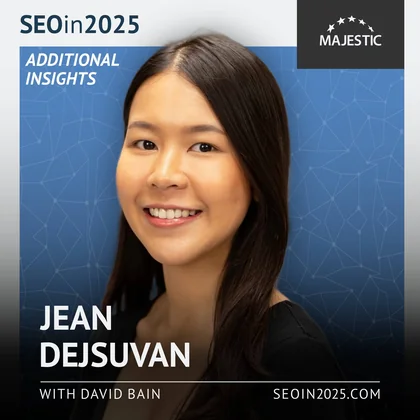
Jean Dejsuvan
Jean Dejsuvan highlights the significance of genuine content, the need for data-driven decisions, and the value of testing new strategies before implementation.
« Back to Additional insights
More Additional Insights



Jean says: “My insight is more like a reminder, actually, (as the SEO landscapes are evolving at the speed of light these days) to stop panicking. SEO isn't dead.
Again, I think this is very important because, as you know, every few months headlines start shouting, ‘SEO is Dead.’ We saw the same thing with voice search, with social search, and now with AI and generative search. When this happens, people start asking, ‘When are we going to change our strategy, and what are we changing it to? We need to pivot, and we need to do it now.’
To that I say, we need to calm down, take a deep breath, and take a little bit of a step back.”
Why do people think that SEO is dead?
“I think because of the changes that have happened.
As we know, Google is making a lot of changes, and now there's ChatGPT making it so that people not only search on Google for information anymore, but they also use different platforms.
Therefore, what you might start seeing if you work in SEO is that you might get fewer organic clicks or less traffic to your site. You might start saying, ‘Is this dead? Do we need to start doing something new and just completely stop what we have been doing before?’”
Do you think SEO is changing significantly?
“I do think SEO is changing, like it always has over the past 10/20 years, and I don't think it will ever stop changing. I don't think it is changing more drastically than before because, again, the same conversation happened when voice search started, and then people started to search on YouTube. I think we’re just living in this loop and cycle of change, as per usual.”
Do you think it's always going to be called SEO for the foreseeable future?
“There have been so many names. Recently, I've heard GEO, Generative Engine Optimization, and Generative Search Optimization. I think, with different names that we are seeing, the foundation is exactly the same as everyone has been doing in the past years, as we know it.
I don't know what SEO is going to be called in the next five or ten years, but I think what we know at the moment is that, no matter how much is changing, the foundation is pretty much what we've been doing for the past years.”
If you search for GEO, Google doesn't know what that means in terms of Generative Engine Optimization. So, I'm not sure if that's particularly catching on in the eyes of Google, but maybe it's catching on in the eyes of SEO.
What does all this mean for new SEOs starting in the industry? What do they have to learn? What do they have to focus on? And how is that different from what it has been in previous years?
“What I will say, that should be a focus – not necessarily for new people starting in SEO or whether you've been doing it for 10/20 years – there are a few key things that we need to keep in mind and focus on, without panicking when these changes happen.
The first thing I wanted to mention is that we should stick to the foundations. To those who have been working in SEO, we by now hopefully know what SEO is really about. You just need to focus on making sure your content/your website is accessible both to bots and to users. That means things like fast load time, structured data, internal linking, and genuinely helpful content for users. I think we all know the deal.
If you are getting all of these right – if your website is set up correctly, if your content can be accessible by bots and users, and it helps them to match the intent that they are trying to fulfil – you're ahead of the curve, and no matter how much platforms have changed or how advanced technology becomes, these foundations remain exactly the same.”
Okay, so content, accessible websites, and things like that.
In terms of content, has the way that content is published/the structure of content not changed a lot because of AI search engines?
“In terms of content, as we know, that's a key focus on SEO. It's evolved from just having keywords, and keyword stuffing and all the black hat stuff, to genuine helpful content. I think that is key. Again, that's the foundation we're talking about.
It depends on what your goal is for your business. If you're trying to sell them something, the salesy content might not work within either the SEO world or the GEO/GSO world, or whatever we want to call it.
If your content is genuinely helpful – it helps users make a decision on what is best for them – then I think you are ahead of the curve. If you show your expertise within that content, and it's something that users can't find elsewhere, I don't see the reason why it wouldn't work on any platform where users can search for information.
There might be a slight change in terms of the technical setup, for example, in terms of how you prioritise things – making sure that not just users in Google can access it, but AI bots can access it. That's just additional steps that you have to consider.
However, there's no need to scrap the EEAT or helpful content that we've been working on for the past years. That's something that you just need to continue doing.”
How do you ensure that your SEO skills stay relevant?
“The way I understand SEO is that we are making data-led decisions. We look at search data, we look at user behaviour from how they search on different platforms, and if you go by that mindset, you can be sure that you will remain relevant, whatever you do.
If you only think about, ‘Oh, I need to add keywords in there,’ without actually looking at whether search behaviour has changed from 10 years ago to now, then your content will not be relevant because you're not actually serving the users correctly. But if you look at what your key target groups are and what your users are trying to find, and you incorporate that into your content/website, then you'll make sure that your content remains relevant and helpful to them.”
What about in terms of staying on top of what works now in SEO? What's best practice? Are there certain podcasts, websites, or other resources that you go to to ensure that you're up to date, and your knowledge is up to date?
“For me, there are so many of them these days. On LinkedIn, I do follow a few people, and there are classic SEO blogs that we read.
One key thing I will say, though, is there are so many articles, researches, surveys, and things like that which get published every single day about SEO. I think it doesn't really matter what sources you go to; you might listen to it directly from Google or someone who works with big clients. One key thing I want to touch on is that you need to evaluate what you read and what you consume.
As I said, there are so many headlines saying that SEO is dead. It isn't. There can be so many things, like people started saying, ‘Oh, there's this new thing, llms.txt. You need to start implementing it on your website.’ Then everyone started going away or deprioritising everything they're working on and started picking this up. ‘We need to get ahead of the curve.’
To that (to go back to my original tip), the key thing is, wherever you consume SEO trends or information from, just remember to evaluate before you act. Don't rush to implement. There are a few things you can ask yourself when you read about new things. I'll use llms.txt as an example here. Think about, what is it? Does it apply to your website or your specific goals? Is there proof that this will benefit you? And, is the reward worth the effort that you will have to go through to implement that?
I work on huge websites, where implementing something like llms.txt would take a huge amount of resources, and maintenance as well. We spoke internally, and our technical lead Esben Rasmussen (I also recommend people go follow him on LinkedIn), looked at it, and we looked at the rewards that we might be able to get with this, and it just wasn't clear.
At the same time, we're working on so many technical priorities to set up the foundation of the website correctly, which we know will work for sure. So, we didn't implement that yet. That wasn't in our roadmap yet – and that's the strategy. That's part of what I would recommend everyone to do when consuming all these headlines and articles as well.”
I like your advice: evaluate what you read and consume. For an experienced SEO, they can filter the information that they receive/read/consume and decide what's likely to be the right advice for them and what advice to reject, but it's more challenging for someone who's relatively young in their SEO career.
If someone's maybe one or two years into their SEO career, the big challenge is what information do you consume and what information do you listen to?
What would your advice be on how to decide whether or not something is worthwhile listening to and implementing?
“Definitely. It can be difficult. As you said, there is so much research and so many headlines these days. Going back to my point about SEO being data-driven, look into the data. Look into whether the result is credible. Does it apply to your website or what you're trying to work on?
For example, some research around e-commerce websites might not apply to you if you're working on an educational, informative, or content-focused site. It also varies differently, and at the same time, if you have the resources and capabilities, always test things yourself.
You can take what you learn online and what you read online. If you have the resources to do so, I always say to our clients, or anyone we work with, before we start rolling things out on a big level, site-wide, we start with a small test to understand whether it drives the reward that we are trying to achieve here. Then you can evaluate whether it's worth the effort of rolling it out or not.”
What's an example of something you've tested recently, and what were the findings?
“One of the tests I would like to mention here (I think this is a perfect example of what we're talking about), is we have a client who is quite new to social platforms. In the SEO world, our SEO team have been talking about organic social and things like that. So, we started a test by looking at the data, implementing/uploading completely new, let's say, YouTube and TikTok channels for this particular client.
However, it doesn't really work well with the nature of that business. The target audience that they are trying to target is not really using those platforms as a major platform in their day-to-day to find the information. We started testing it, and we optimized a few videos – a handful of videos in there. We didn't really see the results that we were hoping to see, and therefore, we said this is not the area that we should be focusing on, as of now.
There are other platforms that we know are working for them, which their target audiences are using day-to-day. That's a really good example of, there's so much hype about social search, but again, is it right for your client or your goals?”
When I got started in SEO, it used to be that the done thing, in terms of testing, was to have your own website, fiddle about with WordPress (or Dreamweaver, back in the day) yourself, and actually see what was happening in terms of HTML code, tweak things, and see what impact it had.
You could take your site, you could do more aggressive tests on it, and get away with greyish hat SEO just to see how much you could get away with.
Is that something that SEOs should still be doing nowadays, or are the days when you have your own site and you do your own tests gone, and you really need to just focus your time and efforts on your client/business’ websites?
“I think it depends on what your focus currently is, at the moment. I would say, if you have your own small website that you want to run some tests on – where, in your day-to-day or your job, you're focusing on, let's say, a 3 million URL website – the result that you're seeing from your small website might not be applicable to those big websites.
I would say to that, you now have a bigger playground, if they allow you to do so. Why not present the test ideas to them? You can run it on a smaller scale, with a subset of pages maybe, and do it there, because then that will really showcase the results of what you're trying to achieve on the same website category/the same industry, for example.
But if the other websites that you're working on are on a similar scale to your website, then I would say that's definitely worth trying. Then you can go to them and say, ‘Here are some results,’ and that will get them to buy in even more as well.
Having your own website, or your own playground, is always fun and recommended, and if that's what you find helpful and interesting for what you're trying to achieve within your job, then I don't see any issue with that.”
Jean, what's the key takeaway from the tip you shared today?
“The key takeaway is to stop panicking when you see things like a slight drop in click-through rate, because your website might get cited in AI overviews, or an impressions spike, but clicks didn't follow.
Instead of panicking and asking, ‘Is there something we're doing wrong? How do we fix this?’ Take a deep breath, zoom out, and think about how you define success. With all these AI features and new platforms, SEO is evolving in a different space now. So, how we report on it and things like that will also have to adapt.
If you're seeing a small decrease in click-through rate, for example, think about, are you getting cited in AI overviews and ChatGPT? If so, even if you're not getting clicks, that's brand equity. Is that considered success for your brand? Does that align with what you're trying to achieve? Is that considered future customer touchpoints, for example?
That's just one example that I'll give here. There are so many things we can be panicking about, reading headlines and seeing other people's case studies, all the changes and things like that. To that I say, take a deep breath. We know what SEO is about. If you're doing that well, you're already ahead of the curve.”
Jean Dejsuvan is an SEO Director at MG OMD, and you can find her on LinkedIn.
Choose Your Own Learning Style
 Video
Video
If you like to get up-close with your favourite SEO experts, these one-to-one interviews might just be for you.
Watch all of our episodes, FREE, on our dedicated SEO in 2025: Additional Insights playlist.
 Podcast
Maybe you are more of a listener than a watcher, or prefer to learn while you commute.
SEO in 2025: Additional Insights is available now via all the usual podcast platforms
 SEO in 2025
Catch up on SEO tips from 106 SEO experts in the original SEO in 2025 series
Available as a video series, podcast, and a book.
Fresh Index

Unique URLs crawled
194,188,717,434
Unique URLs found
618,052,412,077
Date range
07 Apr 2026 to 05 Aug 2026
Last updated
1 hour 2 minutes ago
Historic Index
Unique URLs crawled
4,502,566,935,407
Unique URLs found
21,743,308,221,308
Date range
06 Jun 2006 to 26 Mar 2024
Last updated
03 May 2024
