-
Site Explorer
- Majestic
- Summary
- Ref Domains
- Backlinks
 New
New- Lost
- Context
- Anchor Text
- Pages
- Topics
- Link Graph
- Related Sites
- Advanced Tools
- Author ExplorerBeta
- Summary
- Similar Profiles
- Profile Backlinks
- Attributions
- Compare
-
Link Tools
- My Majestic
- Recent Activity
- Reports
- Campaigns
- Verified Domains
- OpenApps
- API Keys
- Keywords
- N-grams Near Links
- Keyword Checker
- Search Explorer
- Link Tools
- Bulk Backlinks
- Neighbourhood Checker
- Submit URLs
- Experimental
- Index Merger
- Link Profile Fight
- Mutual Links
- Solo Links
- PDF Report
- Typo Domain
- TLD Checker New
- Free SEO Tools
- Support


There's never been a better time to bridge any gaps between SEO and brand marketing
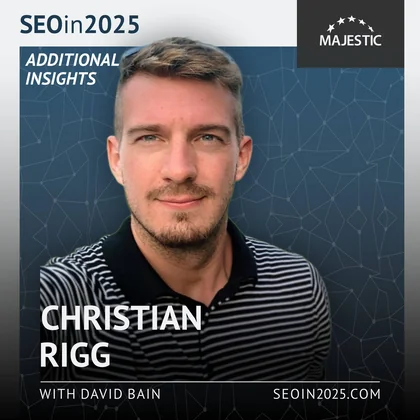
Christian Rigg
Christian Rigg emphasizes the importance of integrating brand marketing and SEO strategies to enhance emotional resonance and improve SEO performance.
« Back to Additional insights
More Additional Insights



Christian says: “My insight is that, with the rise of AI experiences and an increase in branded search, there's never been a better time to focus on bridging any gaps that exist today between your SEO and brand marketing in your strategy – and ensuring that these two essential instruments are working together in really perfect harmony.”
OK, so talking about gaps that exist between SEO and brand marketing, what are some typical gaps that actually exist here?
“Good question. I think many, and I think part of it comes from the fact that (at least in my experience) one of the things that I've seen in a lot of the businesses that we've worked with at Eleven is that SEO can kind of happen in a silo.
SEO has a very strong identity of its own and very clear objectives of what it wants to achieve. It's got its own terminology, it takes a really scientific approach to things, and that doesn't always leave a lot of space for other important parts of marketing – like brand marketing, which, of course, is building an identity and presenting that identity to the world.
I find that, a lot of times, SEO and the deliverables for SEO tend to be very information-focussed, which makes a lot of sense because Google can't really measure emotional impact on the page. So, its goal has been to serve answers to users.
And so, SEO has been very focussed on this idea of providing the right information at the right time to the right people – which is an excellent goal, for sure, but it misses the emotional impact that brand marketing brings. I think that that's something that very often gets left out, or is maybe sprinkled on at the end with a style guide that says, ‘Make sure that you speak in this way.’ But, without it being core to the way that you're producing content, that emotional resonance doesn't really stick.
We know that people make decisions emotionally, even when they believe they're being rational. All decision-making is emotional on a neurological and psychological level. Bridging the gap between those two things is really important.”
I'm intrigued by this phrase ‘emotional resonance’ in relation to brand marketing and how it can impact SEO, and how SEOs can work more effectively with brands in order to actually accomplish that in the content that they publish.
How does an SEO go about doing that? And also, has the role of brand actually changed because of SEO and where a brand appears?
I guess a third question is, what is the role of SEO and brand? Can that be done by a singular person? Or are the roles too different still? Is it still necessary to have two different skill sets and just those people working together to do this?
“It's a super interesting question. I mean, there definitely is value – I'm going to answer these in reverse order, I think, so I'll try to keep them in my head.
In terms of whether we need separate roles, I don't think so, necessarily, no. One of the really central arguments to take away from this insight/tip is the fact that really excellent SEO shares all of the same qualities as (or many of the same qualities as) really great brand marketing, and all of those share all the same properties of really good marketing, which is: clear messaging and having a strong identity – building deep associations between your product, your product space, and your audience.
That third one's a really interesting one because we know that LLMs are very associative in the way that they understand content that's out in the wild, whether through training or retrieval augmented generation, and how they present it to the user. One of the key parts that I've seen of GEO or AEO is building these associations, these relationships – really strong associations, like Kleenex and tissues or Dove and natural beauty. These deep associations between your brand and the space where you operate are really, really key.
I think one person can do this because, if you understand the basics of really good marketing, then you should understand the basis of really good SEO and really good brand marketing.
Obviously, there's power in differentiation. There's so much to learn and to know in SEO and in brand marketing that, if a company has the resources for it, absolutely have those two roles – but make sure that they're not siloed and make sure that they're working really, really closely together. Which, again, is something that we've often seen as a problem in the companies that we work with.
But if you're just a solo marketer, I don't think that you have to choose. In fact, on the contrary. I would say that bringing the best of SEO and brand marketing together is how you're going to succeed at SEO and brand marketing, because the two are actually really complementary, even though they've tended to operate in separate spaces recently.”
I think certain brand marketers have an advantage because, obviously, you mentioned Kleenex there. That was started in 1924, and it was essentially a first mover in the space. They were actually invented to remove cream from your face, but it was the first type of product in its niche. Obviously, the same type of example could be ‘hoovers’. People talk about ‘hoovering’ a floor instead of vacuuming a floor.
Do you think that, in order to get that distinct descriptive phrase in relation to your brand, you need to be a first mover in your niche or do something that will make you relatively unique in the eyes of the consumer?
Is it possible for a brand that has hundreds of competitors to develop that same strong brand presence and relationship to a particular descriptive phrase?
“The answer is definitely the last two things that you said. Yes, you absolutely can create a strong brand identity without being the first one on the scene.
I actually read a really interesting article, maybe two or three years ago (I honestly wouldn't be able to remember the name or the publication), that was looking at this idea of the fact that, historically, first comers aren't actually the most likely to succeed and that you don't need to be the first one on the scene.
I could be wrong, but I want to say that they used Uber as an example because there were other companies like them, that came first and laid the groundwork, but never really caught on. Just like you said in your third point, it absolutely is simply a question of finding the thing that makes you unique, turning that into a really compelling brand identity that people connect with on an emotional level, that creates some kind of emotional connection – whether it's joy, excitement, solace, or whatever – and then building upon that.
So, yeah, I don't think it's necessary to be the first one on the scene. It might help, but some data suggests that being the first one isn't all that good because you're the one who makes all the mistakes. Then somebody else gets to swoop in with a finished product.”
How does an SEO who hasn't got a great deal of experience in brand marketing know if their brand messaging is up to speed, if it's sufficient enough, and if it's really as good as it needs to be?
Obviously, they don't have the experience in doing that, so how do they know when to question it and what to suggest?
“I'd say there are two important things to do. First of all, trust your instincts.
If you have an inkling that maybe things aren't as strong as they could be – if you have to sit down and think, ‘What is our identity as a company?’, and there are not a lot of internal resources that dictate it, and it hasn't been a part of your process as an SEO to be thinking about, ‘What company value am I going to incorporate into this piece that I'm writing?’ (whether it's a How To article or a product review or whatever) – if that hasn’t been a part of your process, then it may well be that the brand identity isn’t strong enough.
If you don’t have the capacity to do that, and there’s not somebody else in your company who has the capacity to do that, then hire a consultant or pair with an agency. The cost is well worth it, to even just check if you're on the right path.
But if something doesn't feel totally right, it’s probably not. You know when your company has a strong brand intuitively, right? If it doesn't feel like you have a strong brand and you're representing it well through the deliverables that you're producing and the content that you're putting out there, then find somebody who can help you with that.
There are lots of excellent consultants available on LinkedIn. There are lots of fantastic agencies out there. Find somebody who has the knowledge, who can accompany you for a short period, show you what you need to be doing, and train you up on it. Then you'll have those skills for life.”
How do you incorporate a company value into a piece of content without it becoming too salesy, and without losing direction in terms of the keyword targeting that you're aiming for?
“It's a good question, and it's also a question in brand marketing, because a lot of the errors that people make are trying to say who they are rather than demonstrate who they are – for example, saying that you are a transparent company rather than doing things that demonstrate transparency.
One of the things that you can do in a piece of content, to demonstrate your values, is incorporate customer success stories. Not in a salesy way, but almost an off-hand, ‘Oh, incidentally, at Eleven, one of our clients was able to X, Y, and Z.’
It has to be relevant to whatever it is that you're talking about. It has to be done in an organic and natural way.
Customer success stories are a really good one. Behind-the-scenes stuff is something that we know people engage with really strongly, especially on social media, where you can do Reels or TikToks where you show what's going on in the office, or a ‘day in the life of’. But there's absolutely no reason that those kinds of things can't also be brought into written pieces and even content where you might not think it sits naturally.
It takes creativity, for sure. You do have to hone and develop those creative muscles, but it's something that we do at Eleven for all of our clients.
One of the ways that we do it is we have a dedicated section in the brief that the subject matter expert, who's writing the piece, can refer back to, where the account manager (who’s familiar with the brand and who kind of serves as the guardian of the brand, with the work that we do) will specifically call out company values or company pillars/principles that make sense for this piece, and offer suggestions on ways that it can be incorporated.
Once you get in the habit of doing that, and you find out what works well for your brand and the kind of content that you're producing, then it just becomes part of your workflow. It's work up front, but it becomes a sustainable workflow.”
What does this look like strategically, if there's an SEO and a brand marketer within an organisation?
Do they sit at the same table together and work together constantly? Do they meet up weekly or quarterly and define whatever strategy they're going to have for content for the coming three months?
“I would say, in an ideal world, you would want to be getting together and speaking about, if not every piece, then each campaign or series of pieces that you're doing – any of the really big, important, hefty content pieces that you might be doing as an SEO or content marketer. So, white papers, e-books, original research, thought leadership, etc. (original research and thought research are fantastic ways to bridge the gap between SEO and brand marketing).
I would say that, yeah, you would definitely want to get input from the brand marketer on the best way to weave those things in together You may find that, in the beginning, it takes a lot of collaboration but, again, over time, both the SEO and the brand marketer will start to develop the skills necessary for working together. An SEO can learn everything that they need to know (or virtually everything that they need to know) to keep things running on a day-to-day basis.
It's kind of like the connection that you want to have between marketing and sales (despite both of them being so important for growth, in a lot of companies, there is this divide between marketing and sales). The more that you can connect those things, the stronger both sides are, and I think the same is true with brand marketing and SEO.
That could look like a once-a-week sit-down for 30-45 minutes, just to make sure that everything is aligned and brainstorm ideas on how we can take content where you might not naturally think that something like brand marketing can fit in, because sometimes it does take creativity. With those kinds of brainstorming sessions, just on the Monday, in 45 minutes, you've got at least a couple of really solid ideas for how to start implementing these things.
Then keep a record of those ideas, refer back to them when you need to, add them into briefs, and eventually it just becomes part of the process.”
How do you measure the ROI of doing a better job of incorporating your brand messaging within your content?
“Normally, I would say an increase in branded searches and an increase in branded links is a good indicator. Right now, obviously, LLMs have led to this natural increase in branded search anyway.
So, for the next couple of months at least, I would say things are going to be a little bit chaotic on that front, and you may not necessarily know whether it's directly attributable to the efforts that you’re making there, or the fact that LLMs are pushing people to do more branded searches. But that’s definitely one metric that you want to follow, regardless, and eventually the dust will settle with LLMs, we’ll have a new status quo, and you can start to get a clearer reading.
Another good measure can be with a tool like Hotjar, or something that allows you to see where people are pausing on the page and where they're interacting. If you notice a lot of activity around the parts of your content where you're telling a brand story (like customer success stories or the behind-the-scenes kind of content we mentioned), that's a good sign that people are interacting with it.
Then, other than that, just a lot of experimentation and A/B testing. You need a good attribution framework that allows you to see how your content is performing at different strategy levels (which is the topic of the talk that I'll be giving at brightonSEO in October), but the best way to do it is to try different things and see which works best. Mainly in terms of conversion, I would say, because one of the things that you really want to hone in on is, are we connecting so much with the audience that we're compelling them to make a buying decision?
Being able to see what of your content is performing – if you try different things like customer success stories in one series of articles and behind-the-scenes stuff in another series of articles – compare the conversion levels on those two things over time, and that kind of thing can give you a really good idea of what's working well for you, what's not, and where you should be putting your time and resources.”
Christian, what's the key takeaway from the tip you shared today?
“The key takeaway from the tip that I shared today, I would say, is just making sure that there are very open lines of communication and a lot of collaboration between brand marketing and SEO within your company, if those are two separate roles.
If you’re a solo marketer, then just try to incorporate, as often as you can, this thought process of bringing brand into everything that you do in content marketing, and basically making sure that you're taking every opportunity to develop and convey your identity to your audience in a meaningful way.
Then, just measure everything that you're doing so that you know what works best for you, your audience, your product, and your product space.
Create deep associations between your product and your audience, and that's going to have the biggest impact – both on SEO and AEO/GEO/LLMs, if that's something that you're aiming for as well.”
Christian Rigg is the Operations Director at Eleven Writing, and you can find him over at ElevenWriting.com.
Choose Your Own Learning Style
 Video
Video
If you like to get up-close with your favourite SEO experts, these one-to-one interviews might just be for you.
Watch all of our episodes, FREE, on our dedicated SEO in 2025: Additional Insights playlist.
 Podcast
Maybe you are more of a listener than a watcher, or prefer to learn while you commute.
SEO in 2025: Additional Insights is available now via all the usual podcast platforms
 SEO in 2025
Catch up on SEO tips from 106 SEO experts in the original SEO in 2025 series
Available as a video series, podcast, and a book.
Fresh Index

Unique URLs crawled
194,188,717,434
Unique URLs found
618,052,412,077
Date range
07 Apr 2026 to 05 Aug 2026
Last updated
1 hour 2 minutes ago
Historic Index
Unique URLs crawled
4,502,566,935,407
Unique URLs found
21,743,308,221,308
Date range
06 Jun 2006 to 26 Mar 2024
Last updated
03 May 2024
