-
Site Explorer
- Majestic
- Summary
- Ref Domains
- Backlinks
 New
New- Lost
- Context
- Anchor Text
- Pages
- Topics
- Link Graph
- Related Sites
- Advanced Tools
- Author ExplorerBeta
- Summary
- Similar Profiles
- Profile Backlinks
- Attributions
- Compare
-
Link Tools
- My Majestic
- Recent Activity
- Reports
- Campaigns
- Verified Domains
- OpenApps
- API Keys
- Keywords
- N-grams Near Links
- Keyword Checker
- Search Explorer
- Link Tools
- Bulk Backlinks
- Neighbourhood Checker
- Submit URLs
- Experimental
- Index Merger
- Link Profile Fight
- Mutual Links
- Solo Links
- PDF Report
- Typo Domain
- TLD Checker New
- Free SEO Tools
- Support


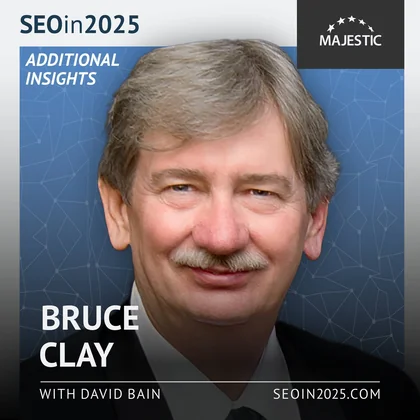
AI is an influencer, PR is vital, and CRO is going to be more integrated into SEO
Bruce Clay
Bruce Clay discusses how SEO is evolving and the importance of optimizing beyond organic search.
« Back to Additional insights
More Additional Insights



Bruce says: “Well, it varies. There are a whole lot of insights. As you know, every Monday, Google has changed something.”
Just every Monday?
“Just a little. What, a hundred things a week? I mean, it's hardly worth mentioning.
But I think that what we, as an industry, are facing is (and I think everybody's talking about it) how Google keeps putting things at the top of the Google search results page and how organic, therefore, is being pushed down.
In many cases, we find that we don't even get the traffic we once did being number one – diminished by 35-70% sometimes. So, it really varies.
I've had this conversation a number of times, and you've heard me say it: Who said that SEO was only organic? When we try to understand how it evolved, obviously, in 1996, ‘97, ’98 – until Google came and even after Google came – there was only the 10 blue links. SEO became connected to organic, and when there were ads, it was decided that it was separate from organic. There was organic and then there were ads.
At a foundation level, if you looked at an org chart or hierarchy chart, there are certainly separate disciplines. My take is that SEO was really ‘traffic from search’, wherever the traffic happened to come from. As a result, we have a lot of things that legitimately are SEO.
Pay-per-click is a discipline of SEO. Organic is a discipline of SEO. Shopping is a discipline of SEO. AIO is a discipline of SEO – and SEO really is Search Engine Optimization: the optimization of anything that generates traffic from the SERP. That really is not something that most people are thinking about.
I think, quite frankly, that we've had a disturbance in the force with AIO, and it has resulted in people thinking that AIO is yet another foundation piece. They're talking SEO, pay-per-click, and AIO as different disciplines when in fact they're symbiotic; they depend upon each other.
What we really need to do in 2025 is understand the co-dependency between all of these, that these different features that are on a Google search result page really can be optimized, and that the goal is to optimize them and dominate what is really a common funnel point.
I mean, even if you found something on social or people recommend things on social, it ends up going to Google and they do a search of some form, for ratings or testimonials or even the website. I think that you need to dominate the portal, if you will, the Google portal – and it's anything, not just organic.”
I completely get the omni-channel approach, the fact that PPC influences SEO and the other way around, and social can drive brand awareness and brand searches, and as a result, have paid and organic uplift.
But are we not just battling with semantics when we're actually talking about, ‘Well, everything is under the SEO umbrella’?
I remember, 15/20 years ago, reading Aaron Wall's SEObook, and there was a graph in there that said ‘SEO is part of SEM (Search Engine Marketing), and pay-per-click is part of that particular umbrella.’
Also, what particular conversation are you advocating that, if we work in an agency, we have with our clients? Should we be saying to our clients, ‘Actually, SEO is the umbrella term’? If so, what's the practical use, as an agency, for doing that?
“Well, you're right – and Danny Sullivan did the same kind of thing with SEM, and SEM became connected more to pay-per-click than SEO.
I think that, at the time, it was an issue of the tail wagging the dog. I mean, it's just a nomenclature. The fact is, regardless of what you call it, it's an omni-view of, ‘Where does traffic come from, from search?’ I don't think there's anybody out there really saying, ‘Today I'm going to optimize the People Also Ask,’ but you can, and you can do this, and you can do that.
When I did the analysis (which, by the way, has taken me a long time. It ended up well over 600 pages), and the analysis was: if I were to optimize this feature, what are the 20 to 30 tasks that I have to do? And, within the task, what are the actions and what tools do I use to accomplish the task? I'll end up with, you know, 25 tasks per feature, each with 30 actions. So, it ended up being a big document.
Then, when you analyse what the common things across all of the features are, it really is more centred on SEO than on anything. You want to be an AIO? You’d better be ranked in SEO. You want to be in the People Also Ask? You’d better show up. You’d better show up. You’d better show up. It's a lot of SEO.
I may be wrong, but I am leaning towards the fact that we have a dominant thing causing ranking to occur, and that happens to be SEO. If you want to really have SERP visibility – and that is, to me, what we're after: SERP visibility. I want to have it so that if somebody searches for my brand or my product or a generic keyword describing what I do – it doesn't matter – I want it to be that, when they do that search, I have presence above the fold on that first page.
With Google pushing organic down, I think that the real problem is that there's just nobody optimizing for the entire SERP. I mean, we've been doing it. We have our tools. We even have a tool that's kind of cool. We take all your keywords, and what it does is it figures out the intent of the keyword, and then it does the search and figures out every Google feature that's in that search result and then tells you whether you're present or not (and we only care about page one because that's the portal into Google).
So, if I can run it against, say, your keywords, I can tell you that you have good or poor search presence for that keyword, but across all the features. It's feature-centric, not just organic. It's feature-centric, not just pay-per-click. I want to show up in as many features as I can, and that is an entirely different level of optimization.
We've been working on that for a long time. As I said, I’ve got 600 pages on it. We can do that. Just, I don't know anybody else that's doing it.”
Is that how you prioritise what has to be done?
Do you analyse the SERP for your target keyword query and then decide on the internet marketing/digital marketing activity that needs to be done in order to actually have your brand positioned within that particular functionality within the SERP?
“And it varies by keyword. As I said, this keyword may not have any pay-per-click, but this other one may. Or this one may not have an AIO, but this other one may. Or this one may not have any shopping links, because that's not what it's about, but this other one would, because it's informational.
Every keyword, it turns out, has a different list of Google features that appear at the top of the search engines. That means that, if you have 100 keywords, you have 100 projects.
This is a little bit more expensive/labour-intensive, to be able to optimize across all the features instead of just having this vision of a keyword but, if you want to dominate the search results so that when somebody goes to Google, every place they look, they see your brand or your company or your product – if you want to really dominate their entry point into Google for that search; what they see above the fold – I don't know how many people are doing that.
It used to be I could be in pay-per-click, and I'm above the fold. Now that's not even guaranteed.”
Is brand visibility the main way to measure success nowadays?
“Well, if you don't have a brand, you may want to dominate by some sort of feature of your product, or your product name, or something else other than a brand.
If I want to rank for, I don't know, ‘expert search engine optimization’ or ‘professional search engine optimization’, or one of those types of keywords, that certainly isn't a brand. The generic words are still a majority of the queries.
If I were going for shopping, I might just go to Amazon and search for something, right? That's not even a Google search, but it is a search. Can we optimize that? Can I optimize if Instagram has a search, or Facebook has a search, or what have you? Can I optimize that? Well, I could, and that is search.
As I said, Search Engine Optimization is the optimization of traffic from search. So, technically, it doesn't even have to be a Google or a Bing or anybody else. It could be something else that's a different search engine. But, overall, I want to rank for whatever generates traffic.
If they search for that and Google gives them a SERP, I want to be on that SERP, and we have a very conscious effort going on there.”
You’ve mentioned AIO a couple of times there as well.
What do you mean when you say that AI is an influencer?
“AI itself is a tool, not a solution. That's like saying Majestic is a solution. No, it's a tool that gives you data that you apply wisdom to, and you make intelligent decisions. Well, AI is the same way.
AI is a fantastic research tool. We have an AI product called PreWriter, but what it does is it does the research, and then you give that research to the writer because AI is a great research tool, but it sucks at writing. The right tool in the right way is a tool, but it's not the solution.
I think we've understood, if you want to rank in a search engine, what to do. If you want to rank in AI, a lot of people look at it as a bright, shiny object, and they want to do AI SEO, but they have to remember that AI relies upon the search engine to resolve the redirects, to resolve the speed issues, to resolve things that AI – Google AI, or anybody else's, any LLM, they don't care how fast you are. They're homogenising your output.
A lot of the stuff that a search engine resolves – Trust. Are you trusted? Are you authoritative? Are you an expert? – that's input to AI. The AI modules can just accept from the search engines a vote. ‘Yes, we trust this site’, and therefore it's a higher weight in the LLM. That's how I think it works.
You've got to do search if you want to be in AI, but AI is a tool. It's just one of the many tools out there.”
You also say that PR is vital.
How does PR fit into the SEO world nowadays, and what aspects of PR are absolutely key?
“Right, and PR is important. You see, in the beginning, when Google came out, it was clear that whoever dies with the most links wins. There was no sentiment analysis to throw it out because they're saying bad things about you rather than good.
There's been a lot of discussion about that but, because people started spamming links and buying links and putting in link farms and all sorts of things, Google has taken the approach that the best link is a link that people give you to content on your site
So, I look at digital PR as, ‘I write content that is great, then I publicise it to people, and then they read it and like it and link to it’, and I actually end up with more links and more mentions doing that than if I placed one blog post that's only going to have a week of fame on somebody else's website and hardly send me any traffic. It's a brand-new page, so it has no trust, and it has no ranking.
I'd rather put it on my site and then attract links to it because it's worthy of attracting links. Can I publish, through PR, to other sites? I can. As you know, I write articles all the time for Search Engine Land. I'm one of their authors. They publish my stuff, and I'm looking for others, but it has to be authoritative, right? You don't want to have Billy Bob's House of Used Cars linking to you if you're not in the used car business.
All that stuff now plays to the point where linking is like a minefield. The best way is through digital PR. You write it, you make it as good as it can be, and then you tell everybody about it with the hope of attracting links; and that is the majority of the way we approach digital PR.
If you have no inbound links, that's a serious problem for AI because (and I think a number of people have talked about this) they're looking for a lot of different sites that link to you. One of the things, for instance, with Majestic, as you know, is it's integrated by API into my tools.
It's important to understand that other people linking to you is good for SEO, but other people linking to you from multiple sites, the AI looks to see how many people are discussing this, and whether your site is worthy of a notation. See, they may use your content, but if you want to get a citation through AI, you need to propagate your brand elsewhere and get it pretty much distributed.”
Now, one key additional element of online success is conversion rate optimization.
What does conversion rate optimization have to do with SEO? Does it actually directly impact SEO success?
“No.” (Bruce nods his head)
I'm trying to explain this to the audio listener as well, because we've got viewers on YouTube.
So, Bruce was nodding while he was saying ‘no’ there.
“That is actually the right answer. You know the old, ‘it depends’. Conversion rate optimization, I believe, is an indirect contributor.
For instance, if somebody goes to your page and they engage with your page, conversion rate optimization can influence that. Then, what it does is it increases your dwell time. By increasing your dwell time, Google thinks of you as being more of an expert or worthy of that query ranking.
So, if you're going to use conversion rate optimization, one of the very important things is time on page. When people look at CRO, they think it's only about them clicking the ‘Buy Now’ – and yes, that's an important step, but that's part of keeping them on your page.
I look at CRO as being, there are things that you can do to a webpage to get people to stay on your webpage. You can put videos on your webpage. You can have graphs and charts on your webpage. You can have all of these things that people think of as perhaps SEO, but a lot of people don't do them.
It's sort of like the concept of usability, right? The concept of usability is, is your site usable? For years, search engine optimization never emphasised jump links. They never emphasised having a footer link to privacy. They never emphasised breadcrumbs. But those are usability signals and, if you want to rank well, you'd better use them.
In the area of conversion rate optimization, it is: How do I increase the engagement of the page with that user? An engagement object on that page causes that user to stay longer, which influences dwell time, which influences intent through RankBrain, and it influences whether your site is worthy.
Maybe it's not as direct as one would like, but I believe it's one of the many features that are in there that you've got to do. You've got to pay your dues.”
Absolutely, I love that way of describing it. I think the indirect impact of an activity is something that many SEOs underestimate or undervalue.
It reminds me of a few things. It reminds me of perhaps the value of a meta description as well – not thought to be the reason, or part of the reason, why Google wants to directly rank a page in its SERP, but obviously, if it encourages click-through rate, then that page is going to likely be ranked more highly in the future because of that.
Something else that rings a bell was, a few years ago, I interviewed Rand Fishkin, and he was saying that he was convinced that the click-throughs from his email newsletter were positively impacting rankings as well, and driving traffic from that.
It's not necessarily Google being able to see that, but the traffic on the site and the perceived authority of the website would want to make Google rank you slightly higher because of that.
“Well, that goes into the concept of: I have a newsletter, people go and read my blog, and they choose to link to it, or they mention it in social media.
It’s not necessarily on my newsletter distribution, but if people are going to talk about what I'm writing, Google's going to see the mentions. and that accumulates relative to SEO as well.”
You shared a lot of advice today. Can you distil it down into one key takeaway? What would you say is the key takeaway from today's discussion?
“Well, all the SEOs are bent out of shape. Even some of the pay-per-click people are bent out of shape about being pushed down the page. Traffic drops. A 70% traffic drop is a lot. Helpful updates are not so helpful sometimes. People get beat up, and a lot of people don't understand that, if Google's going to push organic down the page, something's going to take its place.
So, my recommendation is: look at what's above the fold. Look at something that you can optimize. As I said, there are 40-some things. You may not want to do 40-some things, but you can pick one and optimize for that. A lot of it (probably 70-80%) is able to be done through SEO.
But I would say, don't get so upset because organic is dropping. It's still valuable. In many cases, there aren't a lot of other features on the page. You still have to do it but, come the end of the day, you join them. You don't fight them.
If Google's going to put this stuff up above you, that's where you want to rank.”
Bruce Clay is the CEO of Bruce Clay Inc., and you can find him over at BruceClay.com.
Choose Your Own Learning Style
 Video
Video
If you like to get up-close with your favourite SEO experts, these one-to-one interviews might just be for you.
Watch all of our episodes, FREE, on our dedicated SEO in 2025: Additional Insights playlist.
 Podcast
Maybe you are more of a listener than a watcher, or prefer to learn while you commute.
SEO in 2025: Additional Insights is available now via all the usual podcast platforms
 SEO in 2025
Catch up on SEO tips from 106 SEO experts in the original SEO in 2025 series
Available as a video series, podcast, and a book.
Fresh Index

Unique URLs crawled
194,188,717,434
Unique URLs found
618,052,412,077
Date range
07 Apr 2026 to 05 Aug 2026
Last updated
1 hour 1 minute ago
Historic Index
Unique URLs crawled
4,502,566,935,407
Unique URLs found
21,743,308,221,308
Date range
06 Jun 2006 to 26 Mar 2024
Last updated
03 May 2024
